How to Prepare for a McKinsey Case Interview
A McKinsey case interview is a business problem of about 30 minutes that the interviewer leads you through, one question at a time. It is part of every McKinsey interview and comes straight after the Personal Experience Interview (PEI).
To prepare, you need three things: a way to structure problems that does not depend on memorized frameworks, fast and accurate math, and personal stories that hold up under 15 minutes of follow-up questions.
This guide covers the interview process, how McKinsey's format differs from BCG's and Bain's, what interviewers assess, and a week-by-week preparation plan. It is written by Deniz Ahmet Derici, a former BCG consultant. Together with Doga, he has coached 670+ candidates one-on-one, and the guide also draws on what former McKinsey consultants have told us about how they interview.
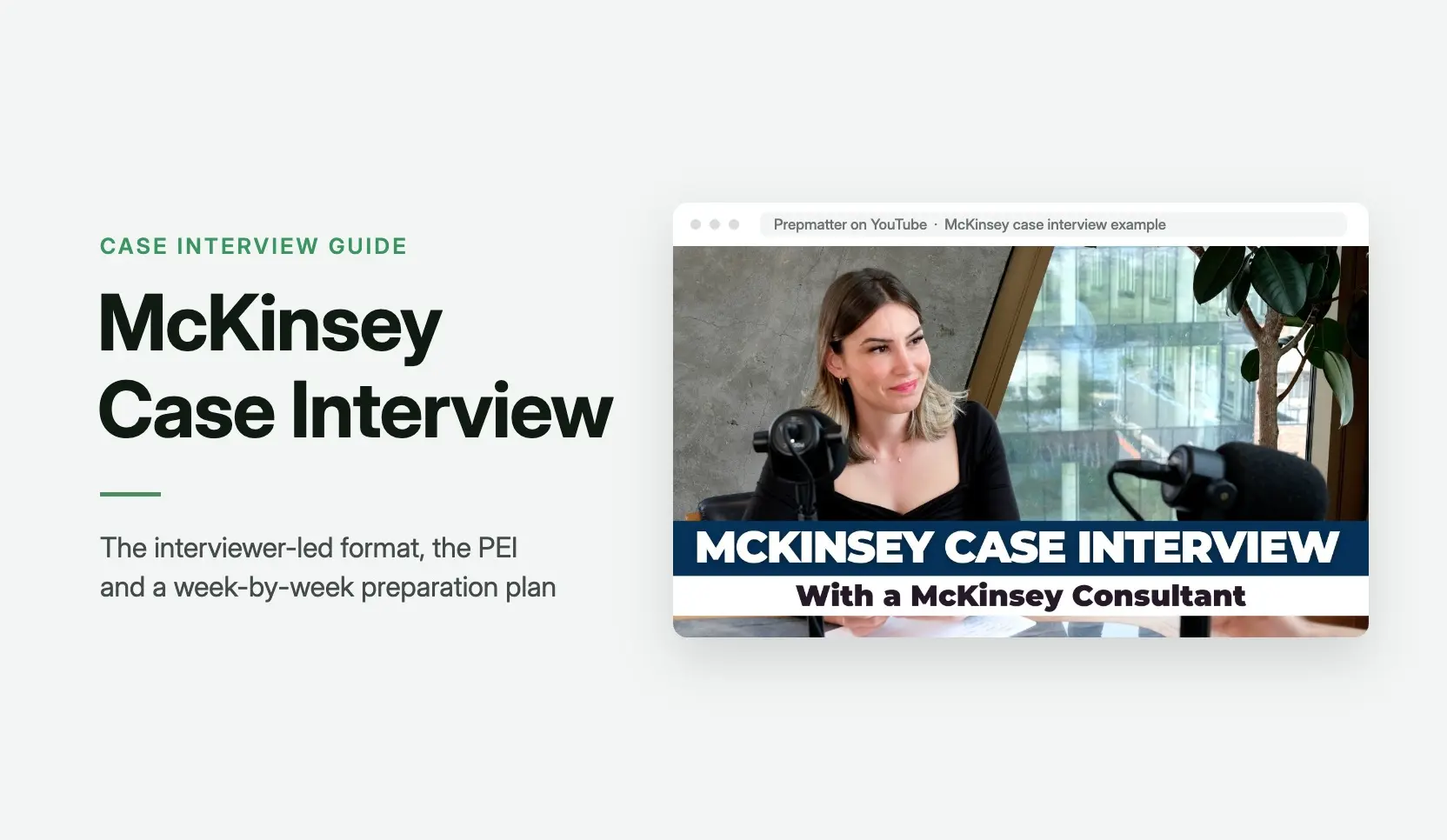
The case and PEI videos in this guide feature Alara Dinc, a former McKinsey consultant who prepared for her own interviews with Prepmatter.
What Does the McKinsey Interview Process Look Like?
McKinsey's process has four stages: the application, the Solve assessment, a first round of interviews, and a final round.
|
Stage |
What happens |
Who you meet |
|---|---|---|
|
Application |
Your resume and cover letter are screened |
Recruiting team |
|
McKinsey Solve |
A 95-minute online assessment with three games: Redrock Island (35 minutes), Sea Wolf (30) and Sustainable Futures Lab (30) |
No interviewer |
|
First round |
Usually two interviews of 45 to 60 minutes, each with a PEI and a case |
Usually associates and engagement managers |
|
Final round |
Usually two or three interviews in the same format |
Partners |
McKinsey does not publish the number of rounds or the length of each interview, and both vary by office and role. Treat the table as typical, and confirm the details with your recruiter. McKinsey's own interviewing page is the best official starting point.
Two points matter for your preparation:
- Every interview has two parts. You start with the PEI, and the case follows. McKinsey positions the two as equally important, so a strong case does not make up for a weak PEI.
- Solve comes first. For most consulting roles, you take Solve before you meet an interviewer. It needs its own preparation: see our McKinsey Solve walkthrough and the Solve simulation.
How Is a McKinsey Case Different From a BCG or Bain Case?
McKinsey cases are interviewer-led: the interviewer decides which question comes next. BCG cases are candidate-led: you decide where the case goes. Bain cases are now a mix of the two: traditionally candidate-led, with more interviewers leading the case in recent years. Our Bain case interview guide covers how to prepare for both.
|
|
McKinsey (interviewer-led) |
BCG (candidate-led) |
|---|---|---|
|
Who steers |
The interviewer moves you through a set of questions |
You propose the next analysis and ask for the data |
|
What it rewards |
A complete, well-prioritized answer to each question |
A clear hypothesis and a sensible path through the whole case |
|
Where candidates slip |
Short answers, and losing sight of the client's question between questions |
Getting lost, or analyzing everything instead of what matters |
The underlying skills are the same. What changes is who decides the next step.
In a McKinsey case, you rarely get to come back to a question. Each answer has to stand on its own: structured, specific to the client, and tied back to the problem you were asked to solve.
What Does McKinsey Assess?
McKinsey assesses problem solving in the case, and four personal qualities in the PEI: Connection, Drive, Leadership and Growth.
In the case. McKinsey does not publish a scoring rubric for cases. From what former interviewers tell us, three areas come up consistently:
- Structuring: breaking the problem into parts that are specific to this client, not a generic framework.
- Quantitative reasoning: fast, accurate math, and the ability to say what the number means for the business.
- Business judgment: turning the analysis into a recommendation a CEO could act on.
Clear communication runs through all three. To see what a structure built for one specific client looks like, watch Alara solve our profitability case.
In the PEI. McKinsey renamed its four PEI dimensions in mid-2025. If you are using older material, the names will not match.
|
Dimension |
Previous name |
What it tests |
|---|---|---|
|
Connection |
Personal Impact |
Challenging and persuading others while keeping their trust |
|
Drive |
Entrepreneurial Drive |
Persistence and sound judgment when the path is not clear |
|
Leadership |
Inclusive Leadership |
Getting a team with different perspectives to act together |
|
Growth |
Courageous Change |
Taking feedback and adapting quickly to something unfamiliar |
On our YouTube channel, we have one video for each dimension. In each video, Alara shares her own PEI answer, and Deniz comments on what went well and what could be improved: Connection, Drive, Leadership and Growth.
For how interviewers rate each area, read What McKinsey and BCG Interviewers Actually Look For.
How Does a McKinsey Case Unfold?
Most McKinsey cases have four or five questions after the prompt: a structuring question, an exhibit, a calculation and a brainstorming question. The interviewer may reorder them or skip one. Unlike BCG and Bain cases, they often end without a request for a final recommendation.
- The prompt. The interviewer describes the client and the problem. Take notes, restate the objective in one sentence, and ask one or two clarifying questions about the goal, the timeframe or any constraints.
- The structuring question. It usually sounds like "What factors would you consider?" Ask for a minute. Build three or four areas that fit this client, with two or three specific points under each. Then say which area you would start with and why. McKinsey's own advice is to tailor your approach to the case, not to apply a standard framework.
- The exhibit. You are handed a chart or a table. Read the title, the axes and the units first. State the main insight in one sentence, then say what it means for the client.
- The calculation. Explain your approach before you calculate. Round where it is sensible, check that the result is plausible, and connect the number back to the question.
- The brainstorming question. It usually sounds like "What else could the client do?" Group your ideas into two or three categories instead of listing them as they come to mind.
- The close. McKinsey interviewers often do not ask for a final recommendation, and the case can end with the last question. If you are asked for one, lead with the answer, support it with two or three reasons and their numbers, name the main risk, and suggest next steps. Our guide on how to conclude a case covers this in detail.
To see the full flow, watch the same case from start to finish. Deniz is the interviewer, and Alara is the candidate:
For more on building structures that are not memorized, see our guide to case interview frameworks, with two worked examples.
How Should You Prepare for a McKinsey Case Interview?
Plan for six to eight weeks and 40 to 50 live cases. On an eight-week plan, that is about one live case a day. On six weeks, you will need two on some days. Most successful candidates spend 100 to 200 hours in total.
|
When |
Focus |
What to do |
|---|---|---|
|
Week 1 |
Learn the method |
Learn how cases work: structuring, market sizing, exhibits and conclusions. Watch three or four full case examples before you attempt one. Start 10 to 15 minutes of mental math a day. List your PEI stories: six in total, so that each of the four dimensions has two you could tell. |
|
Middle four to six weeks |
Live cases, one case type at a time |
Work in sprints of two to three days per case type, such as profitability, market entry or pricing. Practice live, interviewer-led cases with three or four regular partners, and take turns as the interviewer. If you work with a coach, alternate between peer practice and coaching sessions. After each case, write down what went wrong and drill that area. Rehearse your PEI stories aloud, with follow-up questions. |
|
Final week |
Rehearse the interview |
Run full mock interviews of 50 to 60 minutes: PEI first, then the case, ideally with someone who has interviewed candidates. Fix your last two or three recurring mistakes. Do not learn anything new this week. |
McKinsey publishes five practice cases with suggested answers on its interviewing page: Beautify, Diconsa, Electro-Light, Talbot Trucks and a case on transforming a national education system. Save them until you can already structure a case, so you do not waste them in your first week. McKinsey also gives its candidates access to a page that is not public, with a few additional cases. Use those as well.
If you want a structured way through this plan:
- Course. Get the Offer covers the method, 13 live case interview videos, 60+ case studies and drills for structuring, exhibits and math. It also covers McKinsey's PEI.
- Practice partners. You can find other candidates to practice with on Peer Practice.
- Coaching. In 1-on-1 coaching, a former BCG consultant runs interviewer-led cases with you in 75-minute sessions and tells you exactly what to fix.
How Do You Prepare for the Personal Experience Interview?
Prepare six stories, and expect one story to be examined for about 15 minutes. McKinsey itself recommends two personal examples for each of the four areas. In practice, we advise six, because a strong story can cover two dimensions. Make sure each dimension still has two stories you could tell. Eight separate stories is fine if you have the time, but it is usually more than you need.
The PEI is not a list of quick behavioral questions. The interviewer picks one dimension, asks for one story, and then keeps asking what you thought, why you decided as you did, and what happened next.
- Tell the main story in five to seven minutes. The rest of the time is follow-up questions, so leave room for them.
- Say "I," not "we." Interviewers are assessing your contribution. A story told in "we" hides it.
- Explain your reasoning. What you were thinking matters as much as what you did.
- Use recent stories. Examples from the last two to three years carry more weight.
- Keep it a conversation. A memorized script falls apart at the first unexpected question.
Before you write your own stories, watch the four PEI videos linked above. They show what a strong answer sounds like and where it could still be better.
What Are the Most Common Mistakes in McKinsey Cases?
These are the five mistakes we see most often when coaching candidates for McKinsey. The first is the most common.
1. Memorized Frameworks
A memorized framework rarely answers the question the client asked. "Revenue and costs" could describe any company. Interviewers want a structure that could only belong to this client.
Two cases from our coaching sessions show the problem. In the first, an airline is deciding which destination to fly to next. Many candidates open with a standard market entry framework: how attractive the market is, the financials, then the risks. That framework answers "Should we enter this market?" The client asked "Which market should we enter?" A structure that fits the question compares the options: which market is bigger, which is growing faster, and which fits the client's capabilities best.
The second case, which we use with candidates preparing for McKinsey, has two questions. The client wants to know if building a new refinery is a good idea and, if it is, how much crude oil the plant should be able to process a year. Most candidates build a structure for the go or no-go decision and stop there. Nothing in it covers what would determine the plant's capacity. If the client asks two questions, your structure needs a part for each.
Before you present your structure, reread the client's question and check that every part of it helps answer that question.
2. Short Answers
A McKinsey case may have only four or five questions in total, and one of them tests your creativity. In a 30-minute case, expect to spend about five minutes on that question alone. Three quick bullet points will not fill it.
Use the time. Clarify the question, take a short moment to think, then lay out your ideas in groups. To see how deep McKinsey expects you to go, look at question 4 of its Diconsa practice case. It asks how a bank could sell financial products to rural customers who have little education and little experience with banks, in areas with crime and fraud. McKinsey's own hint is to group your ideas around the issues raised in the question, and its suggested answer does exactly that: nine ideas in two groups, six for the low familiarity with banking and three for crime and fraud.
3. Math Without a Plan
Almost every case has a math component, and this mistake comes up in most of the cases we run. In McKinsey cases, the math comes in one of two forms. Either the interviewer gives you the data verbally and asks for an analysis, usually a financial one, or you receive one or more exhibits and a question to answer from them.
In both forms, explain your approach before you calculate. Question 2 of McKinsey's Electro-Light practice case is a good model. It asks what market share a new sports drink needs to break even. The suggested answer states the result first, a 12.5% share, and then shows the two steps behind it: the number of bottles needed to break even, and the share of the market those bottles represent. McKinsey's hints say the same: take your time, and talk the interviewer through your steps. That level of structure is what interviewers expect from you.
4. Numbers Without a "So What"
This mistake is most common among candidates who are new to cases. They calculate a number and stop, without saying what it means for the client. A break-even of four years may be attractive in one case and miss the client's objective in another.
The refinery case shows it well. Candidates discount the cash flows to $120 million, deduct the $50 million investment, and report that an NPV of $70 million looks great. On its own, that tells the client very little. Set against the investment, it says much more: for every dollar invested, the project pays the dollar back and creates $1.40 on top. McKinsey's Electro-Light answer works the same way. It does not stop at 12.5%; it adds that the drink would need to become the number two product in its market.
Finish every calculation by saying what the number means for the client's decision.
5. Treating the PEI as a Warm-Up
Most candidates put the bulk of their time into cases. Some overlook the PEI, or try to cram it into the last couple of days before the interview. McKinsey says the PEI and the case count equally.
Many candidates come to us after a McKinsey rejection, and for some of them the PEI was the reason. Think of it as a hygiene factor: an exceptional PEI will not win you the offer on its own, but a weak one can lose it. Leave enough time for it. In our coaching, we usually set aside one or two full sessions for a trainee's stories. To see what interviewers look for, watch our most recent PEI example video.
Frequently Asked Questions About the McKinsey Case Interview
How long is a McKinsey case interview?
The case takes about 30 minutes, inside an interview of 45 to 60 minutes. The PEI comes first and takes about 15 minutes, and the last few minutes are for your questions. Timings vary by office, so confirm with your recruiter.
Are McKinsey cases always interviewer-led?
Usually, yes. First-round cases follow the interviewer-led format closely. In the final round, partners often run the case as a looser conversation and challenge your answers more, but they still decide where it goes.
How many cases should I practice before a McKinsey interview?
We recommend 40 to 50 live cases, practiced with three or four regular partners and spread across all the main case types. Most successful candidates spend 100 to 200 hours in total over six to eight weeks. The number only helps if you review each case and fix what went wrong before the next one.
Is the PEI as important as the case?
Yes. McKinsey positions the two as equally important. A former McKinsey consultant we interviewed put it this way: when two candidates perform similarly on the case, the one with the stronger PEI gets the offer.
Do I need business experience to pass?
No. McKinsey hires from law, medicine, engineering, the military and many other fields. The case tests how you think, not what you know about an industry. You do need to be comfortable with basic business terms such as revenue, profit and margin.
Can I use AI to prepare for McKinsey interviews?
Yes, for preparation. McKinsey says it is fine to use AI to practice interview questions or to have a concept explained. Using AI to generate answers during an interview or an assessment is not allowed, and McKinsey asks you to switch off AI note-takers and assistants for virtual interviews.
Do I have to pass McKinsey Solve before the case interview?
For most consulting roles, yes. Solve is the screening step before interviews. Our Sustainable Futures Lab guide and Solve walkthrough explain the current format.
Sign up for our newsletter
Join a community of aspiring consultants and elevate your preparation journey with Prepmatter.