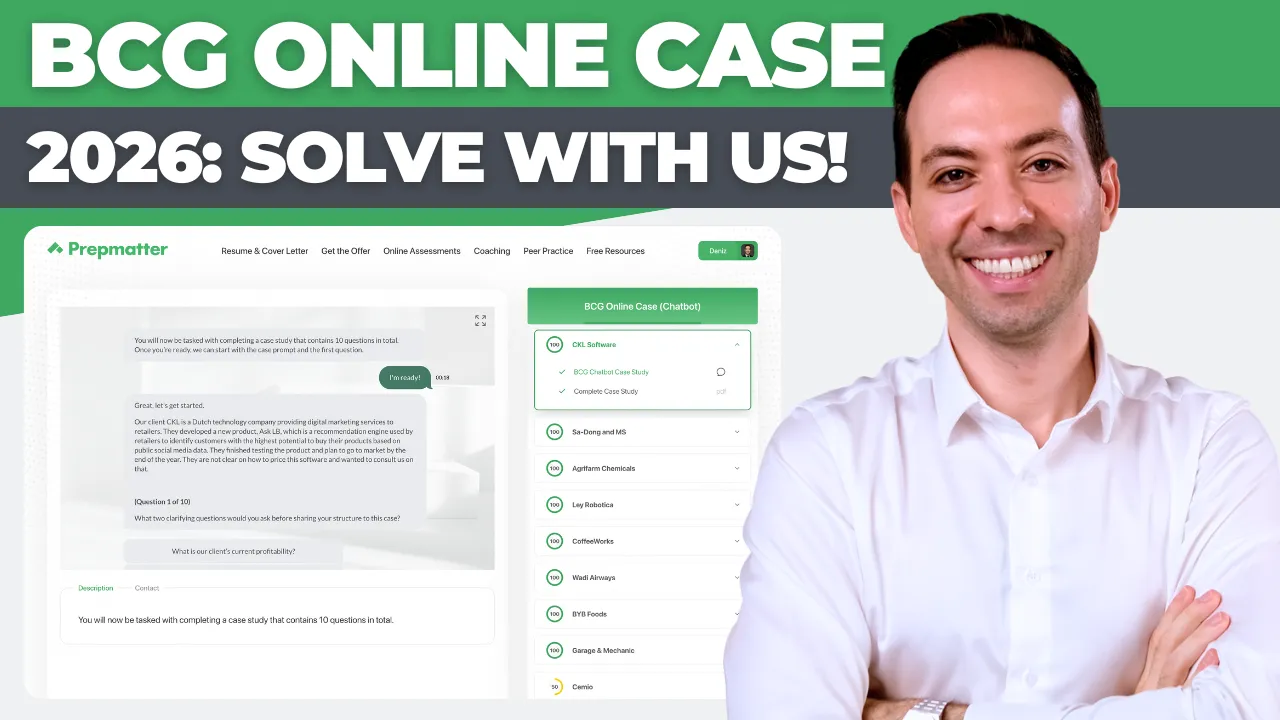
BCG Online Case Assessment: Complete Guide to Casey Chatbot Interview
The BCG Online Case Assessment is a 35-minute case study where you answer 8-10 questions through a chatbot interface. BCG uses this assessment during early recruitment stages to evaluate business judgment, quantitative reasoning, data interpretation, and communication skills through multiple-choice questions, short answers, exhibit analysis, and a 1-minute video recommendation.
This guide covers the current format based on real candidate experiences, including step-by-step preparation strategies and access to practice resources with proven success rates. Our BCG Online Case simulation course includes 15 interactive cases updated regularly, with students achieving significantly higher pass rates than industry averages.
BCG Online Case Quick Facts:
Format Details:
-
Duration: 35 minutes total
-
Questions: 8-10 per case (varies by case study)
-
Question types: Multiple choice + Short answer + Exhibits + 1-minute video
-
Answer policy: Cannot change once submitted
Technical Requirements:
-
Physical calculator recommended
-
Spreadsheet programs are not permitted
-
Webcam required for video recording
-
Desktop or laptop (mobile not supported)
Skills Evaluated:
-
Business judgment and problem structuring
-
Quantitative reasoning (percentages, ratios, weighted averages)
-
Chart and table interpretation under time pressure
-
Concise communication through video delivery
Regional Variations:
-
Some regions: Assessment before interview invitations
-
Other regions: Paired with first-round interviews
-
Structure may vary by candidate seniority
Pass Rates:
-
Industry average: 20-30% advance to interviews
-
With structured preparation, 95% of our students pass (based on Prepmatter's refund request data)
Watch our complete walkthrough where an ex-BCG consultant solves a full case in real-time, explaining decision-making at every step.
What is the BCG Online Case Assessment?
BCG's Online Case Assessment replaced traditional screening methods to evaluate thousands of candidates globally without requiring in-person testing. The assessment goes by several names: BCG Chatbot, BCG Digital Assessment, BCG Chatbot Interview, or simply BCG Online Case. All refer to the same digital evaluation tool.
You take the test online from your computer using a standard web browser. BCG offers the assessment in multiple languages. Most candidates complete it remotely with built-in proctoring through webcam monitoring. The entire assessment happens in one continuous session with no pausing between questions.
When You'll Face This Assessment
BCG uses the online case at different stages depending on the office and candidate level. In some regions, BCG sends the invitation immediately after your resume passes initial screening, serving as a filter before interview invitations. In other regions, the assessment becomes part of Round 1 interviews, replacing one traditional live case. The structure may also vary based on candidate seniority, with some senior hires facing different formats.
Regardless of timing, strong performance determines whether you advance to case interviews or receive a rejection.
The assessment applies to nearly all consulting applicants: undergraduate candidates, MBA students, experienced professionals, and specialists. Rare exceptions exist for senior hires or candidates with particularly strong internal referrals, but most people invited to interview face this digital screening.
Why BCG Created This Format
BCG needed a scalable way to assess analytical capabilities across global recruiting without flying consultants to every university campus. The old paper-based Potential Test required physical test centers and manual grading. The digital format enables automated scoring while testing the same problem-solving skills consultants use daily.
The assessment also reduces bias by standardizing the evaluation. Every candidate faces similar question types and time constraints. Your performance depends on analytical skills rather than whether you attended target schools or participated in case competition prep programs.
Stakes and Consequences
The assessment serves as a critical filter. BCG rejects roughly 70-80% of candidates at this stage. Those who pass move forward to case interviews. Those who fail typically must wait 12 months before reapplying to BCG.
However, some high-growth offices may make exceptions to this waiting period. Clarify the specific reapplication policy with your BCG recruiter, as policies can vary by office and region.
You get one attempt. No retakes. No second chances. The digital format records every answer permanently. Once you submit a response, you cannot return to change it.
This single assessment can determine your consulting career trajectory. Passing opens doors to interviews at one of the world's top strategy firms. Failing means waiting while your peers move forward.
Start practicing with our BCG Online Case simulation to build the skills BCG evaluates.
How the BCG Online Case Works: Question Types and Format
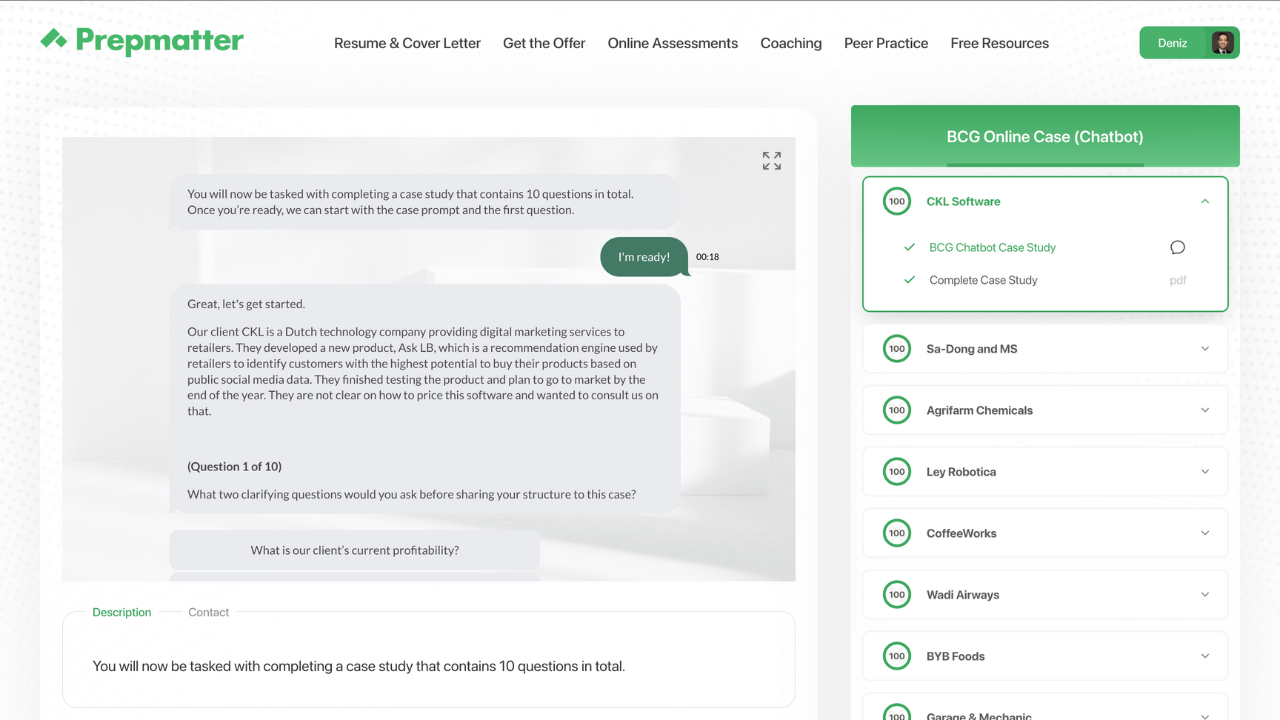
The chatbot introduces the business scenario through a brief prompt. You receive context about a client, their industry, and the challenge they face. Then the interface asks you questions one at a time. The assessment resembles a conversation, but you're responding through structured inputs rather than typing freely.
Multiple Choice Questions
These questions present 3-12 answer options. You select the response that best addresses the prompt. Multiple-choice questions test several skills:
Factor Selection Questions: The chatbot describes a business situation and asks which factors matter most for analysis. These questions test your ability to prioritize what drives decisions rather than listing everything that seems relevant.
For example, in a telco joint investment case, you might evaluate whether two companies should pursue a 5G partnership. The assessment asks you to identify the most critical investigation areas. Strong business judgment recognizes that financial outcomes, synergy potential, service quality impact, and risk factors matter most for this decision. Weaker responses might select less relevant factors like historical subscriber growth or marketing budgets.
Data Interpretation Questions: You receive an exhibit showing data in tables, charts, or graphs. Questions ask you to identify trends, compare values, or draw conclusions. Time pressure forces quick interpretation without deep analysis.
Watch for unit mismatches. An exhibit might show monthly revenue for one product and annual revenue for another. Failing to convert units leads to wrong answers even if your logic is sound.
Quantitative Questions: You calculate specific values using the provided data. Options include the correct answer alongside plausible wrong answers that result from common mistakes.
You must calculate correctly under time pressure using a physical calculator. Estimation helps eliminate obviously wrong options, but final answers require precision.
Short Answer Questions
The interface allocates 3-4 lines of text for your response. These questions test your ability to communicate business logic concisely.
Typical Prompts:
-
Explain why market share declined despite revenue growth
-
Describe two risks associated with this strategy
-
What data would you need to test this hypothesis?
Strong answers stay structured and specific. Weak answers ramble or state generic business concepts without tying them to the case context.
Writing Strategy: Lead with your main point in the first sentence. Use the second sentence to provide supporting evidence or reasoning. Add a third or fourth sentence only if you need to address multiple components of the question.
Avoid business jargon that adds words without adding meaning. Write as if explaining to a smart colleague who needs to make a decision quickly.
Exhibit Interpretation Questions
BCG shows you business data through charts, tables, graphs, or documents. Questions ask you to extract insights, compare values, or identify patterns.
Common Exhibit Types:
Revenue and Cost Tables: Rows show different products, regions, or time periods. Columns display metrics like revenue, variable costs, fixed costs, and margins. You calculate totals, averages, or changes between periods.
Supply and Demand Curves: Graphs plot price on the vertical axis and quantity on the horizontal axis. Questions ask you to identify equilibrium price, predict impacts of price changes, or calculate revenue and profit at different price points.
Market Data Charts: Bar charts compare competitors on metrics like market share, growth rate, or profitability. You identify leaders, laggards, trends, or gaps.
Reading Strategy: Scan the exhibit structure first. Identify what each axis, row, column, or data point represents. Check units carefully. Then read the question to understand what specific insight the assessment wants. Extract only the data you need rather than trying to absorb everything.
The 1-Minute Video Recommendation
The final question asks you to record a video delivering your recommendation to the client. You get 1 minute of preparation time, then 1 minute to record. You have one attempt only; once you stop recording and submit, you cannot redo it.
What the Assessment Evaluates:
-
Clarity of recommendation (clear yes/no/conditional decision stated upfront)
-
Supporting logic (2-3 key reasons why this recommendation makes sense)
-
Communication skills (confidence, structure, pace)
-
Professionalism (appropriate tone for a client-facing consultant)
Structure That Works: Start with your recommendation in one sentence. Spend 30 seconds explaining the 2-3 most important reasons supporting this recommendation. Use the final 15 seconds to acknowledge one key risk or outline an immediate next step.
Delivery Tips: Look at the camera, not the screen. Speak at a measured pace as if talking to a senior executive who needs to make a decision. Avoid filler words. Practice your video structure before test day because you cannot redo it once recorded.
Watch how to structure your recommendation at 27:45 of our latest walkthrough or our dedicated case conclusion video.
Time Allocation Strategy
You have 35 minutes for 8-10 questions. That means roughly 3-4 minutes per question on average. Some questions take 30 seconds. Others require 4-5 minutes for complex calculations.
Budget your time based on question complexity. Spend less time on quick multiple-choice questions to bank extra minutes for quantitative problems. If you get stuck on a calculation for more than 3 minutes, skip it and move forward.
The video recommendation deserves 3-4 minutes total: 1 minute reviewing your notes and planning your message, 1 minute preparing mentally, then 1 minute recording.
Running out of time means leaving questions unanswered. That guarantees lost points. Better to answer all questions reasonably well than to perfect half while missing the rest.
Skills BCG Evaluates Through the Online Case
BCG designed the assessment to measure the capabilities consultants use daily when advising clients. Understanding what BCG evaluates helps you prepare more effectively.
Business Judgment and Problem Structuring
Consulting requires deciding which analyses matter for solving a client's problem. BCG tests this through questions asking you to prioritize factors, select relevant data, or choose appropriate frameworks.
How Questions Test This Skill: In the telco joint investment case from our latest video, two telecom operators consider sharing 5G infrastructure. The assessment asks candidates to identify the most critical investigation areas from multiple options.
Strong business judgment recognizes that financial outcomes (expected revenues, costs, and profits under different scenarios), synergy potential (procurement, operations, distribution savings), service quality changes (speed, capacity, network coverage), and risk factors (regulatory, dependency, unbalanced gains) matter most for evaluating the partnership.
Weak responses might select less relevant factors like historical subscriber counts, marketing budgets, or employee headcount, details that don't directly drive the go/no-go decision.
The test rewards strategic thinking: understanding what actually matters for making the decision rather than cataloging every potentially relevant factor.
Quantitative Reasoning
Consultants calculate figures like profit impact, market share changes, and return on investment. BCG tests your ability to perform multi-step calculations accurately under time pressure.
Question Patterns:
-
Calculate revenue, costs, or profit using the provided data
-
Determine percentage changes or growth rates over time
-
Compare options using weighted averages or ratios
-
Identify break-even points or optimal decisions from exhibits
The math stays relatively straightforward: addition, subtraction, multiplication, division, percentages, and basic algebra. Complexity comes from layered calculations requiring multiple steps and careful unit tracking.
Calculator Usage: Use a physical calculator for every calculation, even simple ones you could do mentally. Keep your scratch paper organized to track multi-step problems. Write down intermediate values to avoid errors when combining multiple calculations.
Data Interpretation Speed
Consultants spend significant time extracting insights from client data, market research, and financial statements. BCG tests how quickly you read charts, tables, and graphs to answer specific questions.
Exhibit Reading System: Scan the exhibit structure first: What do the axes represent? What units does the data use? What time periods does it cover? Then read the question to understand what specific insight you need. Extract only relevant data rather than absorbing everything.
Common Traps:
-
Revenue in millions for one product but thousands for another
-
Monthly data for one year, annual data for another year
-
Percentage points confused with percentages (80% to 65% is a 15 percentage point decline, not 15%)
-
Comparing incompatible metrics (absolute values vs. growth rates)
Candidates lose points by misreading units or making calculation errors, not by lacking analytical ability. Slow down enough to read carefully while moving fast enough to finish on time.
Communication Through Constraints
The short answer format (3-4 lines) and video recommendation (1 minute) test communication skills under severe constraints. Consultants must synthesize complex analyses into messages that busy executives can absorb quickly.
What Strong Communication Looks Like:
-
Lead with the main point or recommendation
-
Support with 2-3 specific reasons drawn from the case
-
Use concrete language rather than vague generalities
-
Maintain a professional tone appropriate for client-facing work
-
Deliver with confidence even when handling ambiguous situations
What Weak Communication Looks Like:
-
Burying the main point in the middle or end
-
Listing generic consulting concepts without case-specific application
-
Using jargon or complex sentence structures that obscure meaning
-
Lacking structure or jumping between disconnected thoughts
-
Showing uncertainty through excessive hedging or an apologetic tone
BCG evaluates not only whether you reached the right conclusion but also whether you can articulate it in a way that drives client action.
Develop these skills through structured case interview training that builds both analytical capabilities and communication.
How to Prepare for BCG Online Case: Structured Plans
BCG officially states that no specific preparation is needed. Their logic: the assessment measures innate analytical ability and business intuition that develops through experience, not memorization.
Candidate data tells a different story. Those who practice with realistic simulations pass at much higher rates. Our students achieve 95% pass rates compared to industry averages of 20-30%. The format matters. Familiarity with question types matters. Time management under pressure matters.
If You Have 1 Week (10-12 Hours Total)
Days 1-2: Format Mastery (3 hours) Understand exactly what the assessment tests. Watch our complete case walkthrough to see question types and pacing. Read through question examples to recognize patterns. Study the 1-minute video structure and practice delivering recommendations out loud.
Take notes on timing: How long do candidates spend on multiple-choice vs. quantitative questions? When should you skip a question? How much time does the video component need?
Days 3-4: Skill Building (5 hours). Focus on your weakest areas. Most candidates struggle with one of three skills:
Quantitative Speed: Practice calculating percentages, ratios, and weighted averages quickly. Use our mental math drills to build calculation speed. Time yourself: Can you calculate a three-year compound growth rate in under 30 seconds?
Exhibit Interpretation: Use our Get the Offer course exhibit drills for targeted practice, reading charts and tables under time pressure. Practice extracting specific data points in 60 seconds: What was revenue growth? Which product performed best? What trend does the data show?
Concise Writing: Answer case questions in writing, limiting yourself to 3-4 sentences. Record yourself delivering 1-minute recommendations. Watch the recording to identify filler words, pacing issues, or structural problems.
Days 5-7: Full Simulations (4 hours) Take 6 complete BCG Online Case simulations under timed conditions. Sit at your computer with a physical calculator. Set a 35-minute timer. Answer every question as if taking the real assessment.
Cover different case types:
-
Day 5: Take 2 cases (market entry, profitability)
-
Day 6: Take 2 cases (competitive response, M&A)
-
Day 7: Take 2 cases (pricing, growth strategy)
Review your performance after each simulation. Which question types took too long? Where did you make errors? What patterns emerge in your mistakes?
Track whether your timing improved. Note whether you avoided previous error patterns.
If You Have 2 Weeks (20-25 Hours Total)
Week 1: Foundation (10 hours)
Days 1-2: Watch both video walkthroughs and study question type breakdowns. Understand the assessment structure and all question types. (2-3 hours)
Days 3-7: Take one practice case per day to establish baselines across different case types:
-
Day 3: Market entry case
-
Day 4: Investment case
-
Day 5: Product launch case
-
Day 6: Profitability case
-
Day 7: Competitive response case
After each case, review performance in detail. Identify your 2-3 weakest areas. (5-7 hours total)
Week 2: Refinement (10-15 hours)
Days 8-9: Practice question types where you struggled in baseline simulations. If you lost time on quantitative questions, do 20-30 calculation problems daily using our Get the Offer course. If exhibit questions caused trouble, complete 10 exhibit interpretation drills daily under time pressure. (4-5 hours)
Days 10-12: Take remaining cases from the course to cover all topic types:
-
Day 10: M&A case + Pricing case
-
Day 11: Growth strategy case + Investment case (if not done in Week 1)
-
Day 12: Any remaining case types from the 15-case library
Track improvement in timing and accuracy. Practice the complete flow: answering questions sequentially without returning to change answers. (4-5 hours)
Days 13-14: Light review without overloading. Watch specific segments of walkthroughs addressing your weak areas. Practice 1-minute video recommendations. Get adequate sleep before test day. (2-3 hours)
Key Areas to Practice
Get the Offer Course - Primary Resource: Our Get the Offer course provides the best foundation beyond BCG-specific practice:
-
Exhibit interpretation drills
-
Framework videos and structuring drills
-
Quantitative reasoning under time pressure
-
40+ case studies building business judgment
-
Communication and synthesis practice
This course builds the fundamental consulting skills that the assessment evaluates.
Economics Fundamentals: Review basic microeconomics if you lack a business background:
Supply and Demand: Understand how curves intersect to determine equilibrium price and quantity. Practice identifying what happens to price and quantity when supply or demand shifts.
Revenue vs. Profit Maximization: Revenue = Price × Quantity. Profit = Revenue - Costs. Maximum revenue occurs at a different price point than maximum profit. Practice finding both using supply/demand curves and cost data.
Break-Even Analysis: Calculate the sales volume where total revenue equals total costs. Understand how fixed costs, variable costs, and price determine break-even points.
Supplemental GMAT Practice: If you need additional quantitative practice beyond the Get the Offer course, GMAT Integrated Reasoning sections provide useful supplemental material:
-
Percentages and percentage point differences
-
Ratios and proportions
-
Weighted averages
-
Multi-step word problems
-
Table analysis and data sufficiency
Filter for business scenario questions rather than abstract math problems.
1-Minute Video Structure: Create a template you can adapt to any case:
[Recommendation - 5 seconds]: "I recommend [specific action] for [client name]."
[Reason 1 - 15 seconds]: "First, [supporting reason with specific data point from case]."
[Reason 2 - 15 seconds]: "Second, [another supporting reason with specific data]."
[Reason 3 or Risk - 15 seconds]: "Additionally, [third reason or acknowledge one key risk]."
[Next Step - 10 seconds]: "The immediate next step is [specific actionable item]."
Practice delivering this structure with different cases until you can adapt it naturally under time pressure. Learn more about clear communication in our video on communicating consulting insights.
Work with a coach for personalized guidance on strengthening your specific weak areas within your preparation timeline.
Question-by-Question Strategy Guide
Different question types require different approaches. Use these strategies to maximize your score across all formats.
Multiple Choice Question Strategy
Read the question carefully before looking at the answer options. Understand exactly what the assessment asks. Then evaluate options systematically.
Elimination Method: Cross out obviously wrong answers first. Often, 1-2 options contradict information stated in the case or represent common misconceptions. Eliminating wrong answers before selecting the right one reduces cognitive load.
Unit Discipline: Check whether all numbers use consistent units. If one option shows annual revenue and another shows monthly revenue, convert to the same unit before comparing. Missing this detail causes more errors than complex calculations.
Estimation First: For quantitative multiple choice, estimate the answer before calculating precisely. If options range from $10M to $500M and your rough estimate suggests around $100M, you can eliminate extreme values immediately. This prevents wasting time on full calculations when estimation suffices.
When to Guess: If completely stuck after 2 minutes, make your best guess and move forward rather than spending 4 minutes trying to perfect an answer. Moving on ensures you have time to complete all questions.
Short Answer Question Strategy (3-4 Lines)
The text constraint forces brutal prioritization. Every word must earn its place.
Structure for 3-4 Lines:
Line 1: State your main point directly. Answer the question in one complete sentence.
Line 2: Provide the most important piece of supporting evidence or reasoning.
Line 3: Add a second supporting point if the question asks for multiple elements.
Line 4: Use only if additional supporting detail strengthens your answer significantly.
What to Include:
-
Specific references to case data ("revenue declined 15%" not "revenue declined")
-
Cause-and-effect logic ("costs increased because raw material prices rose")
-
Prioritization when appropriate ("market size matters most because...")
What to Cut:
-
Introductory phrases ("In my opinion..." or "Based on the case...")
-
Generic statements ("We need to increase revenue and decrease costs")
-
Hedging language ("This might suggest that possibly...")
-
Repetition of the question prompt
Example Question: "Why did profit margin decline despite revenue growth?"
Weak Answer: "The profit margin declined for several reasons. Revenue grew but costs also increased. We need to look at both fixed and variable costs to understand the full picture."
Strong Answer: "Profit margin fell because costs grew 25% while revenue grew only 15%. Variable costs per unit increased from $45 to $58, driven by raw material price increases cited in the supplier data."
The strong answer provides specific numbers, identifies the root cause, and references case data. All in two sentences.
Exhibit Interpretation Strategy
Exhibits test reading speed and pattern recognition under pressure. Develop a systematic approach.
5-Step Exhibit Reading Process:
1. Structure Scan (10 seconds): Identify what the exhibit shows before reading details. Is it a table comparing products? A line graph showing trends over time? A bar chart ranking competitors? Understanding structure tells you how to read the data.
2. Unit Check (5 seconds): Note the units used. Revenue in millions or thousands? Time period in months or years? Percentages or absolute values? Write units on your scratch paper if they vary across data points.
3. Read the Question (10 seconds): Understand what specific insight the assessment wants before diving into data. This focuses your attention on relevant information.
4. Extract Relevant Data (30-45 seconds): Find only the numbers you need to answer the question. Copy them to scratch paper with clear labels. Don't try to absorb the entire exhibit.
5. Calculate and Answer (45-60 seconds): Perform required calculations using your organized data. Double-check units one final time before selecting your answer.
Common Exhibit Pitfalls:
Revenue/Cost Tables: Watch for different units across rows or columns. Product A shows annual figures while Product B shows quarterly figures. Multiply quarterly by 4 before comparing.
Supply and Demand Graphs: Revenue maximization occurs at a different price than profit maximization. If the question asks for one specifically, don't confuse it with the other.
Market Share Charts: Percentage point changes differ from percentage changes. A company growing from 20% to 25% market share gained 5 percentage points but grew 25% (5/20 = 0.25).
Video Recommendation Strategy
Your video gets evaluated on content, structure, and delivery. Prepare all three elements.
Content Strategy: State a clear recommendation in your opening sentence. Avoid hedging with "I think maybe the client should consider possibly..." Say: "The client should enter the Asian market."
Support your recommendation with 2-3 reasons drawn directly from your analysis. Reference specific numbers: "First, the Asian market offers $500M opportunity with 15% annual growth." Generic reasons communicate less effectively: "First, there is significant market opportunity."
Acknowledge one key risk or implementation consideration: "The primary risk is regulatory approval, which typically takes 6-8 months based on the case data."
End with a concrete next step: "I recommend conducting detailed due diligence on regulatory requirements in target countries."
Structure Strategy: Practice the timing template until it becomes automatic:
-
Recommendation: 5-10 seconds
-
Reason 1: 15-20 seconds
-
Reason 2: 15-20 seconds
-
Risk or Reason 3: 10-15 seconds
-
Next step: 5-10 seconds
This fills 50-65 seconds, leaving a small buffer without going over time.
Delivery Strategy: Position your camera at eye level. Look at the camera lens, not your reflection on screen. This creates eye contact with evaluators.
Speak at a measured pace. Use your full minute to demonstrate confident, clear communication, but remember you can click "stop and submit recording" once you're done, you don't need to wait awkwardly until the timer ends.
Maintain professional energy. You're not giving a motivational speech, but you should sound engaged and confident in your analysis. Avoid monotone delivery that suggests uncertainty or disinterest.
Practice Method: Record yourself delivering recommendations for different cases. Watch the recordings to identify issues:
-
Do you say "um" or "uh" frequently?
-
Does your pace feel rushed or slow?
-
Do you look at the camera or down at notes?
-
Does your structure feel clear or jumbled?
-
Would a client trust your recommendation?
Improve specific issues with targeted practice, then record again to track progress. Use the preparation minute to outline your structure on scratch paper: Recommendation, Reason 1, Reason 2, Risk, Next Step. Follow this outline precisely during recording.
Learn more about delivering clear recommendations in our communication clarity video.
Common Mistakes That Fail Candidates
Understanding frequent errors helps you avoid them during your assessment.
Time Management Failures
Spending Too Long on One Question: Candidates get stuck on a difficult calculation and spend 6-7 minutes trying to perfect it. This burns time needed for other questions. Set a mental limit: if you're not making progress after 2-3 minutes, make your best guess and move forward.
Some questions may intentionally exceed your capabilities. BCG wants to see how you handle uncertainty and time pressure. Answering 9 questions reasonably well outperforms perfecting 6 while leaving 4 blank.
Not Banking Time on Easy Questions: Simple multiple-choice questions might take only 30-45 seconds. Use this to your advantage. Answer quick questions efficiently to save time for complex quantitative problems that legitimately require 4-5 minutes.
Track your pacing. If you're 15 minutes into the assessment and only on question 4 of 10, you're running behind. Accelerate on the remaining questions or you won't finish.
Calculator and Computation Errors
Careless Arithmetic Mistakes: Time pressure causes errors in basic math. You know that 15% of $10M equals $1.5M, but under stress, you might calculate incorrectly.
Build accuracy by showing your work on scratch paper. Write: "Revenue = 15M × 1.15 = 17.25M" before entering it as your answer. The extra 5 seconds prevents costly mistakes.
Use a physical calculator for every calculation. This documents your problem-solving process and prevents mental math errors under pressure.
Rounding Too Early: Rounding intermediate calculations compounds errors in final answers. If you round to the nearest million after each step in a multi-step problem, your final answer may differ from the correct, precise answer by enough to select the wrong option.
Maintain full precision during calculations. Round only the final answer according to instructions.
Exhibit Misreading
Skipping the Unit Check: An exhibit shows "Revenue (in millions)" in the header. You calculate confidently and select an answer. The answer is wrong because one column actually showed thousands rather than millions despite the header.
Always verify units for each specific data point, not just the overall exhibit label. This 10-second check prevents expensive errors.
Confusing Percentage Points and Percentages: Market share increased from 20% to 25%. That's a 5 percentage point increase. It's a 25% percentage increase (5/20 = 0.25).
If the question asks "by what percentage did market share increase," the answer is 25%, not 5%. If it asks "by how many percentage points," the answer is 5.
Read questions carefully to determine which measure they request.
Missing Key Details in Exhibits: Exhibits often contain crucial information in footnotes, axis labels, or table headers. "Note: Figures shown are quarterly results" completely changes your interpretation compared to annual results.
Scan the entire exhibit structure before extracting data. Check every label and note. This takes 15 seconds and prevents major analytical errors.
Video Recording Issues
Rambling Without Structure: Candidates start their video without a clear plan: "So, um, based on the case I think, well, there are a few things to consider, and first of all the revenue looks okay, but costs are a concern, so maybe..."
This demonstrates poor communication skills. You're supposed to be a consultant delivering a recommendation to a C-suite executive. Rambling suggests unclear thinking.
Use the preparation minute to outline your structure on scratch paper: Recommendation, Reason 1, Reason 2, Risk, Next Step. Follow this outline precisely during recording.
Speaking Too Fast or Too Slow: Nervous candidates rush through their recommendations in 30 seconds. Others speak so slowly that they run out of time before finishing their second reason.
Practice pacing by recording yourself repeatedly. Aim to fill 55-60 seconds comfortably without feeling rushed or dragging.
Looking Down at Notes: Reading your entire recommendation from paper shows poor preparation and weak communication skills. Consultants must deliver messages conversationally, not read scripts.
Use notes only as a quick reference for specific numbers or structure points. Deliver the actual message while looking at the camera. This requires practice but makes a significant difference in how evaluators perceive your capabilities.
Forgetting the Case Context: Generic recommendations lacking specifics fail to impress: "The client should focus on improving operations and reducing costs while maintaining quality."
Strong recommendations reference actual case data: "The client should consolidate the Cleveland facility into the Pittsburgh location, reducing annual fixed costs by $12M while maintaining the 95% fill rate shown in Exhibit 3."
Always ground your video in specific information from the case you just analyzed.
Format Misunderstandings
Attempting to Change Previous Answers: Candidates realize they made a mistake on question 3 while answering question 6. They try to navigate back to fix it. The system doesn't allow this. They waste time trying to find a way to return to previous questions.
Understand before starting: answers are final once submitted. Focus on getting each question right the first time rather than planning to review later.
Ignoring the Preparation Strategy: BCG provides practice cases and preparation materials. Some candidates skip these, thinking their general case interview prep suffices.
The format matters. Question styles differ from live cases. Time pressure feels different when facing a computer than when talking to a person. Take the practice seriously to understand exactly what you'll encounter.
Avoid these mistakes by practicing with realistic simulations that mirror actual test conditions.
Where to Practice: Resources and Materials
Effective preparation requires materials that match the actual assessment format, difficulty, and time pressure.
Prepmatter's BCG Online Case Simulation
Our interactive platform includes 15 complete cases covering the business scenarios BCG tests most frequently: market entry, investment, M&A, product launch, growth strategy, competitive response strategy, pricing, and profitability.
What Makes Our Simulation Effective:
The interface mirrors BCG's actual assessment. You answer questions through the same types of inputs: multiple choice selections and text boxes with character limits. At the end of each case, you write your final recommendation, allowing you to practice synthesizing your analysis. Familiarizing yourself with the interface reduces cognitive load during the real test.
Question difficulty matches reported candidate experiences. Our cases include complex exhibits requiring multi-step calculations under time pressure. The 35-minute format builds the stamina and pacing skills you need.
You receive immediate feedback showing which answers were correct and why. After completing each case, review your performance to identify patterns in your mistakes. This targeted improvement builds skills faster than random practice.
Current Offer: We run a success-tracking campaign. If you purchase our BCG Online Case simulation and don't pass the actual assessment, we will refund 50% of your cost. Forward us your official BCG result email within 2 months of purchase to claim the refund.
This offer reflects confidence in the simulation's effectiveness. Based on refund request data, 95% of students pass their actual BCG assessment after preparing with our materials.
Start practicing with 15 interactive cases updated regularly to reflect current assessment difficulty.
Free Sample Case
Try our simulation before purchasing. We've unlocked the first 2 questions so you can experience the interface firsthand. This sample demonstrates the question types, timing, and difficulty level you'll face.
The sample takes a few minutes to complete. You'll answer questions testing creativity and structuring, the same skills BCG evaluates in the full assessment. This gives you a real preview of both the platform and our content quality.
Access the free sample to evaluate whether our preparation approach fits your needs.
Official BCG Resources
BCG provides a practice online case through their recruiting website. This represents the single most valuable free resource available. The practice case comes directly from BCG, guaranteeing format accuracy.
How to Use It: Take the practice case seriously. Treat it like the real assessment: find a quiet space, use a physical calculator, complete it in one sitting, and record your video recommendation. Don't pause to look up information or discuss questions with others.
After completing it, analyze your performance. Which question types took longest? Where did you make errors? What surprised you about the format?
BCG also offers the Interactive Case Library on their careers site. These cases don't replicate the chatbot format but provide practice with exhibit interpretation and business analysis under time pressure.
Important Caveat: Recent candidates report that BCG's practice case runs easier than the actual assessment. Don't assume that passing the practice case comfortably means you're fully prepared. Use it to understand the format, but supplement with additional practice materials that match real test difficulty.
Video Walkthroughs
Watch consultants solve complete cases in real-time. Video walkthroughs show not only the right answers but the thought process that leads to them.
Our YouTube channel features two complete BCG Online Case walkthroughs:
-
29-minute walkthrough of a telco joint investment case with extensive quantitative analysis
-
18-minute walkthrough of a hotel competitive response case with exhibit interpretation
These videos demonstrate pacing, calculation methods, exhibit reading techniques, and video recommendation structure. Watch them before taking practice cases to see strong performance in action. Return to specific segments when working on weak areas.
Subscribe to our channel for free case walkthroughs and consulting prep advice.
Get the Offer Course - Foundational Skills
Beyond BCG-specific practice, our Get the Offer course provides the best resource for building fundamental consulting skills that the assessment evaluates:
-
Exhibit interpretation drills: 50 practice exercises, building speed reading charts and tables
-
Framework videos and drills: Structured approaches to business problems
-
Quantitative reasoning: Mental math and calculation practice under pressure
-
40+ case studies: Building business judgment across industries
-
Communication practice: Synthesizing insights clearly and concisely
These skills transfer directly to the BCG Online Case while also preparing you for live interviews.
Supplemental Resources
GMAT Integrated Reasoning Practice: If you need additional quantitative practice, GMAT Integrated Reasoning sections test your ability to analyze data presented in tables, graphs, and multi-source scenarios.
Focus on:
-
Table analysis (extracting values, calculating comparisons)
-
Graphics interpretation (line graphs, bar charts, scatterplots)
-
Multi-source reasoning (synthesizing information from multiple sources)
The GMAT Official Guide provides authentic practice problems. Filter for business scenarios rather than abstract logic or geometry.
Economics Review: If you lack a business background, review microeconomics fundamentals. Khan Academy offers free video lessons covering supply and demand, market equilibrium, revenue and profit maximization, and elasticity.
Focus on practical application. Practice reading supply and demand graphs to identify equilibrium price and quantity. Calculate revenue and profit at different price points. Understand what happens when supply or demand curves shift.
Peer Practice for Video Recommendations
The 1-minute video requires practiced delivery. Record yourself multiple times before test day to build comfort and refine your approach.
Use our Peer Practice platform to connect with other candidates. Exchange practice cases and provide feedback on video recommendations. Watching others helps you identify effective techniques and common mistakes.
Practice until delivering a structured 1-minute recommendation feels natural rather than scripted. You should adapt your template instinctively to different cases without needing to consciously think about structure during recording.
Personalized Coaching
Want guidance tailored to your specific situation? Our ex-MBB coaches help with both BCG Online Case preparation and broader interview readiness.
Coaches review your practice case performance, identify your weakest areas, and design targeted exercises addressing your gaps. They also help with overall recruiting strategy, behavioral interview preparation, and case interview fundamentals.
One-on-one coaching accelerates improvement by focusing exclusively on your needs rather than providing generic advice that applies to everyone.
Success Stories: Real Candidate Outcomes
Our students achieve significantly higher pass rates than industry averages. Here's what candidates say about preparing with Prepmatter.
Petros, BCG: "Prepmatter's materials helped me prepare and know what to anticipate from the BCG chatbot exercise. By going through the materials, I passed the chatbot test on the first try, and my journey ended by finally receiving a BCG offer. Thank you Prepmatter for giving me this opportunity!"
Kate, BCG Candidate: "The content helped me succeed at my second attempt to pass the online case. It gives you the guidelines on how to structure your preparation and what resources are available to do so."
Jacqueline, BCG: "From my experience, going into online assessments like BCG's test can be very stressful. As someone who has strong communication skills, my favorite part of case assessments is talking through the problems and working with someone. Regardless of this, the Prepmatter team's experience with the BCG way of thinking helps you prepare perfectly for whatever format or question BCG throws your way. The guide helped expose me to the format of the assessment and think through the types of questions asked. All of these materials were incredibly instrumental and helped me to make it through the BCG second round!"
Rylie: "Very good chatbot at a reasonable price. The exhibits are so similar to the real BCG exhibits it is uncanny; this team has BCG experience and it really shows!"
George: "Prepmatter's BCG chatbot was ideal prep for the online test. Did two walkthroughs and felt very confident going into the actual assessment, which was very manageable because of the practice. Strongly recommended to everyone!"
Teo: "Really helped complete the actual online case. I would even say that the cases offered are a bit more difficult, so when it was time to complete my actual Chatbot case, it felt easy! Very worth the investment."
Muraz: "Extremely well designed both in terms of interface and content. Totally worth trying this while preparing for the online test, especially helpful when you have limited time left before the test. In my experience, the best simulator one can find (and I tried basically all other simulators out there)."
The Numbers Behind Success
Based on our refund policy data, only 5% of students who purchase our simulation request refunds after failing their actual BCG assessment. This means 95% pass their real test after preparing with Prepmatter materials.
Industry pass rates typically range from 20-30% of candidates advancing beyond the online case stage. Our students achieve success rates 3-4 times higher than these averages.
The difference comes from realistic practice that mirrors actual assessment conditions: authentic question types, appropriate difficulty level, strict time pressure, and immediate performance feedback enabling targeted improvement.
Read all testimonials from candidates who secured offers at BCG, McKinsey, Bain, and other top firms after preparing with Prepmatter.
What Happens After the BCG Online Case
Completing the assessment is only the first step in BCG's recruitment process. Understanding what comes next helps you prepare for the complete journey.
Results Timeline
BCG typically takes 1-2 weeks to evaluate all candidates in a recruiting cycle and make advancement decisions. During this time, algorithms score your online case performance while recruiters conduct deeper resume reviews.
The timeline varies by office and recruiting context. Campus recruiting often has fixed decision dates where all candidates hear back simultaneously. Off-cycle or experienced hire recruiting may provide individual feedback on rolling timelines.
Timing doesn't signal positive or negative outcomes. Don't interpret silence as rejection during the normal evaluation period.
If You Pass: Next Steps
Passing the online case means you've cleared a major hurdle. BCG invites you to case interviews, the next stage of evaluation.
The invitation email typically includes:
-
Confirmation that you passed the digital assessment
-
Interview round details (Round 1 or final round)
-
Format information (in-person, video conference, or hybrid)
-
Available interview dates and scheduling instructions
-
Preparation resources and timeline
What you need to do immediately: Schedule your interviews as soon as possible. Popular time slots fill quickly, and you want maximum control over your interview timing.
Begin case interview preparation if you haven't already. The online case tests analytical skills, but live cases require additional capabilities: hypothesis-driven problem solving, verbal communication, structured frameworks, and interpersonal interaction.
Prepare behavioral interview answers. BCG evaluates cultural fit alongside analytical ability. Develop stories demonstrating leadership, teamwork, initiative, and impact using the STAR method (Situation, Task, Action, Result).
Research BCG and your target office. Understand their recent work, industry focuses, and office culture. This knowledge helps you articulate why BCG specifically appeals to you and demonstrates genuine interest.
Prepare for case interviews with structured training covering frameworks, exhibits, and communication skills BCG evaluates in live rounds.
If You Don't Pass: What This Means
Receiving a rejection doesn't mean you lack consulting potential. The 70-80% rejection rate means most capable candidates fail at this stage.
The rejection email typically states: "We will not be moving forward with your application at this time." BCG provides no detailed feedback about specific performance issues or which questions you missed.
You can request general guidance from your recruiting contact, but don't expect specific action items. Most offices cannot or will not provide detailed score breakdowns or question-by-question performance reviews.
Your options after rejection:
Reapply to BCG: Most offices enforce a 12-month waiting period before reapplying. However, some high-growth offices may make exceptions to this policy. Clarify the specific reapplication timeline with your BCG recruiter.
Use the waiting time to strengthen your profile. Gain relevant work experience that demonstrates analytical skills, leadership, or industry expertise. Improve case interview capabilities through structured practice. When reapplying, your resume and application materials should show clear growth since the previous attempt.
Apply to other consulting firms immediately: Bain, McKinsey, Strategy&, Oliver Wyman, Kearney, and other firms use different assessment methods. You may pass their screening while waiting to reapply to BCG. Consulting careers aren't exclusive to one firm.
Pursue alternative paths: Corporate strategy roles, startup opportunities, or industry positions provide valuable experience. Many successful consultants join firms after building business skills elsewhere rather than straight from school or previous jobs.
Strengthen your analytical capabilities: Take the rejection as feedback about your current skill levels. Invest time in developing quantitative reasoning, business judgment, and problem-solving speed. Future consulting applications will benefit even if you ultimately choose a different path.
Behavioral Interview Component
Some offices pair the online case with a separate behavioral interview assessment. This might happen immediately after the online case or as a distinct video submission.
Format: You receive 5-7 behavioral questions asking about past experiences, leadership situations, teamwork challenges, and motivation for consulting. You typically get 1-2 minutes per answer.
What BCG evaluates:
-
Past performance as a predictor of future performance
-
Leadership potential and initiative
-
Teamwork and collaboration capabilities
-
Communication clarity and confidence
-
Genuine interest in BCG specifically
Preparation approach: Develop 5-6 strong STAR stories covering different competencies. Practice delivering these stories in 90 seconds: concise situation setup, clear task explanation, specific actions you took, and measurable results achieved.
Don't memorize scripts word-for-word. Memorized answers sound robotic. Prepare the structure and key points, then deliver naturally in the moment.
Learn more in our behavioral interview guide
Sign up for our newsletter
Join a community of aspiring consultants and elevate your preparation journey with Prepmatter.