How to Write a Consulting Cover Letter: Structure, Example and 10 Tips
Consulting firms read cover letters more closely than most employers do. Your resume shows what you have done; your cover letter makes the case for why you belong in consulting, and at that firm in particular. This guide covers why firms ask for one, the four-paragraph structure that works, a full BCG example, and ten tips we give every candidate we coach.
Why Consulting Firms Ask for a Cover Letter
Many job postings outside consulting say "cover letter optional". For consulting applications, a cover letter is usually expected, unless you are being referred by a current employee or the office asks only for a resume. Writing one takes time and tailoring, so it also tells the firm you are serious about the role.
Think of it as your written answer to three questions you will hear in the interview: tell me about yourself, why consulting, and why this firm. Consulting firms hire from a wide range of backgrounds, so the answers to the last two are rarely obvious from a resume alone.
Your resume and cover letter should work together:
| Resume | Cover letter | |
|---|---|---|
| Details your relevant experience | Yes | |
| Lists university and organization names | Yes | |
| Quantifies your main achievements | Yes | |
| Makes the case for why you | Yes | |
| States your interest in that firm | Yes | |
| Explains your future ambitions | Yes | |
| Addresses questions your resume raises | Yes |
In short, the resume is the evidence and the cover letter is the argument.
Format: Keep It Short and Consistent
- Under 400 words, one page. Nobody wants to read a dense page of text. Be concise and compelling rather than listing every reason you deserve an interview.
- Match your resume. Use the same header, margins and font, and make sure names, dates and numbers match exactly.
- Error-free. Proofread it yourself, then have someone else read it. One typo in a firm's name is enough to end an application.
- Professional, not stiff. Confident but not arrogant, formal but not overly so.
Who to Address It To
Ideally, address the lead recruiter for the role. If you are recruiting on campus, your university will usually have a main point of contact. If you are being referred, ask your contact who the letter should go to. You can also check the firm's website for the head of recruiting at the office you are applying to.
If you can't find a name, write "Dear Hiring Team". Your application will be read by several people, so that is perfectly acceptable, and it reads far better than "To Whom It May Concern".
The Four-Paragraph Structure
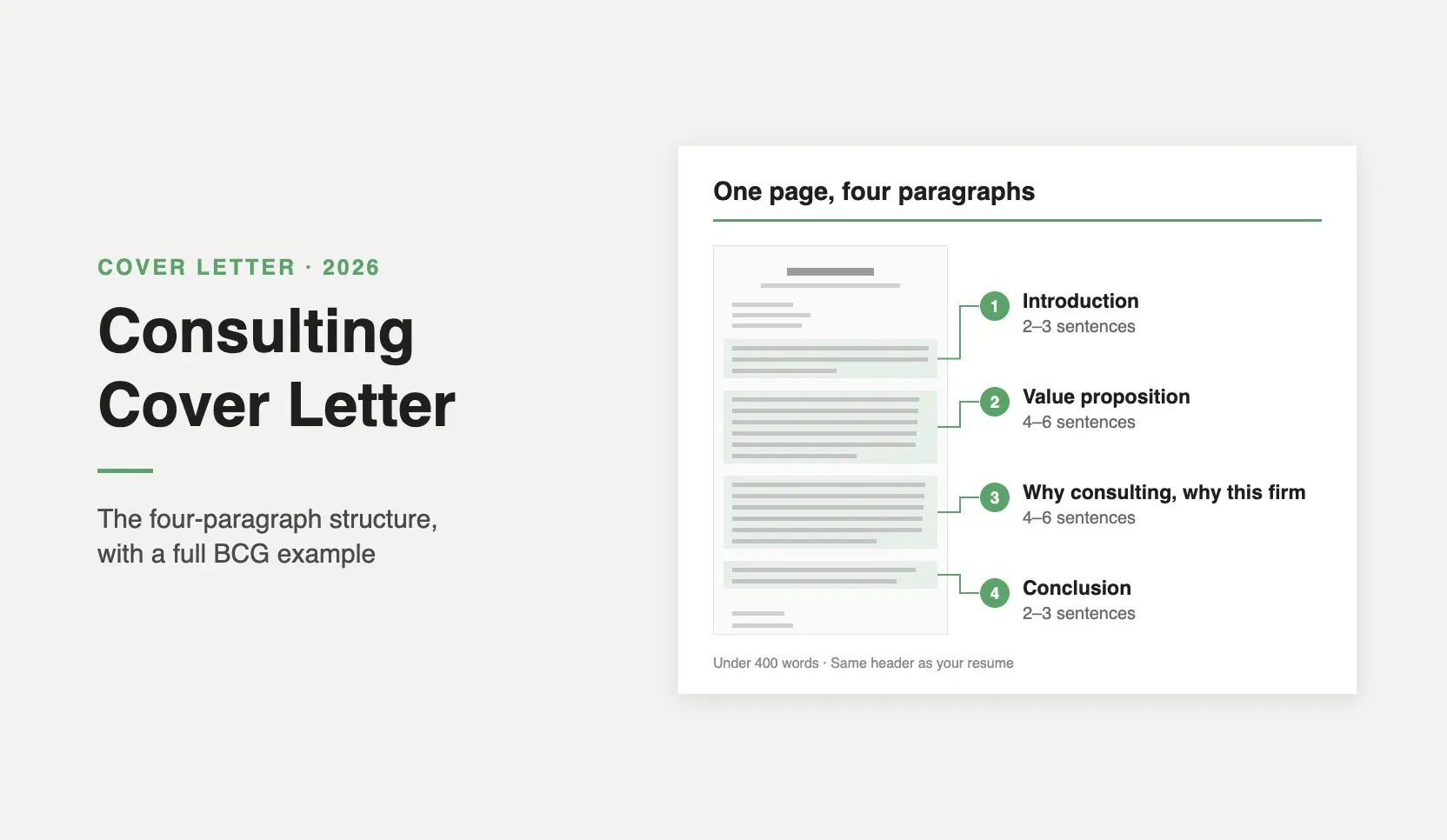
A strong consulting cover letter has four paragraphs: the introduction, your value proposition, why consulting and why this firm, and the conclusion. The examples below come from one complete letter to BCG's New York office.
Paragraph 1: The Introduction (2 to 3 sentences)
Make it easy for the reader to see which role, office, practice area (if relevant) and firm you are applying to, and give them a reason to keep reading.
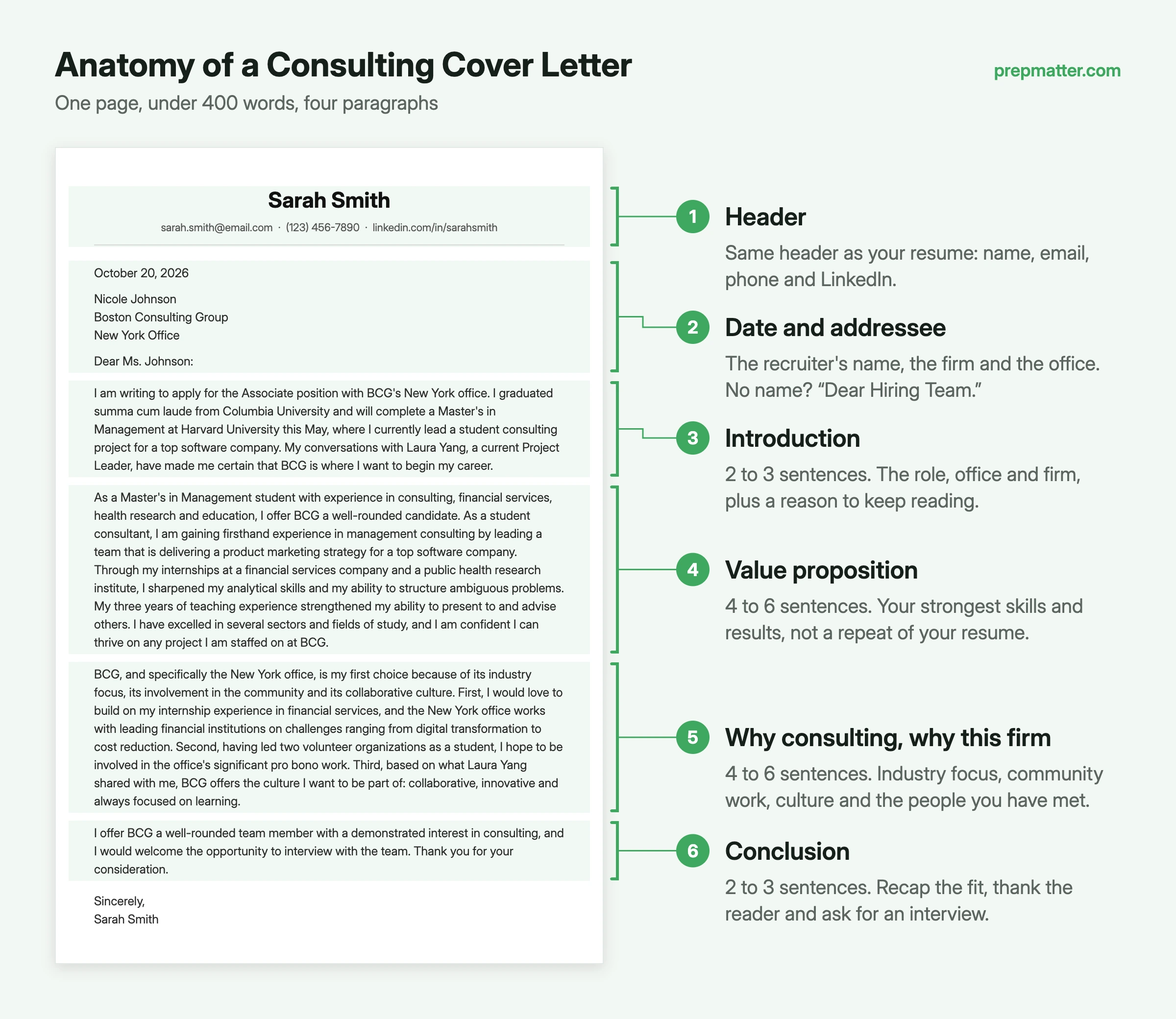
I am writing to apply for the Associate position with BCG's New York office. I graduated summa cum laude from Columbia University and will complete a Master's in Management at Harvard University this May, where I currently lead a student consulting project for a top software company. My conversations with Laura Yang, a current Project Leader, have made me certain that BCG is where I want to begin my career.
Paragraph 2: Your Value Proposition (4 to 6 sentences)
Build the case for why you would be a valuable member of the team. Don't repeat your resume or write a long list. Pick the skills and achievements that matter most, mention strong employer or university names, and show results you have driven. This paragraph should convince the reader you can do the job.
As a Master's in Management student with experience in consulting, financial services, health research and education, I offer BCG a well-rounded candidate. As a student consultant, I am gaining firsthand experience in management consulting by leading a team that is delivering a product marketing strategy for a top software company. Through my internships at a financial services company and a public health research institute, I sharpened my analytical skills and my ability to structure ambiguous problems. My three years of teaching experience strengthened my ability to present to and advise others. I have excelled in several sectors and fields of study, and I am confident I can thrive on any project I am staffed on at BCG.
Paragraph 3: Why Consulting, and Why This Firm (4 to 6 sentences)
Consulting is a demanding career, and firms want to know why you want it and that you understand what makes them different. Cover both.
Why consulting. Explain why you want to start your career in consulting (if you are a student), move into consulting (if you work in another role or industry), or switch firms (if you already consult). Never criticize a current or past employer; that is a red flag. If a role isn't the right fit, describe why the responsibilities, industry or location don't match where you want to go.
Why this firm. Consider:
- Type of firm: a strategy firm like McKinsey, BCG or Bain, a boutique with a niche focus, or a consulting practice inside a larger professional services firm.
- Type of work: short strategy projects, longer implementation work, or a mix.
- Industry or practice focus: offices like New York and London serve many financial services clients, while others lean toward digital, government or energy. If you are applying to a specific practice, explain why.
- Culture: the best way to understand it is to talk to people at the firm, at career fairs or on networking calls. You can also look at the office's pro bono work and development programs.
Our guide to the main types of consulting firms can help you describe the differences accurately.
BCG, and specifically the New York office, is my first choice because of its industry focus, its involvement in the community and its collaborative culture. First, I would love to build on my internship experience in financial services, and the New York office works with leading financial institutions on challenges ranging from digital transformation to cost reduction. Second, having led two volunteer organizations as a student, I hope to be involved in the office's significant pro bono work. Third, based on what Laura Yang shared with me, BCG offers the culture I want to be part of: collaborative, innovative and always focused on learning.
Paragraph 4: The Conclusion (2 to 3 sentences)
Keep it short. Briefly recap the mutual fit, thank the reader, and say that you would welcome an interview.
I offer BCG a well-rounded team member with a demonstrated interest in consulting, and I would welcome the opportunity to interview with the team. Thank you for your consideration.
Sincerely,
Full name
Here is how the full letter fits together on one page:
Watch: The Cover Letter That Got Deniz Into BCG
In this video, Deniz Ahmet Derici, founder of Prepmatter and a former BCG consultant, reviews the cover letter he used to get into BCG, including what worked and what he would change today.
10 Tips for a Consulting Cover Letter
- Be concise. Stay under 400 words. A short, compelling letter beats a long list of reasons.
- Use clean formatting. Same header, margins and font as your resume.
- Be error-free and professional. Proofread, then ask someone else to check it. Double-check the firm's name before you send it.
- Follow the four-paragraph structure. It makes the letter easy to follow and makes sure you cover everything that matters.
- Tell a story. Connect your experience and your goals into one argument for why you and the firm are a good fit.
- Complement your resume, don't repeat it. Turning resume bullets into sentences wastes the reader's time; they already have your resume.
- Know your value proposition. Double major in math and literature? You are well-rounded. Interned at a consulting firm? You know the work. Varsity athlete with honors? You bring grit and leadership. Say what you specifically offer.
- Show you know the firm. Mention its industry focus, its mix of strategy and implementation, or the office's community work. Tailor the introduction and the "why this firm" paragraph for every application.
- Mention the people you have spoken to. Naming one or two people you met at the firm, and what you learned from them, is one of the best ways to stand out. Focus on what you learned, not on the number of names. Our networking guide explains how to get those conversations.
- Address red flags briefly. If you have a significant gap or a low GPA with a genuine explanation, such as caring for a family member or working to pay for school, add one or two sentences. Don't let it become the focus of the letter.
Next Steps
- Free course: our Secure the Interview course covers consulting resumes, cover letters and networking, with real examples from trainees who were hired at top firms.
- Expert review: if you want a former consultant to edit your resume and cover letter line by line, see our Application Review.
- Your resume: read our guide on how to structure your resume so the two documents match.
Frequently Asked Questions
How long should a consulting cover letter be?
One page and under 400 words, in four paragraphs: introduction, value proposition, why consulting and why this firm, and conclusion.
Do consulting firms actually read cover letters?
Yes. For most consulting applications a cover letter is expected, unless you are referred by a current employee or the office asks only for a resume. It is often the only place you explain why consulting and why that firm, which a resume can't show.
Who should I address my cover letter to?
The lead recruiter for the role if you can find the name, your university's recruiting contact if you are applying on campus, or the person your referrer suggests. Otherwise, "Dear Hiring Team" is fine. Avoid "To Whom It May Concern".
Can I use the same cover letter for McKinsey, BCG and Bain?
You can reuse your value proposition, but rewrite the introduction and the "why this firm" paragraph for each firm and office. Recruiters notice generic letters, and sending a letter with the wrong firm's name in it is an easy way to be rejected.
Should I mention people I have networked with?
Yes, if the conversation was real and taught you something. Name one or two people, say what you learned, and explain why it made you want to apply.
Sign up for our newsletter
Join a community of aspiring consultants and elevate your preparation journey with Prepmatter.