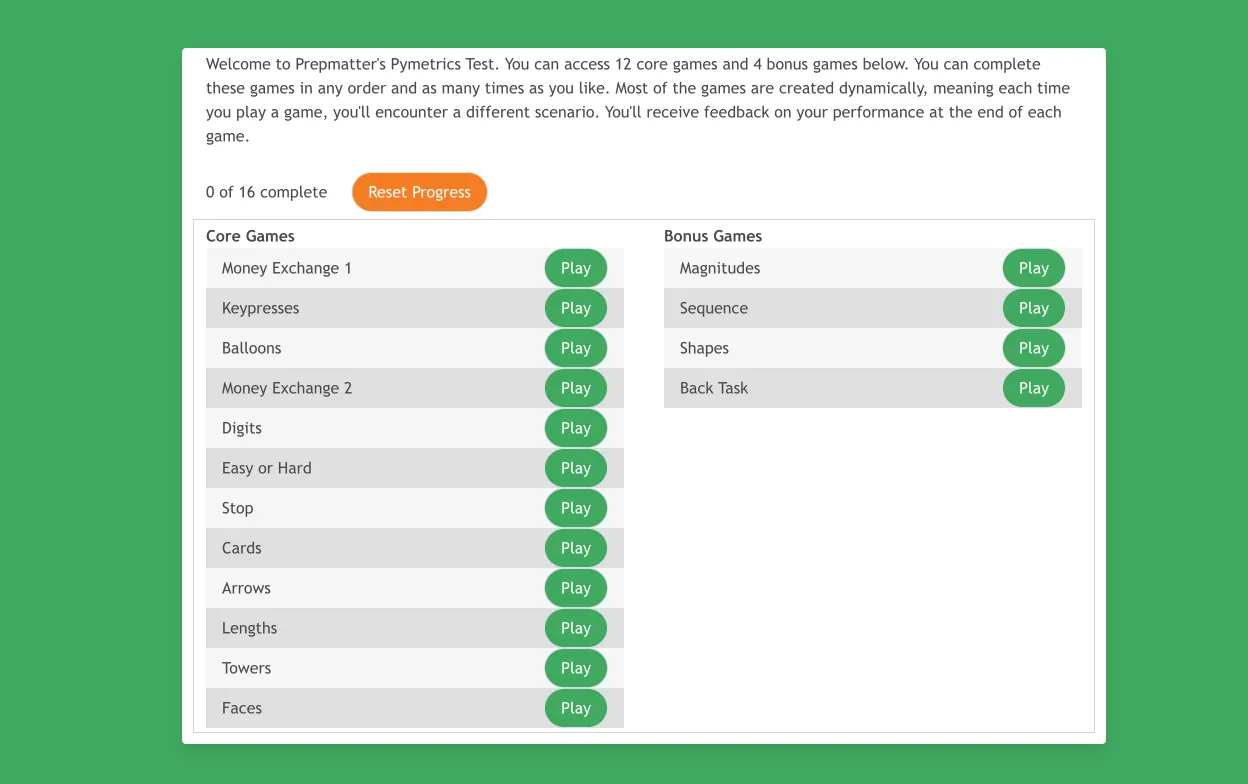
Pymetrics Test: Complete Guide to All 16 Games (BCG, Bain, Blackstone & More)
The Pymetrics test screens candidates for BCG, Bain, Blackstone, JPMorgan, and dozens of other top employers before interviews begin. If you have received an invitation to complete this assessment, your next career step depends on understanding what the test measures and how to approach each game.
Over 150,000 candidates have used our Pymetrics guidelines to prepare, and more than 300 trainees have practiced with our simulation. Our tutorials rank among the most-watched Pymetrics preparation content online, and our simulation remains the only one covering all 16 games.
Pymetrics Test Quick Facts
|
Fact |
Detail |
|
Format |
12-16 online mini-games |
|
Duration |
20-30 minutes total |
|
Traits Assessed |
9 categories, 91 total traits |
|
Scoring |
Trait matching (no pass/fail score) |
|
Companies |
BCG, Bain, Blackstone, JPMorgan, Accenture, and more |
|
Can you prepare? |
Yes - familiarity reduces anxiety and improves consistency |
Start practicing with our Pymetrics simulation.
What is the Pymetrics Test?
The Pymetrics test is a set of 12-16 neuroscience-based online mini-games used by major employers for pre-employment screening. The assessment measures cognitive and behavioral traits through observed actions rather than self-reported answers. AI algorithms analyze your decisions, speed, and patterns to build a behavioral profile.
Unlike traditional assessments, Pymetrics has no correct answers to memorize. The games track how you make decisions, handle uncertainty, maintain focus, and respond to challenges. Your results are compared to those of successful employees at your target company, generating a fit recommendation.
Pymetrics was acquired by Harver, though the assessment format remains largely unchanged. Candidates still encounter the same games and scoring methodology.
BCG Pymetrics: What to Know
BCG is the most common search term associated with Pymetrics, and for good reason. Some BCG offices still use Pymetrics, while others use alternative assessments such as the Online Case or CCA.
According to BCG's official documentation, "The pymetrics games are just one of several components of our overall candidate evaluation process, and your results will always be considered alongside other factors."
BCG states the assessment helps them "learn more about you, above and beyond what's on your resume and application form." The goal is to identify candidates whose natural working style matches successful BCG consultants, regardless of educational or professional background.
If you are applying to BCG, preparing for both Pymetrics and case interviews gives you the strongest foundation.
Prepare for BCG case interviews with Get the Offer.
Companies That Use Pymetrics
Consulting Firms
-
Boston Consulting Group (BCG)
-
Bain & Company
-
Ernst & Young (EY)
-
PricewaterhouseCoopers (PwC)
-
Accenture
Finance
-
JPMorgan Chase
-
Blackstone
Consumer, Tech, and Other Industries
-
Unilever
-
Tesla
-
McDonald's
-
LinkedIn
-
British American Tobacco (BAT)
-
Standard Chartered
-
Sage
-
Kraft Heinz
-
Diageo
Important: This assessment is not used universally by all these firms. Some companies have adopted it and later discontinued use. We recommend checking with your target company's HR department to confirm the assessment type before applying.
When You Take Pymetrics
Most candidates receive the Pymetrics invitation after the initial resume screen. You complete the assessment remotely on a computer or smartphone, typically within a 1-2 week deadline. Results influence whether you advance to interviews, though Pymetrics is rarely the sole determining factor.
Perfect your resume before Pymetrics with Secure the Interview.
The 9 Traits Pymetrics Measures
Pymetrics assesses 91 traits organized into 9 categories. Understanding these categories helps you approach each game with the right mindset.
|
Trait |
What It Measures |
Games That Test It |
|
Attention |
Concentration and filtering distractions |
Stop, Arrows, Lengths |
|
Focus |
Sustained concentration over time |
Digits, Stop, Arrows |
|
Decision Making |
Handling uncertainty and choices |
Balloons, Cards, Easy or Hard |
|
Risk Tolerance |
Comfort with potential gains and losses |
Balloons, Money Exchange, Cards |
|
Effort |
Persistence when facing challenges |
Keypresses, Easy or Hard |
|
Learning |
Adaptability and pattern recognition |
Cards, Arrows |
|
Fairness |
Sense of fair distribution |
Money Exchange 1 and 2 |
|
Generosity |
Willingness to share or cooperate |
Money Exchange 1 and 2 |
|
Emotion |
Emotional intelligence and recognition |
Faces |
How Companies Use Your Results
Recruiters receive a report showing where you performed well and where you scored differently from their target profile. Your results generate one of three outcomes: Highly Recommended, Recommended, or Not Recommended.
BCG states publicly that "Pymetrics results are never used as a 'filter' to eliminate candidates; BCG views Pymetrics as an inclusion tool." The assessment helps identify candidates whose natural working style matches successful consultants, regardless of background.
No single "winning" profile exists. Different roles favor different trait combinations. A risk-tolerant profile might fit trading roles better than operations positions. The goal is accurate matching, not achieving maximum scores.
All 16 Pymetrics Games Explained
The assessment typically includes 12 core games, though some versions feature 16. Each game takes 2-3 minutes and measures specific traits.
Watch our overview video above to understand what each game measures before practicing.
The 12 Core Games
Game 1: Money Exchange 1 (~2 minutes)
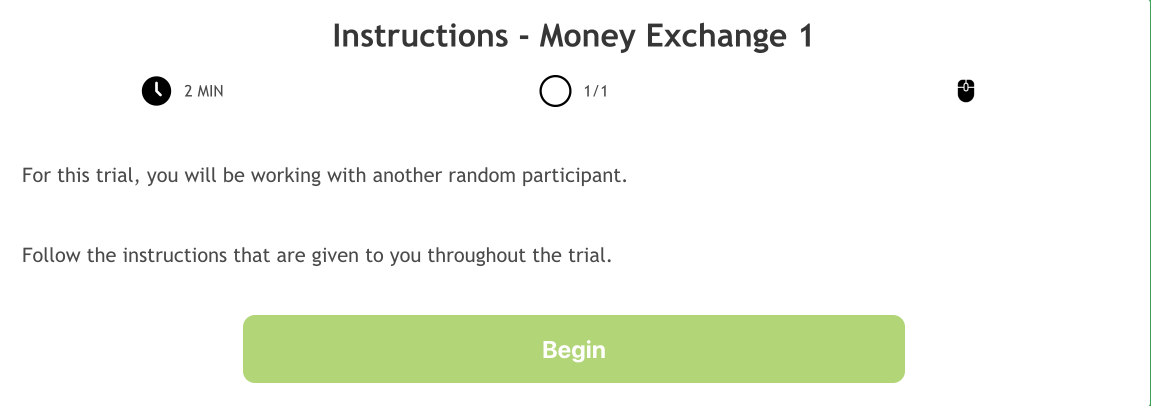
You receive $10 and decide how much to send to a partner. The money triples when transferred. Your partner then decides how much to return. After the exchange, you rate how fair the transaction was.
This game is based on the Trust Game from behavioral economics. It measures fairness and risk tolerance.
Game 2: Keypresses (10-20 seconds)
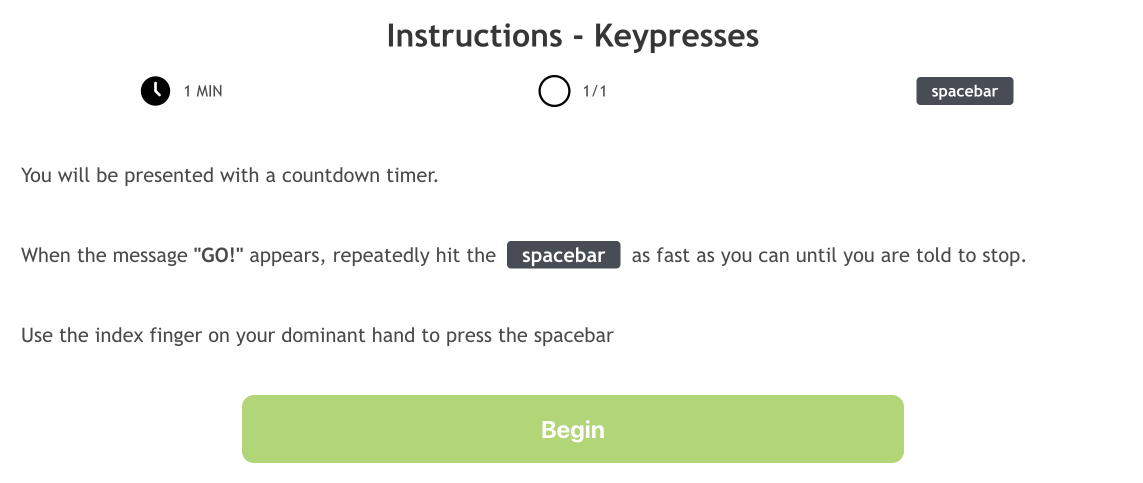
When "Go" appears, press the space bar as many times as possible until told to stop. The game measures effort through your physical persistence.
Game 3: Balloons (~3 minutes, 39 balloons)
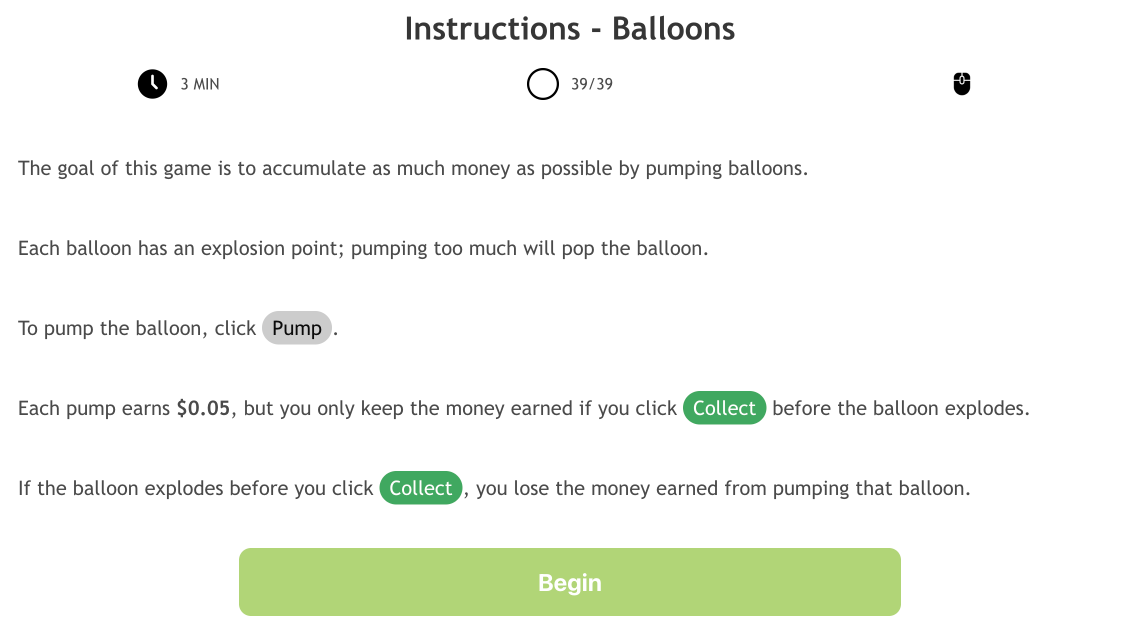
Pump balloons to earn money at 5 cents per pump. Collect your earnings before the balloon pops, or lose everything for that balloon. Different colored balloons have different explosion thresholds.
This game measures risk tolerance and decision-making through your pumping patterns.
Game 4: Money Exchange 2 (~2 minutes)
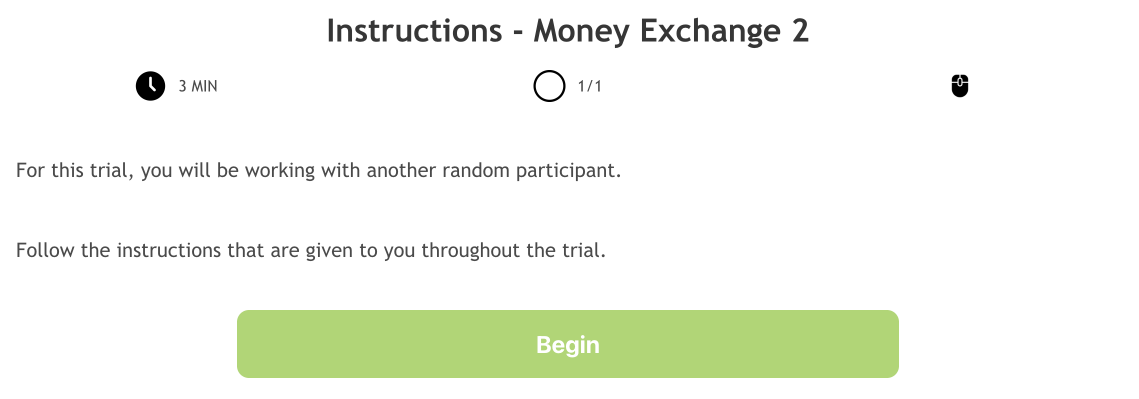
Similar to Money Exchange 1, but you can also take money from your partner. Both you and your partner start with $5, and you receive an additional $5. You decide whether to give, keep, or take.
Based on the Dictator Game from game theory, this measures fairness more directly than the first exchange.
Game 5: Digits (Until 3 wrong answers)
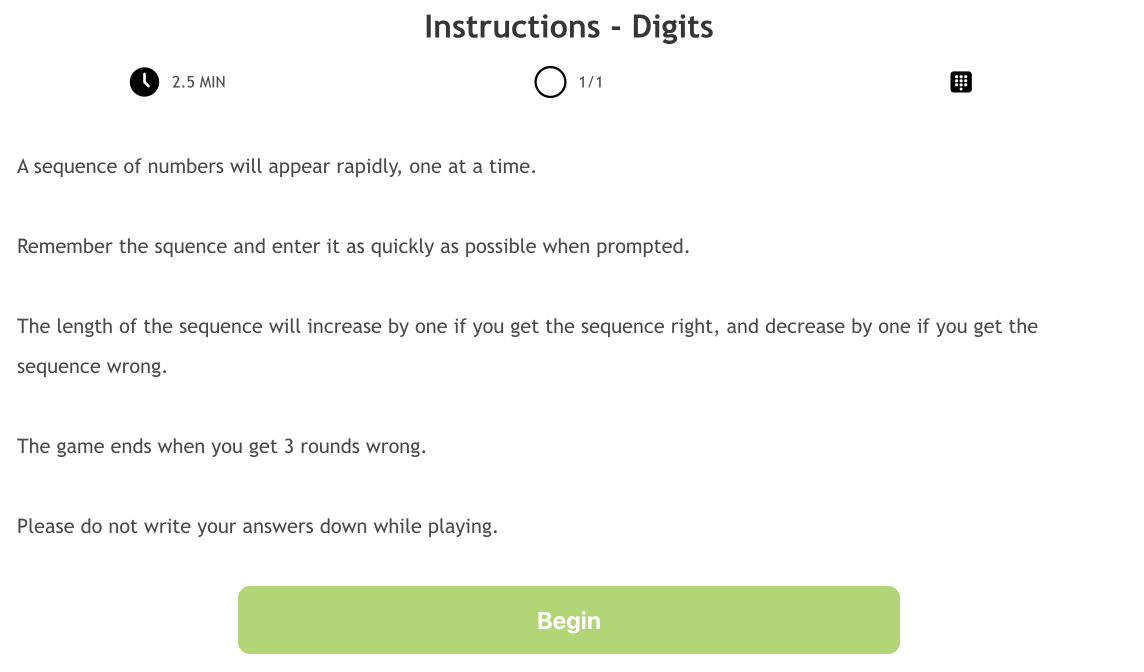
Numbers flash on the screen one at a time. After the sequence ends, enter the digits in order. Starting with 4 digits, the sequence increases by 1 for each correct answer and decreases by 1 for each wrong answer. Three wrong answers end the game.
This measures attention and focus through working memory capacity.
Game 6: Easy or Hard (2 minutes, 12 tasks)
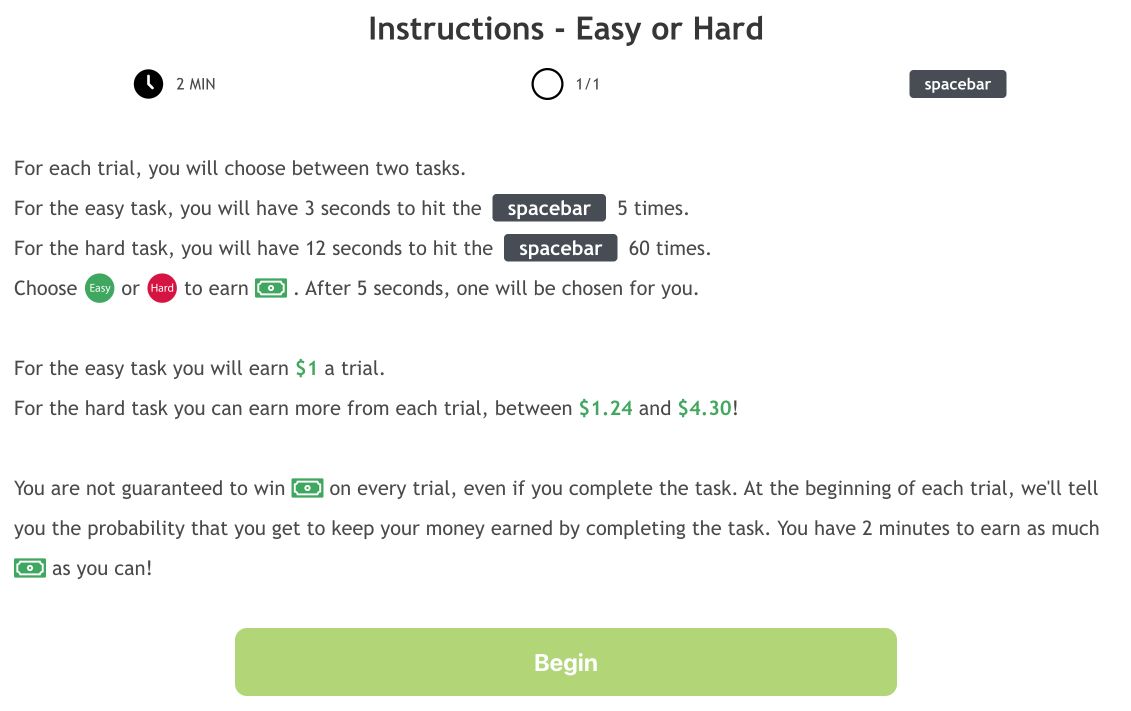
Choose between an easy task ($1 reward, 5 presses in 3 seconds) or a hard task ($1.24-$4.30 reward, 60 presses in 12 seconds). Each task shows your probability of winning the reward. Even if you complete the task successfully, the stated probability determines whether you receive the money.
This measures effort, decision-making, and risk tolerance.
Game 7: Stop (70-80 circles)
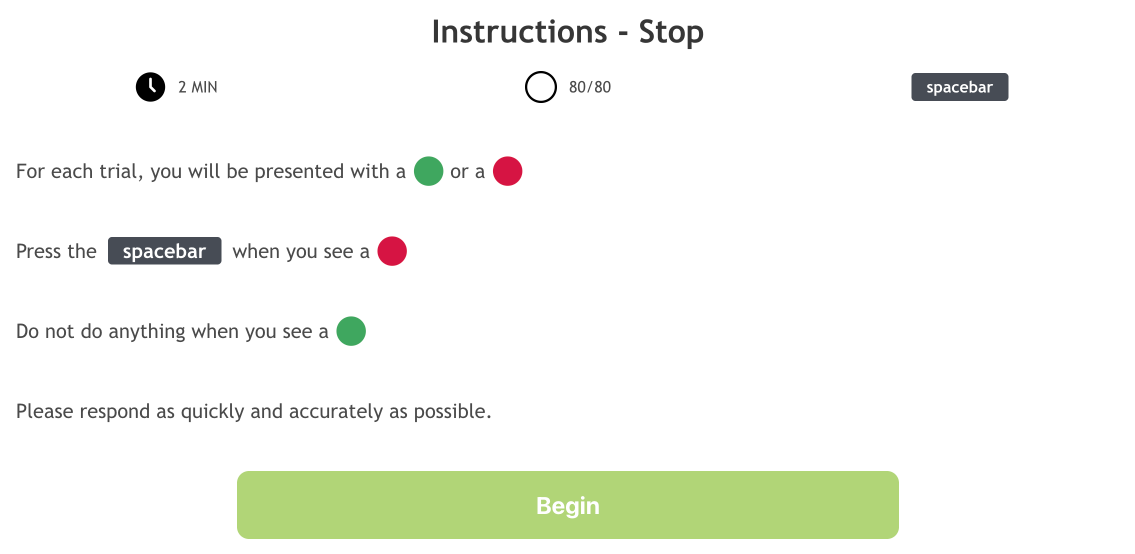
Circles appear one at a time. Press the space bar when you see a red circle. Do nothing for green circles. You have about one second between circles.
This measures attention and focus through response control.
Game 8: Cards (8+ rounds, $2,000 starting balance)
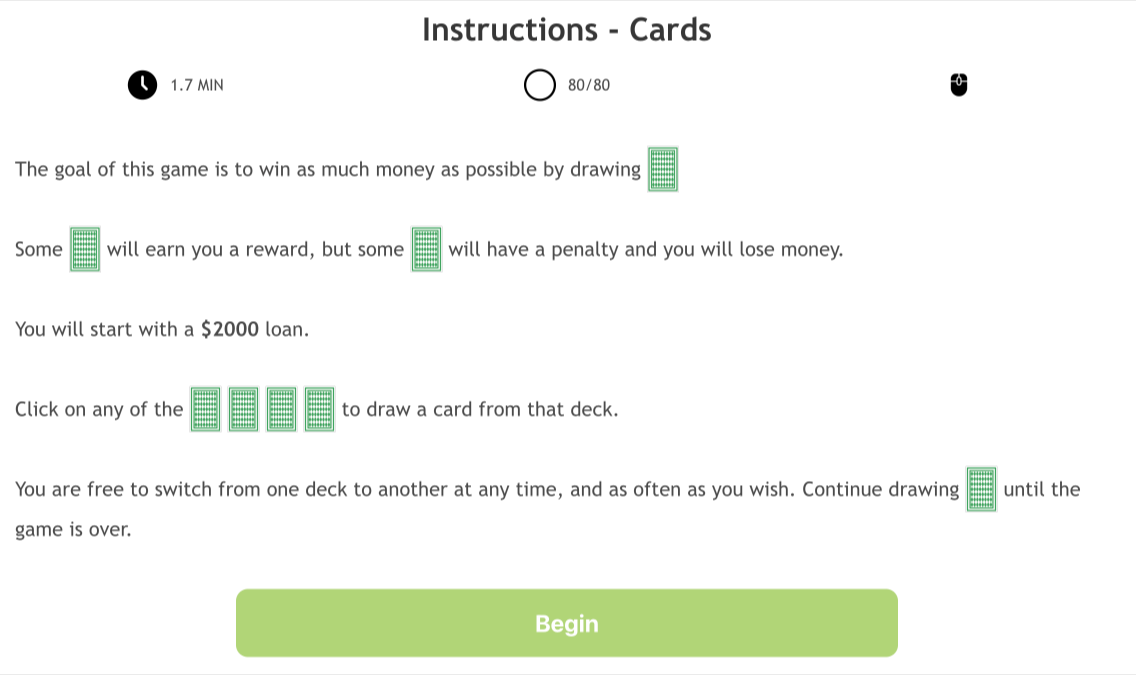
Draw cards from any of four decks. Some cards earn rewards ($25-$100), some yield nothing, and some cause losses ($25-$1,150). Your goal is to accumulate as much money as possible.
Based on the Multi-armed Bandit problem, this measures risk tolerance and decision-making through your exploration and exploitation patterns.
Game 9: Arrows (135 rounds)
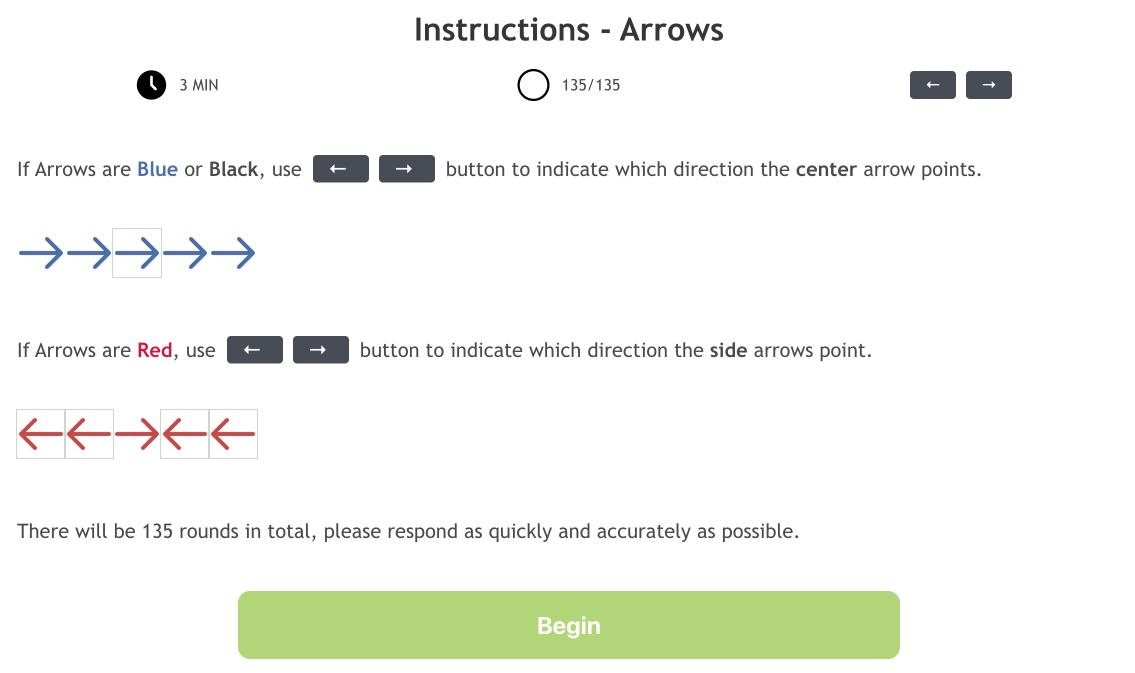
Arrows appear on screen. For blue or black arrows, press the key matching the direction of the CENTER arrow. For red arrows, press the key matching the direction of the SIDE arrows.
This measures learning and attention through your ability to switch rules quickly.
Game 10: Lengths (90 faces)
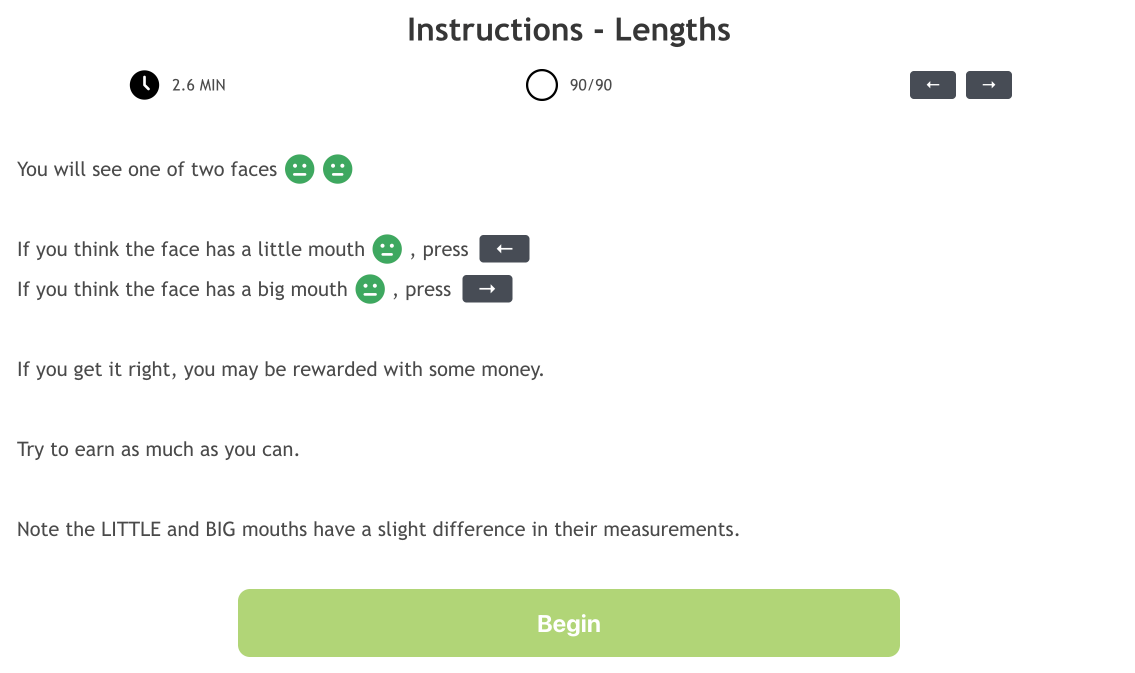
Faces appear one at a time. Press left if the face has a small mouth, right if it has a big mouth. The mouth size differences are subtle.
This measures attention and focus through sustained visual discrimination.
Game 11: Towers (varies)
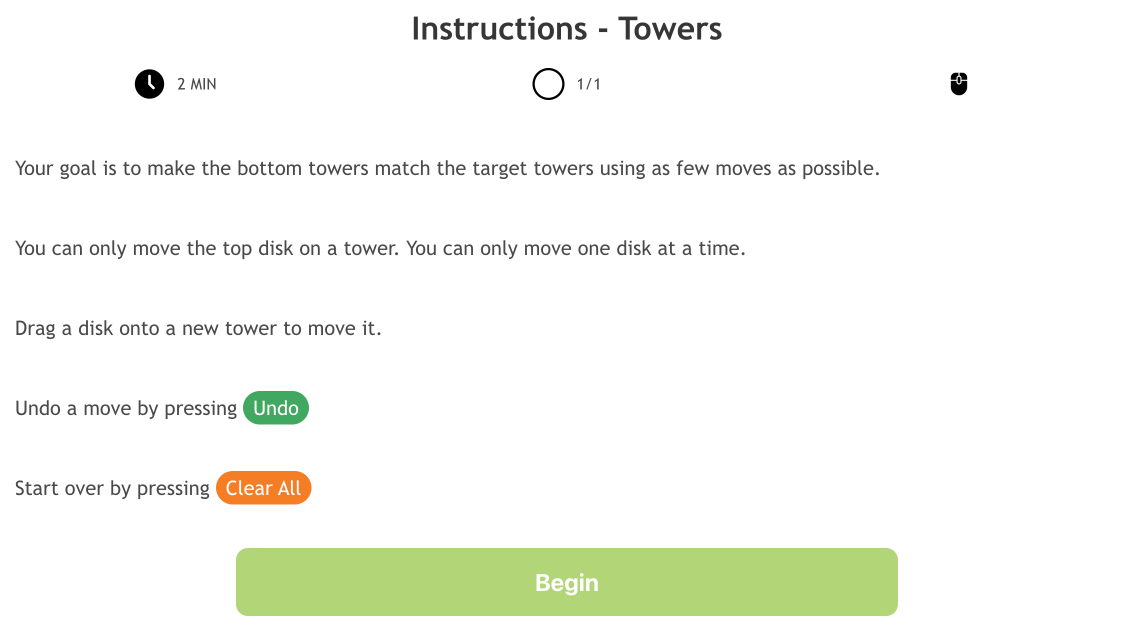
Match a target tower configuration by moving colored discs between rods. You can only move the top disc from any rod, and you want to complete the puzzle in the minimum number of moves.
Based on the Tower of Hanoi, this measures decision-making through planning ability.
Game 12: Faces (14 questions)
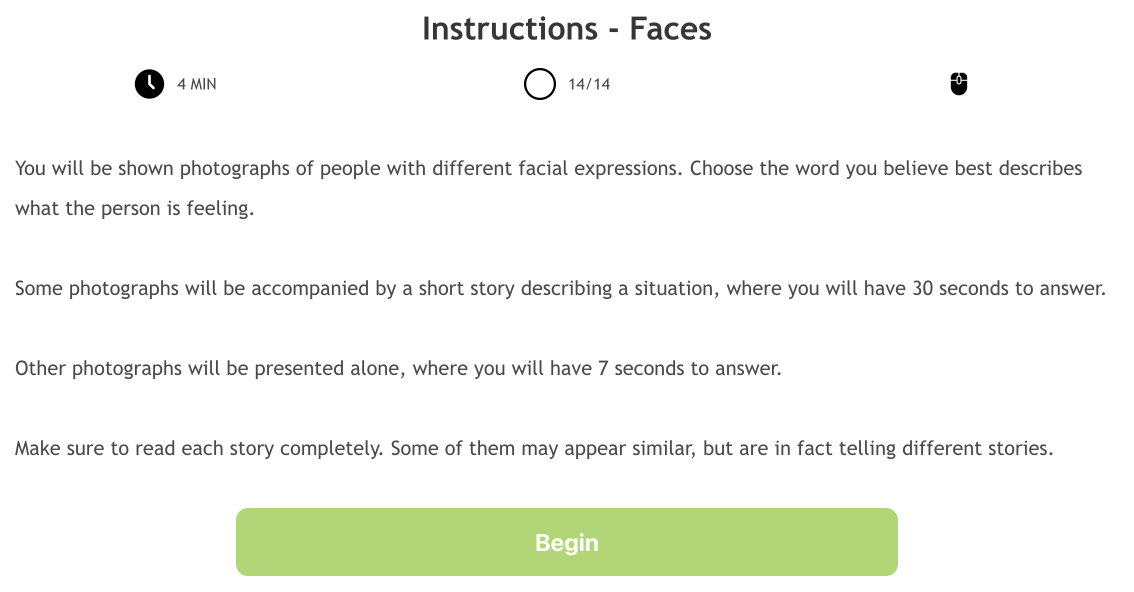
Photographs of people appear showing various emotions. Select the word that best describes each emotion. Some photos include a short story providing context. Photo-only questions give you 7 seconds. Questions with stories give you 30 seconds.
This measures emotional intelligence through facial expression recognition.
The 4 Bonus Games
Some assessments include additional numerical and logical reasoning games.
Game 13: Magnitudes (5 seconds per question)
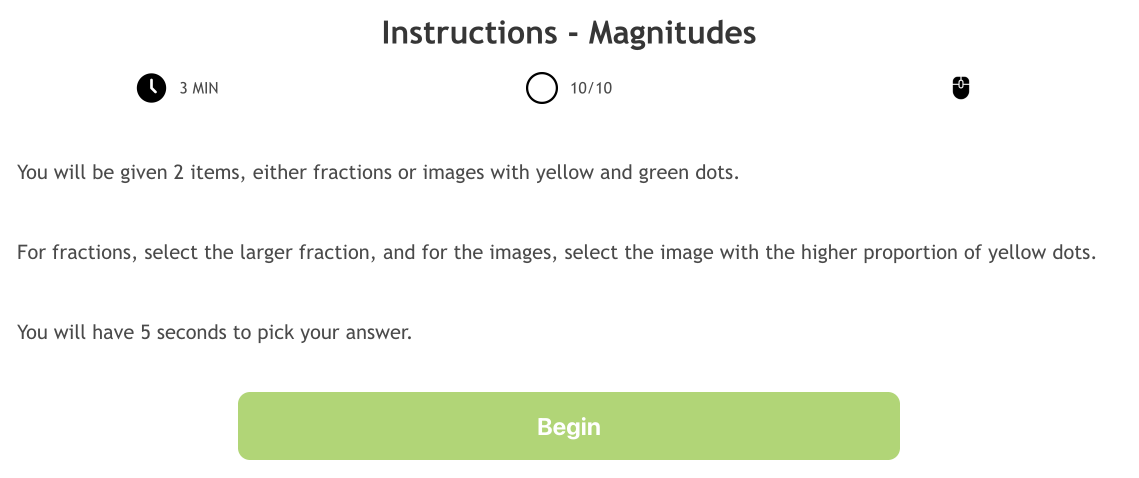
Compare two items: either fractions or images with colored dots. For fractions, select the larger value. For dot images, select the image with the higher proportion of yellow dots.
Game 14: Sequences (30 seconds per question, 20 questions)
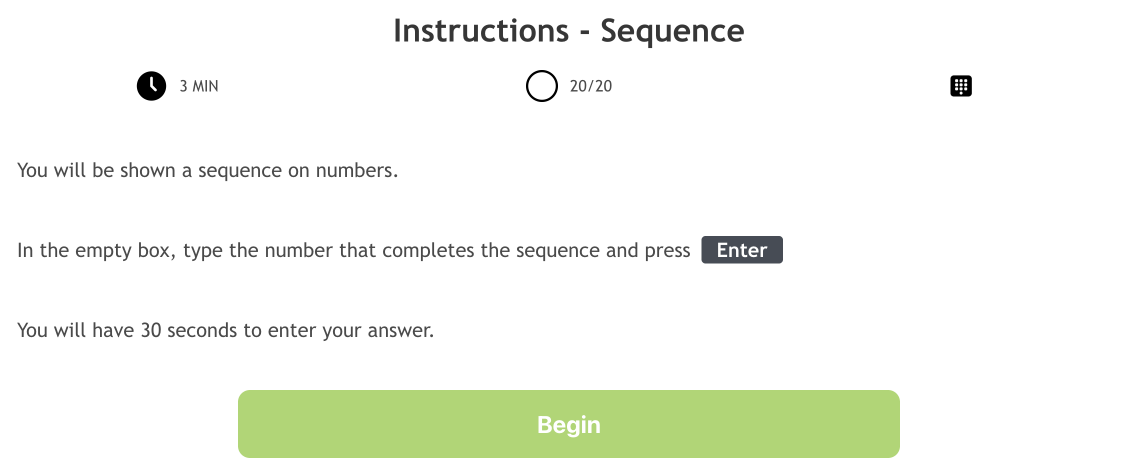
Complete numerical patterns by entering the missing number. Patterns may involve addition, multiplication, squares, or combined operations.
Game 15: Shapes (45 seconds per question, 14 questions)
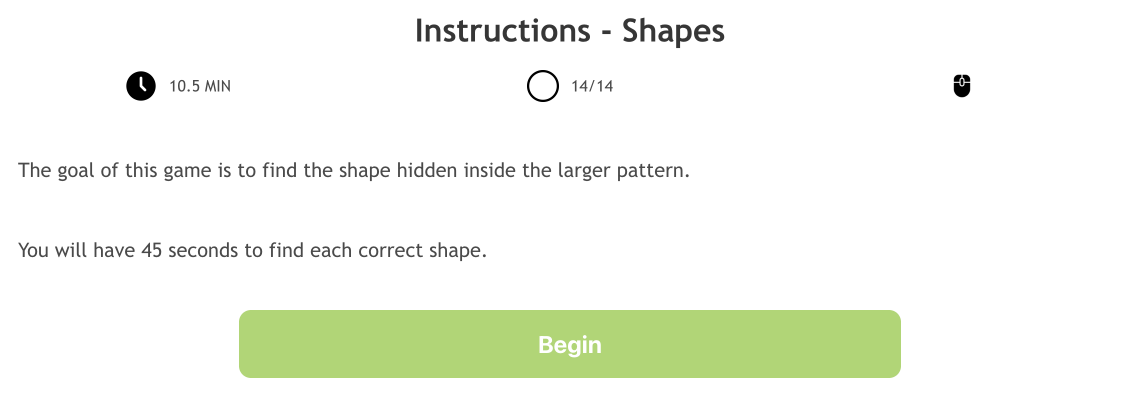
Find a hidden shape within a complex pattern. You receive one target shape and must identify where it appears in the larger image.
Game 16: Letters (Back Task) (40 letters total)
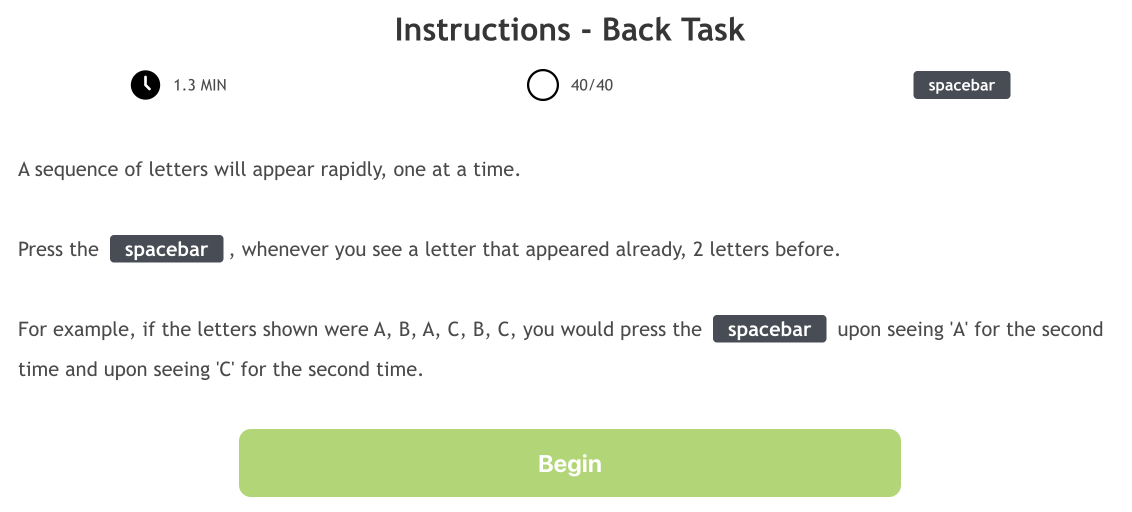
Letters appear one at a time. Press the space bar when you see a letter that appeared exactly two letters before. This N-back task measures working memory and attention.
Practice all 16 games with our simulation.
How Pymetrics Scoring Works
Pymetrics does not score you as pass or fail. The assessment builds a behavioral profile and compares it to successful employees at your target company.
Trait Matching, Not Right or Wrong
Your responses create a profile across 91 traits. No correct answers exist for games like Money Exchange or Balloons. The algorithm analyzes your behavioral patterns, not whether you made the "right" choice.
Your profile is compared to a "success profile" built from current employees at the company. The comparison determines your recommendation level.
The Three Outcomes
|
Outcome |
Meaning |
|
Highly Recommended |
Strong trait alignment with successful employees |
|
Recommended |
Acceptable trait alignment |
|
Not Recommended |
Significant trait misalignment |
What Employers See
Recruiters receive a detailed trait breakdown across all 9 categories. They see how your natural working style compares to that of their benchmark employees. The report includes behavioral insights, not raw scores.
Why Consistency Matters
The algorithm detects erratic behavior patterns. If you suddenly change strategies mid-game or give wildly different responses to similar situations, this flags inconsistency. Steady performance across games produces a clearer, more reliable profile.
The "Most Unique" Designation
Some candidates receive "Most Unique" labels for certain traits, indicating extreme scores in either direction. This designation is neither positive nor negative on its own. Whether it helps or hurts depends on the target company's profile requirements.
Can You Prepare for Pymetrics?
Pymetrics claims the assessment measures natural tendencies that remain stable over time. Our experience with 150,000+ candidates shows that preparation significantly improves outcomes.
What Preparation Does NOT Do
-
Change your fundamental personality
-
Give you the correct answers to memorize
-
Let you manipulate the system
What Preparation DOES Do
-
Reduces anxiety from unfamiliar interfaces
-
Builds familiarity with game mechanics
-
Improves time management under pressure
-
Increases consistency across games
-
Identifies games requiring extra attention
The Prepmatter Approach
Step 1: Understand the Games
Watch our overview video to learn what each game measures. Understanding the traits being assessed helps you approach each game without confusion.
Step 2: Practice with Simulation
Complete all 16 games in a realistic environment. Experience the pacing, interface, and time pressure before the real assessment.
Step 3: Review Your Performance
Identify which games felt challenging. Note where you felt rushed or uncertain. Practice those specific games until they feel comfortable.
Watch our full walkthrough above to see all 16 games completed with strategies explained.
Prepmatter's Pymetrics Simulation
|
Feature |
Detail |
|
Games Included |
All 16 (only simulation with complete coverage) |
|
Scenarios |
Dynamic - different each time you play |
|
Feedback |
Detailed analysis after each game |
|
Access |
6 months, unlimited attempts |
|
Price |
$109 (one-time charge) |
|
Guarantee |
50% refund if you do not pass |
|
Rating |
5.0 from 276 trainees |
We offer a free demo featuring the Easy or Hard game. Try it to experience the interactive nature of our simulation before purchasing.
What Candidates Say After Using Our Resources
Candidates who practiced with our tutorials and simulation consistently report positive outcomes.
"I have just completed the pymetrics test, and it is pretty spot on for all the questions. Definitely do your revision on this video before you attempt the test." — @brianlim3578
"I completed my pymetrics assessment yesterday and passed, thanks to this video. It was very informative and helpful." — @phambiligumede9307
"Thank you so much. I got the job at Sage HR." — @ThokozileKunene-j7p
"All the sections are identical to the examples you showed in the video. This one video was more than sufficient for the test." — @maanav-i7j
These results come from candidates who watched our free videos and practiced with our simulation. Familiarity with game mechanics makes a measurable difference.
Practice with our Pymetrics simulation.
Game-by-Game Strategies
Each Pymetrics game has specific mechanics and optimal approaches. These strategies come from observing thousands of candidates.
Money Exchange 1 and 2 Strategy
Game Theory Foundation
Money Exchange 1 is based on the Trust Game. Money Exchange 2 is based on the Dictator Game. Both measure how you balance self-interest with fairness.
Recommended Approach
Give approximately 50% of your money ($5 out of $10 in Exchange 1, $2.50 of the additional $5 in Exchange 2). Never take money from your partner in Exchange 2. Rate transactions as fair (7-10) when final amounts are relatively close.
What to Avoid
Giving everything signals excessive risk-taking. Keeping everything signals low fairness. Taking from your partner in Exchange 2 signals unfair behavior. Stay balanced.
Keypresses Strategy
Official Instruction: Use your dominant hand index finger.
Prepmatter Tip: Use BOTH hands. Alternating between hands significantly increases your press count without additional fatigue.
Average press counts hover around 60. Using both hands, most people exceed this easily. The game measures effort, not finger technique.
Balloons Strategy
Key Insight: Different colored balloons have different explosion thresholds. Some colors consistently allow higher inflation than others.
Recommended Approach
During your first few balloons, test each color to identify patterns. For favorable colors (often red and yellow), push to 40-50 cents. For less favorable colors (often blue and green), collect at 20-25 cents.
If you experience several early explosions, increase your risk on subsequent balloons to recover lost earnings. Target total: $8-10.
What to Avoid
Pumping every balloon to maximum ignores color patterns and guarantees losses. Always collecting at a minimum shows excessive conservatism. Neither extreme produces ideal results.
Digits Strategy
Official Instruction: Do not write down answers.
Prepmatter Tip: WRITE THEM DOWN. Grab a pen and paper before starting. Write each digit as it appears on screen.
Recommended Approach
Write digits as they flash. Reach 10-12 digits correctly, then intentionally provide wrong answers to end the game at a reasonable level. The average human digit memory capacity is around 9 digits. Reaching 14-15 looks unrealistic and may flag manipulation.
Three wrong answers end the game. Control when you exit rather than failing randomly.
Easy or Hard Strategy
Key Insight: The probability of winning matters more than the reward amount.
Recommended Approach
Choose HARD if the probability is 50% or higher. The hard task (60 presses in 12 seconds) is achievable. We have consistently hit 100+ presses in that time frame.
Choose EASY if the probability is below 20%. Low probability means you likely will not receive the reward regardless of task completion.
Move quickly between decisions. The timer runs continuously, and delays cost you attempts.
Target score: $8-10 total.
Stop Strategy
Mechanics: The red circle means press the space bar. A green circle means do nothing.
Recommended Approach
You have approximately one second between circles. No need to rush your response. Focus on accuracy over speed. Target 70+ correct out of 80. Small error rates (5-10%) are acceptable and normal.
Cards Strategy
Game Theory Foundation: The Multi-armed Bandit problem asks whether to explore new options or exploit known good ones.
Recommended Approach
Start by exploring all 4 decks in the first few rounds. Identify which decks yield positive outcomes and which cause losses. Once you recognize patterns, focus on favorable decks but continue varying between 2-3 of them.
Do not draw from the same deck repeatedly. After a large loss from any deck, avoid it for at least 5 rounds.
Target ending balance: $6,000-7,000 from the $2,000 start.
Arrows Strategy
Rules
Blue or black arrows: Press the direction of the CENTER arrow. Red arrows: Press the direction of the SIDE arrows.
Recommended Approach
Keep your eyes focused on the center of the screen. Only shift attention to the sides when you see red. Mentally remind yourself throughout: "Red means sides."
Expect some mistakes. The game runs for 135 rounds and can be mentally tiring. A score of 124/135 represents strong performance. Do not panic over a few errors.
This game is frequently cited as the most challenging. Practice with arrow reaction games online to build speed.
Lengths Strategy
Prepmatter Tip: Place your cursor at the edge of the first face's mouth as a reference point. Compare subsequent faces to this marker.
Recommended Approach
Position your cursor at the small mouth edge. If the mouth extends past your cursor, the mouth is big (press right). If it stays within your cursor, the mouth is small (press left).
90 faces total. Target 87+ correct. The cursor trick eliminates most guesswork.
Towers Strategy
Game Foundation: Tower of Hanoi puzzle.
Key Insight: The configuration may vary across assessments, and there is no guaranteed standard scenario.
Recommended Approach
Most versions can be completed in approximately 8–10 moves if solved efficiently. Rather than memorizing a fixed move sequence, focus on understanding Tower of Hanoi logic: free smaller discs first, plan several steps ahead, and minimize unnecessary moves.
Avoid back-and-forth corrections, as these increase your total move count and signal weaker planning.
Practice Tower of Hanoi puzzles to build intuition for any configuration presented.
Faces Strategy
Time Limits
Photo only: 7 seconds Photo with story: 30 seconds
Recommended Approach
For questions with story context, read the story carefully. The narrative often provides the emotional context that the photo alone might not reveal. For photo-only questions, trust your first instinct.
Common emotions tested: happiness, sadness, fear, anger, surprise, disgust, hope, determination, puzzlement.
This game is often cited as difficult because of its short time limits. Practice with emotional intelligence quizzes online.
Bonus Games Strategy
Magnitudes: Compare quickly. Trust your visual judgment for dot proportions. For fractions, convert to common denominators mentally if time permits, otherwise estimate.
Sequences: Look for common patterns: constant addition, multiplication series, squares, or Fibonacci-like relationships. You have 30 seconds per question. Use pen and paper.
Shapes: Start from the leftmost option and systematically check each choice. The 45-second limit feels generous but passes quickly when you are uncertain.
Letters (Back Task): Say the last two letters aloud as you see them. When the current letter matches what you said two letters ago, press immediately.
Practice these strategies with our simulation.
Common Mistakes That Hurt Your Results
Based on feedback from thousands of candidates, these mistakes most commonly lead to poor Pymetrics outcomes.
Strategy Mistakes
Trying to game the system
Algorithms detect inconsistent behavior. Extreme responses designed to seem "ideal" often flag manipulation. Play within strategic bounds, but stay natural.
Rushing through games
You often have more time than you think. Speed without accuracy damages your profile. Read instructions twice before starting each game.
Ignoring game mechanics
Each game has specific rules that affect scoring. Misunderstanding mechanics leads to poor performance. Use the untimed tutorial period fully.
Being too conservative OR too risky
Extreme behavior in either direction creates an unbalanced profile. Aim for measured responses that show you can calibrate to situations.
Not tracking patterns
In Cards, failing to note which decks perform well wastes information. In Balloons, ignoring color patterns costs money. Mental or written notes help.
Technical Mistakes
Poor test environment
Distractions reduce focus scores. Background noise, interruptions, or an uncomfortable setting all affect performance. Take the test in a quiet, private space.
Wrong device choice
Some games work better on a computer than phone. Larger screens help with Shapes and Arrows. Keyboards work better than touchscreens for space bar games. Use a stable device with reliable internet.
Taking the test when tired
Cognitive performance drops significantly when fatigued. Take the assessment in the morning when you are fresh. Avoid late-night attempts.
Mindset Mistakes
Treating it like a competition
No winning score exists. The goal is accurate trait matching, not maximum points. Authentic behavior produces the best match for roles that actually fit you.
What Happens After Pymetrics
You have completed all the games. The screen thanks you for participating. Now what?
Results Timeline
Most companies provide results within 1-2 weeks. Some batch process candidates and notify everyone on the same day. High-volume recruiting periods may take longer.
If you have not heard back after 2 weeks, following up politely with the recruiting coordinator is appropriate. Silence does not necessarily indicate bad news.
What You Receive
You typically receive a simple notification: advancing or not advancing. Detailed score breakdowns are not provided automatically. Some candidates successfully request trait highlights from HR, but this varies by company.
If You Advance
Advancing means an invitation to the next stage, usually interviews. For consulting firms like BCG and Bain, this means case interviews. For finance roles at Blackstone or JPMorgan, expect technical and behavioral interviews.
Pymetrics represents one data point in your application. Strong interview preparation remains critical.
Prepare for case interviews with Get the Offer.
If You Do Not Advance
Your Pymetrics profile often remains valid for approximately 1 year. The same profile may be shared across companies using the Pymetrics platform. You can retake the assessment for different companies, but be aware that your existing profile might carry over.
Use the time to strengthen other application components: resume, networking, and interview skills. Many successful consultants were rejected on their first attempt.
No Detailed Feedback
Pymetrics does not provide detailed score reports. You will not know which traits matched or mismatched. This opacity makes thorough preparation even more valuable. Control the variables you can control.
Practice With Prepmatter's Simulation
We built the only Pymetrics simulation covering all 16 games.
|
Feature |
Detail |
|
Games |
All 16 (12 core + 4 bonus) |
|
Scenarios |
Dynamic - different each time |
|
Feedback |
Detailed analysis after each game |
|
Access |
6 months, unlimited attempts |
|
Price |
$109 (one-time) |
|
Guarantee |
50% refund if you do not pass |
|
Support |
Response within 8 hours |
Why Our Simulation
Complete Coverage: Other simulations cover only 12 games. We include all 16, so you are prepared for whatever version you encounter.
Dynamic Scenarios: Unlike static practice tests, our games generate different scenarios each time. You build real skills rather than memorizing specific answers.
Realistic Interface: Our simulation mirrors the actual assessment format. Nothing feels unfamiliar on test day.
Performance Feedback: After each game, see exactly where you performed well and where to improve. Use this data to focus your practice.
Risk-Free Practice: Our 50% refund policy means that if you do not pass, you get half your money back. Forward your result email to team@prepmatter.com within 2 months of purchase.
Free Resources
Not ready for the full simulation? Start with our free content:
-
Free Demo: Try the Easy or Hard game on our website
-
YouTube Overview (24 minutes): Learn what each game measures
-
Full Walkthrough (1 hour): Watch us complete all 16 games with strategies explained
Pymetrics Test Day Checklist
One Day Before
-
Confirm you received the assessment link and that it works
-
Test your internet connection and device
-
Prepare pen and paper for the Digits and Sequences games
-
Watch our walkthrough video one more time if needed
30 Minutes Before
-
Close all unnecessary browser tabs and applications
-
Silence your phone and remove distractions
-
Ensure your room is quiet and well-lit
When Starting
-
Read each game's instructions twice during the tutorial
-
Tutorial time is untimed, so use it fully
-
Position your cursor for the Lengths game trick
-
Have pen and paper ready for Digits
-
Take a breath between games if needed
Technical Issues
If your computer crashes or the internet disconnects mid-assessment, contact the employer's HR team immediately. Most companies have protocols for technical problems and can reset your assessment or provide a new link. Document the issue with screenshots if possible.
Do not attempt to restart without HR confirmation, as this may flag your assessment.
You Are Ready to Pass Pymetrics
Pymetrics measures behavioral traits through 16 mini-games. No right or wrong answers exist. The assessment builds a profile compared to successful employees at your target company. Major employers, including BCG, Bain, Blackstone, and JPMorgan, use it for candidate screening.
Preparation reduces anxiety and improves consistency. Understanding game mechanics before test day gives you confidence. Practicing with realistic simulations builds familiarity with the interface and time pressure.
150,000+ candidates have used our Pymetrics guidelines. Our simulation is the only one covering all 16 games with dynamic scenarios that differ each time. We offer a 50% refund if you do not pass.
Start practicing today.
Not ready to commit? Watch our free walkthrough video or try the demo game on our website.
Find practice partners on Peer Practice
Thousands of candidates have used our resources to prepare for Pymetrics and advance to interviews. You can too.
Frequently Asked Questions
What is the Pymetrics test?
The Pymetrics test is a game-based assessment measuring behavioral and cognitive traits through 12-16 online mini-games. Companies like BCG, Bain, Blackstone, and JPMorgan use it to screen candidates before interviews. The games assess traits like attention, risk tolerance, and decision-making through observed behavior rather than self-reported answers.
What are the 12 games in Pymetrics?
The 12 core games are Money Exchange 1, Keypresses, Balloons, Money Exchange 2, Digits, Easy or Hard, Stop, Cards, Arrows, Lengths, Towers, and Faces. Some assessments include 4 additional games: Magnitudes, Sequences, Shapes, and Letters.
How long does the Pymetrics test take?
The assessment takes 20-30 minutes to complete. Each game lasts 2-3 minutes, and you complete all games in one sitting without breaks.
Are there right or wrong answers in Pymetrics?
No. Pymetrics measures behavioral traits, not correct answers. Your responses create a profile compared to those of successful employees at the target company. The goal is trait matching, not achieving a high score.
How is Pymetrics scored?
Pymetrics builds a behavioral profile across 91 traits in 9 categories. Your profile is compared to the company's success profile, resulting in one of three outcomes: Highly Recommended, Recommended, or Not Recommended. You do not receive a numerical score.
Can I prepare for the Pymetrics test?
Yes. While you cannot change fundamental traits, preparation helps you understand game mechanics, reduce anxiety from unfamiliar interfaces, improve consistency across games, and manage time effectively. Prepmatter's simulation lets you practice all 16 games with realistic scenarios.
What companies use Pymetrics?
Major employers include BCG, Bain & Company, EY, PwC, Accenture, JPMorgan Chase, Blackstone, Unilever, Tesla, McDonald's, LinkedIn, Standard Chartered, Sage, and British American Tobacco. Not all offices of these firms use Pymetrics. Check with HR to confirm.
Does BCG still use Pymetrics?
Yes, BCG continues to use Pymetrics as part of its screening process. However, some offices also use other assessments, e.g., BCG Online Case or BCG Consulting Career Assessment (CCA) for numerical and logical skills. The exact assessment can vary by location and role.
Is the Pymetrics test hard?
The games themselves are straightforward, but some require quick thinking under time pressure. The Arrows game is frequently cited as challenging due to the rule-switching between blue/black and red arrows. With practice, most candidates find the assessment manageable.
Can I retake Pymetrics if I fail?
Your Pymetrics profile often remains valid for about 1 year and may be shared across companies using the platform. You can retake for different companies, but the same profile may apply to multiple applications within that period.
Should I take Pymetrics on the phone or computer?
We recommend a computer. Larger screens help with games like Shapes and Arrows. Keyboards work better for games requiring space bar presses. Use a stable device with a reliable internet connection.
Does Pymetrics use AI?
Yes. Pymetrics uses AI algorithms to analyze your gameplay patterns, decisions, and timing. The AI builds a behavioral profile without human bias, comparing your traits to those of successful employees at your target company.
Where can I practice Pymetrics games?
PrepMatter offers the only simulation with all 16 games. Our simulation features dynamic scenarios that differ each time, detailed feedback after each game, and 6 months of unlimited access for $109. We offer a 50% refund if you do not pass.
Is Pymetrics still widely used in consulting?
Pymetrics is still used by some consulting firms, but not universally. Usage varies by firm, office, and recruiting cycle. Some offices may use alternative assessments instead. Always check the official communication for your specific role and location.
What does "Most Unique" mean in Pymetrics results?
"Most Unique" indicates you scored at the end of a particular trait. This is neither positive nor negative. Whether it helps or hurts depends on the target company's profile requirements for the specific role.
Can I use a calculator during Pymetrics?
No calculator is provided or needed for most games. The Sequences bonus game involves math, but you have 30 seconds per question. Mental math or pen and paper is sufficient.
About the Author
This guide was created by the Prepmatter team. Prepmatter provides preparation resources for consulting and finance job assessments. Our Pymetrics tutorials have helped over 150,000 candidates, and our simulation has trained 276+ users. Our team includes former MBB consultants and professional game developers who continuously update content to match the latest assessment formats.
Disclaimer
Prepmatter's Pymetrics Simulation is an independently developed training tool designed to familiarize you with the style and types of games used in Pymetrics assessments. It is not an official Pymetrics product, nor is it endorsed or sponsored by Pymetrics. Our simulation features different visuals and unique scenarios. Prepmatter is not liable for any outcomes related to Pymetrics assessments based on the use of this simulation.
Sign up for our newsletter
Join a community of aspiring consultants and elevate your preparation journey with Prepmatter.