How to Practice for a BCG Case Interview
A BCG case interview is a business problem that you solve in conversation with a BCG consultant. It is candidate-led: you decide what to analyze, you ask for the data you need, and you finish with a recommendation. It is part of every BCG interview for client-facing roles and sits alongside a fit conversation about your experience and motivation.
To prepare, you need three things: a structure built for the client's question, the habit of driving the analysis yourself, and a clear recommendation at the end.
This guide covers BCG's interview process and online assessments, how its cases differ from McKinsey's, what interviewers assess, and a week-by-week preparation plan. It is written by Deniz Ahmet Derici, a former BCG consultant. Together with Doga, he has coached 670+ candidates one-on-one.
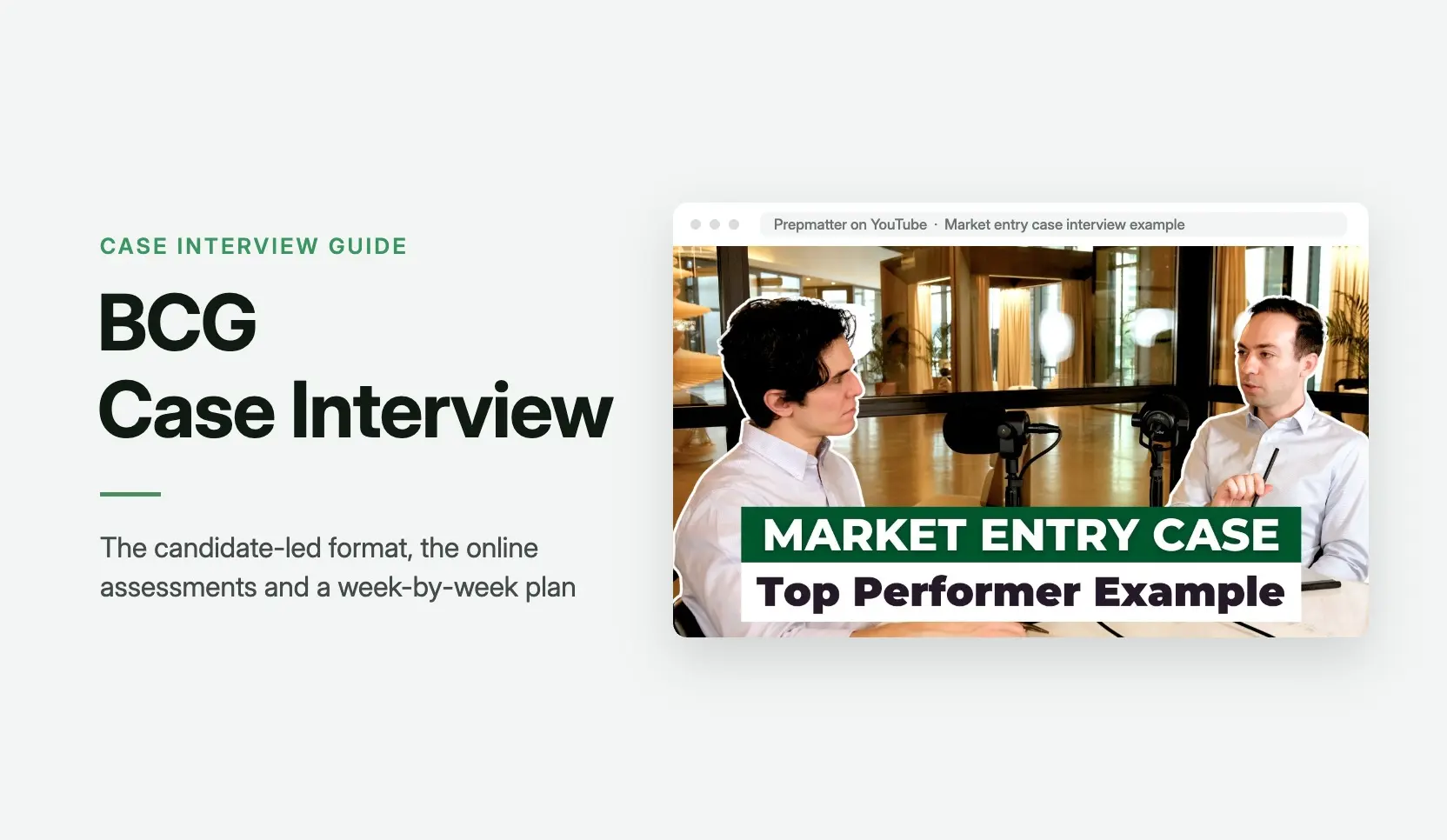
The guide also includes a full market entry case in the candidate-led format, with Deniz as the candidate and Doga as the interviewer.
What Does the BCG Interview Process Look Like?
BCG's process has five stages: the application, the Consulting Career Assessment, an online case, a first round of live interviews, and a final round.
|
Stage |
What happens |
Who you meet |
|---|---|---|
|
Application |
Your resume and cover letter are screened |
Recruiting team |
|
Consulting Career Assessment (CCA) |
An online test of 30 to 35 minutes. The invitation arrives 30 to 90 minutes after you apply, and you have 48 hours to complete it |
No interviewer |
|
Online case |
A chatbot-led case of about 35 minutes, also known as Casey. Selected candidates are invited about two weeks after the application deadline |
No interviewer |
|
First round |
Usually two live interviews, each with a fit part and a case |
Usually project leaders and principals |
|
Final round |
Usually two or three live interviews in the same format |
Partners |
BCG does not publish the number of rounds or the length of each interview, but the usual pattern is two rounds with four or five interviews in total. Its interview process page describes the fit part as a skills interview about your experience and motivation, and the case as a test of your problem-solving and analytical skills. Details can differ by office and role. Your recruiter usually sends the exact breakdown with the interview invitation.
Two points matter for your preparation:
- The online assessments come first, and fast. The first invitation arrives within 90 minutes of your application, so prepare before you apply. These timings come from BCG's US recruiting page, and some offices outside the US use different tests. See our guides to the Consulting Career Assessment and the BCG Online Case, also known as Casey or the chatbot case.
- Every interview follows the same structure. It starts with 10 to 15 minutes of fit questions, continues with a case of 25 to 30 minutes, and ends with 5 to 10 minutes for your questions. A strong case does not make up for a weak fit conversation, so prepare both.
How Is a BCG Case Different From a McKinsey Case?
BCG cases are candidate-led: after you present your structure, the interviewer waits for you to say where you want to go. McKinsey cases are interviewer-led: the interviewer asks a set of questions, one at a time. Bain cases are now a mix of the two: traditionally candidate-led, with more interviewers leading the case in recent years. Much of this guide still applies to Bain.
|
|
BCG |
McKinsey |
|---|---|---|
|
Who leads the case |
You do. You choose what to analyze and in what order |
The interviewer, through a set of questions |
|
How you get data |
You ask for it, and you say why you need it |
The interviewer hands it to you with each question |
|
How the case ends |
You give a recommendation |
Often with the last question, without a final recommendation |
|
Fit part |
A conversation about your experience, skills and motivation |
The Personal Experience Interview: one story examined in depth |
The candidate-led format gives you more control and more ways to go wrong. The interviewer may let you spend ten minutes on an analysis that does not matter. That is why BCG preparation is mostly about one habit: at every point in the case, knowing what you want to look at next and why.
If you are also interviewing with McKinsey, read our McKinsey case interview guide for the interviewer-led format.
What Does BCG Assess?
BCG assesses how you solve the problem and how you would come across to a client. On its case interview preparation page, BCG says there is not always one correct answer, and that your approach and the quality of your reasoning matter most. It names three things interviewers look for: clear communication, logical thinking, and business intuition and creativity.
Those three are BCG's own categories, and they are broad. To prepare for a candidate-led case, we break them down into five skills you can practice:
- Structuring. You break the client's question into the parts that answer it. The structure fits this client, not any client.
- Driving the case. You say what you want to analyze first and why, and you ask for the data you need.
- Working with numbers and exhibits. You set up calculations before you compute, and you say what a chart means for the client, not only what it shows.
- Business judgment. Your ideas are practical, and you spot what matters most.
- Communication. You are structured and concise, and you end with a clear recommendation.
BCG's own advice points the same way. Its list of do's is: listen actively, be yourself, think structurally, communicate clearly, clarify assumptions and show your thinking.
In the fit part, BCG looks for five qualities, listed on its interview process page: integrity, intellectual curiosity, creative thinking, a collaborative mindset and drive.
For more on how interviewers score candidates, read What McKinsey and BCG Interviewers Actually Look For.
How Does a BCG Case Unfold?
A BCG case has no fixed list of questions. The interviewer gives you the situation and expects you to take it from there. A typical case runs like this:
- The prompt. The interviewer describes the client and the question. Take notes, because the details will not be repeated, and say the question back in one sentence to confirm it.
- Clarifying questions. Ask three or four high-level questions, and no more than four. Confirm the scope of the case, the reason behind the client's request, and the financial objective or how the client defines success. Also ask about any term you do not know. Say why you are asking each one.
- Your structure. Take up to two and a half minutes, then present the three or four areas you would look at and what you would check in each.
- Your first move. This is where BCG differs most. Do not wait to be asked. Say which area you want to start with, why, and what data you need. The natural starting point is often the first item in the first area of your structure.
- The analysis. You receive data, a chart or numbers to calculate. After each piece of analysis, say what it means for the client's question and where you want to go next. Keep a working hypothesis and update it as the data comes in.
- Ideas. At some point you will be asked something open, such as how the client could respond. Group your ideas into two or three categories instead of listing them as they come to mind.
- The recommendation. BCG interviewers expect one. Lead with your answer, support it with two or three reasons and their numbers, name the main risk, and suggest next steps. Our guide on how to conclude a case covers this in detail.
To see the full flow, watch this market entry case from start to finish. Deniz is the candidate, and Doga is the interviewer:
For more examples in the same format, watch our product launch case in healthcare and our profitability case.
For more on building structures that are not memorized, see How to Write a Strong Case Interview Framework.
How Should You Prepare for a BCG Case Interview?
Plan for six to eight weeks and 40 to 50 live cases. On an eight-week plan, that is about one live case a day. On six weeks, you will need two on some days. Most successful candidates spend 100 to 200 hours in total.
|
When |
Focus |
What to do |
|---|---|---|
|
Before you apply |
Online assessments |
Practice the Consulting Career Assessment and the online case before you submit your application. In the US, the first invitation arrives within 90 minutes of applying. |
|
Week 1 |
Learn the method |
Learn how cases work: structuring, market sizing, exhibits and conclusions. Watch three or four full case examples before you attempt one. Start 10 to 15 minutes of mental math a day. List the stories you will use in the fit part. |
|
Middle four to six weeks |
Live cases, one case type at a time |
Work in sprints of two to three days per case type, such as profitability, market entry or pricing. Practice live, candidate-led cases with three or four regular partners, and take turns as the interviewer. As the interviewer, give data only when your partner asks for it. If you work with a coach, alternate between peer practice and coaching sessions. After each case, write down what went wrong and drill that area. |
|
Final week |
Rehearse the interview |
Run full mock interviews: the fit part first, then the case, ideally with someone who has interviewed candidates. Fix your last two or three recurring mistakes. Do not learn anything new this week. |
The rule about data is the one most practice partners get wrong. If the interviewer hands over every exhibit without being asked, you are practicing a McKinsey case, not a BCG case.
BCG also offers OneDay@BCG, a free job simulation that shows what a consultant's day looks like. It is useful background for your motivation answers, but it does not replace case practice.
If you want a structured way through this plan:
- Online assessments. Our BCG Online Case simulation has 15 interactive cases, and our Consulting Career Assessment simulation covers all three sections of the test.
- Course. Get the Offer covers the method, 13 live case interview videos, 60+ case studies and drills for structuring, exhibits and math. It also covers the fit interview.
- Practice partners. You can find other candidates to practice with on Peer Practice.
- Coaching. In 1-on-1 coaching, a former BCG consultant runs candidate-led cases with you in 75-minute sessions and tells you exactly what to fix.
How Do You Prepare for the BCG Fit Interview?
The fit part comes first and lasts 10 to 15 minutes. You introduce yourself and answer three to five questions. BCG calls it the skills interview and describes it as a conversation about your experience, your skills and your motivation for joining BCG.
Unlike McKinsey's Personal Experience Interview, it does not follow one fixed format, so you need to be ready for a range of questions.
The questions fall into three groups:
- Why you and why BCG. "Tell me about yourself" or "Walk me through your resume," "Why consulting?", "Why BCG?" and "Why this office?" Most interviews open with one of these. Keep your introduction to about two minutes, and explain the choices behind each step, not only the steps.
- Your experience. "Tell me about a time when you led a team," had a conflict with a manager or a client, changed someone's mind, made a mistake, or worked under pressure.
- Additional questions. For example, "Are you interviewing with other firms?" or "What would be your biggest challenge as a consultant here?"
Our video goes through 24 commonly asked questions from these three groups and how to prepare for each:
You do not need 24 separate answers. Prepare a small set of stories that together cover leading a team, working in a team, a conflict, a mistake and a challenge you overcame. One story can answer several questions. Check that your stories also show the five qualities BCG looks for: integrity, intellectual curiosity, creative thinking, a collaborative mindset and drive.
In the fit part, interviewers are mainly judging your effectiveness and impact: what you achieved, what you did yourself, what your team gained from you, and what you learned. Build each story around those points.
- Say "I," not "we." Interviewers are assessing your contribution. A story told in "we" hides it.
- Explain your reasoning. What you were thinking matters as much as what you did.
- Use recent stories. Examples from the last two to three years carry more weight.
- Know the office. Research the office you are applying to and the people interviewing you, so that your "Why BCG?" answer is specific.
- Keep it a conversation. A memorized script falls apart at the first unexpected question.
The last 5 to 10 minutes of the interview are for your questions. BCG describes the interview as a two-way conversation, and good questions show that you have thought about the job.
For question lists and example answers, read The Ultimate Guide to Fit Interviews.
What Are the Most Common Mistakes in BCG Cases?
These are five mistakes that cost candidates in candidate-led cases. The first is the one that sets BCG apart.
1. Waiting for the Interviewer to Lead
Many candidates present a structure and then stop. Candidates who have prepared for McKinsey do this most, because in an interviewer-led case the next question always comes. In a BCG case, the silence is yours to fill.
In our coaching, the cause is rarely that candidates cannot lead. It is one of two things. Some do not know they are expected to drive the case. Others do not have a structure good enough to drive with: without the big picture, you cannot tell which analysis the case needs next.
End your structure with a first move: "I would like to start with the market, because the size of the opportunity decides if the rest matters. Do we know how large it is and how fast it is growing?" Do the same after every analysis: say what you learned and where you want to go next.
Then practice it, and expect to get it wrong at first. A good interviewer will see that you are trying to drive the case and will steer you back if you head the wrong way. Sometimes your next step is reasonable and the case simply does not unfold that way. That is fine. Trying to lead and being redirected is better than waiting.
We give the same advice to candidates preparing for McKinsey. Case leadership is valued at every firm, and even more for senior hires.
2. Memorized Frameworks
A memorized framework rarely answers the question the client asked. There is a simple test: if you could copy your framework into a different case and it would still make sense, it is generic.
The first signs are small. Some candidates never name the client's product in their structure, and never repeat the client's specific problem.
Two cases from our coaching sessions show what gets missed. In the first, the client is a white goods supplier. The candidate did not ask which products that covers, so his structure never reflected what the client actually sells: household appliances such as refrigerators and washing machines.
The second is a market entry case in poultry, which Deniz built from a real consulting project. Few candidates ask what poultry includes. A structure that fits the case looks beyond chicken to turkey, other meat products and even eggs.
Before you present your structure, check that it names the client's product and answers the client's question.
To learn the principles, go through the framework videos in Get the Offer, then apply them in the course's framework drills. You will see that we keep about half of the skeleton from case to case and customize the rest to the client's product and problem.
3. Questions Without a Reason
After the prompt, some candidates ask whatever comes to mind, and others ask nothing. Later in the case, the same habit shows up as data requests with no purpose: revenue by product, then by region, then by channel, in the hope that something stands out.
For clarifying questions, imagine you have just been staffed on the project and have a few minutes with your manager. What would you ask in that meeting? Good questions are high-level and tied to the client's ask. They scope the problem, or they help you understand the client or the market.
Then do two things with every question: say why you want to know, and once you have the answer, say what it means for the case. In the poultry case, you could ask about the client's size like this: "Market entry is the only way the client wants to grow, so I would like to understand how aggressively it should enter. How much revenue did it make last year?" If the answer is $8 billion: "Then the client needs a sizable entry, because a small one will not move the needle. That will matter when we compare ways to enter the market."
The same rule applies to every data request later in the case. "If the decline is concentrated in one region, the problem is local. Do we have revenue by region?" That is what working with a hypothesis looks like in practice.
You learn which questions to ask by repetition. Get the Offer has a video on clarifying the prompt, and each of its 50 framework drills comes with three or four clarifying questions.
4. Numbers Without a "So What"
Candidates calculate a number and move on, without saying what it means for the client. Many switch off while they do the math and forget why they started the calculation. In a candidate-led case, this is a leadership problem as much as a math problem: you cannot drive the case if you do not know what your number means.
One of our pricing cases is about a new MRI device. A key analysis is to work out how many hospitals would be interested in it. Most candidates read the exhibit correctly and arrive at 500 hospitals. Then they stop.
Strong candidates keep going: "Now that we know 500 hospitals are interested, how many devices would each of them buy? That gives us the volume. With the volume and the expected costs, we can calculate the minimum price that meets the client's objective."
Finish every calculation by saying what the number means for the client's decision and what you want to look at next.
5. A Summary Instead of a Recommendation
At the end, many candidates retell the case in the order it happened. The interviewer asked what the client should do.
Take about 30 seconds to note your key messages. Then give your recommendation in about one minute, in this order:
- Recommendation. One action-oriented sentence. If the case was about diagnosing a problem, such as falling profits, start with the diagnosis and then give the solution.
- Three reasons. Two with numbers from your analysis and one qualitative. They should not overlap.
- Risks. The main risk, and what the client can do about it.
- Next steps. What the client should do first.
For example: "The client should enter the cosmetics market with the new product. First, it can make $800 million in profit over three years, above the objective of $600 million. Second, the market is expected to grow 9% a year over the next ten years. Third, the client can share back-end operations with its existing business. The main risk is tighter health regulation, so the client should plan for compliance from the start. As a next step, I would design a detailed production plan."
Spend most of that minute on the recommendation and its reasons. Some candidates give half of their time to risks and next steps, which buries the answer. For more examples, watch How to Conclude a Consulting Case Interview.
Frequently Asked Questions About the BCG Case Interview
How long is a BCG case interview?
The case takes 25 to 30 minutes, inside an interview of about 45 minutes. The fit part comes first and takes 10 to 15 minutes, and the last 5 to 10 minutes are for your questions. BCG does not publish these timings, but your recruiter usually sends the breakdown with the interview invitation.
Are BCG cases always candidate-led?
Usually, yes. You are expected to choose what to analyze and to ask for the data you need. Interviewers differ in how much they guide you, and partners in the final round often run the case as a looser conversation.
How many cases should I practice before a BCG interview?
We recommend 40 to 50 live cases, practiced with three or four regular partners and spread across all the main case types. Most successful candidates spend 100 to 200 hours in total over six to eight weeks. The number only helps if you review each case and fix what went wrong before the next one.
Do I have to pass an online assessment before the interviews?
In most offices, yes, but the test depends on the office. In the US, BCG sends the Consulting Career Assessment to applicants, and invites selected candidates to an online case of about 35 minutes. Other offices use different tests. Our guides to the Consulting Career Assessment, the BCG Online Case and the Pymetrics test explain each format.
What does BCG look for in candidates?
BCG lists five qualities: integrity, intellectual curiosity, creative thinking, a collaborative mindset and drive. In the case, interviewers look for clear communication, logical thinking, and business intuition and creativity.
Do I need business experience to pass?
No. The case tests how you think, not what you know about an industry. You do need to be comfortable with basic business terms such as revenue, profit and margin.
Does BCG use a written case?
Rarely. Some offices use one for certain roles; we have seen it in London for a project leader role. Your recruiter will tell you in advance if you have one.
In the format BCG describes in its practice version, you receive a set of documents and a few questions from a partner. You have two hours to prepare three to five slides on paper, then you present for 15 minutes and answer questions for another 15. BCG's own advice is to form a hypothesis early instead of reading every document, to leave enough time to write your slides, and to put the main message in each slide title.
Can I use AI to prepare for BCG interviews?
Yes, for preparation. BCG says applicants may use AI to help them prepare, but that their own voice, insights and experiences matter most and should not be replaced by AI.
Sign up for our newsletter
Join a community of aspiring consultants and elevate your preparation journey with Prepmatter.