Bain SOVA Assessment 2026: Format, Sections, and How to Prepare
The Bain SOVA assessment is the online test some Bain & Company offices send after you apply and before your first case interview. In its current version it has three parts: a personality assessment, numerical reasoning and logical reasoning. Bain expects it to take about 40 minutes.
The format has changed. Older versions included verbal reasoning and, on paper, a situational judgment test. The version candidates received in 2026 has neither. Below we cover what is in the test today, how it is scored, a worked example for each reasoning section and how we would prepare.
Quick facts
- Sections: Personality, Numerical Reasoning, Logical Reasoning
- Length: about 40 minutes in total, by Bain's own estimate
- Questions: 15 numerical (5 blocks of 3) and 15 logical (5 blocks of 3), plus about 40 personality screens
- Timer: none on screen, but your response time is recorded and counts
- Calculator: allowed in numerical reasoning
- Sittings: you can split the sections across sittings and take them in any order, as long as you finish before the deadline
- Going back: not possible once you submit an answer
Practice before your invite arrives. Our Bain SOVA course has four full tests in the 2026 format: 60 numerical and 60 logical reasoning questions with explanations, plus a sample personality section. If you do not pass the assessment, we refund 50%.
SOVA or TestGorilla: Which Bain Test Will You Get?
Bain uses two online assessments, and you do not choose between them. According to Bain's digital assessment page, if your office requires one, you receive an email after you apply that says whether it is Sova or TestGorilla.
Where an assessment is required, it is mandatory: Bain does not consider applications that have not completed it by the deadline in the invitation email. Bain says the result is one part of its review, alongside the rest of your application, and that applicants can expect to hear back within 60 days.
The two are different tests, so check the email before you start preparing:
|
|
Bain SOVA |
Bain TestGorilla |
|---|---|---|
|
Sections |
Personality, numerical reasoning, logical reasoning |
Several skill tests, such as numerical reasoning, critical thinking and business judgment |
|
Timer |
None on screen; response time is recorded |
A visible timer on each test |
|
Where it is used |
Mostly Bain's offices in Europe; adjustments run through Bain's EMEA team |
A growing number of Bain offices since 2024 |
|
Our guide |
This post |
If your email says TestGorilla, switch to our TestGorilla guide: the sections and pacing are different, and SOVA practice will only partly carry over.
Bain SOVA Format in 2026
The test opens on a homepage with one tile per section. You can take the sections in any order, and a finished section turns gray. Each reasoning section starts with instructions and a practice question that does not count.
|
Section |
What you do |
Questions |
Calculator |
|---|---|---|---|
|
Personality |
Rate four work-behavior statements per screen from "Least Like Me" to "Most Like Me" |
About 40 screens of four statements |
Not needed |
|
Numerical Reasoning |
Read a chart or table and calculate the answer |
15 (5 blocks of 3 questions on one chart each) |
Allowed |
|
Logical Reasoning |
Find the rule in a sequence of shapes and pick the next one |
15 (5 blocks of 3) |
Not needed |
Bain's instructions estimate about 40 minutes for the whole assessment. You do not have to finish in one sitting, and the test runs on a computer, tablet or phone.
We recorded this walkthrough in 2023, when the test still had a verbal section. The numerical, logical and personality parts work the same way today.
What changed compared with older versions
- Verbal reasoning is gone. Older SOVA tests had five passages with three true, false or cannot-say statements each. The 2026 version has no verbal section.
- No situational judgment test. SOVA offers one, but none of our trainees received it from Bain in earlier years, and it is not in the 2026 test.
- The personality section uses a five-column scale. You place four statements across five columns, using each column once, instead of simply ranking them.
Because Bain configures the test itself, the mix can change again. Read the homepage of your own invitation first: it lists the sections you will get.
How the Bain SOVA Test Is Scored
The reasoning sections are timed but not time-limited. There is no clock on the screen and you can take as long as you need on each question, but SOVA records how long you take. Your result combines accuracy and response time.
This changes how you should work:
- Do not rush, and do not linger. A wrong answer given quickly costs more than a right answer given a little slower. A question you stare at for three minutes costs you too, even if you get it right.
- There is no going back. Once you answer and click Next, the question is locked. Check your answer before you submit, not after.
- Use the practice question. It does not count, so use it to get used to the screen and the answer buttons, not to rush.
- Treat each sitting as a block. Since you can split the test, take each reasoning section in one go, at a quiet moment, and never start one you cannot finish without interruptions.
SOVA does not publish how accuracy and time are weighted, so assume both matter.
Numerical Reasoning: Method and Worked Example
Each block gives you one chart or table and three questions on it. The charts are simpler than case interview exhibits; the challenge is reading them correctly and quickly.
Our method for each block:
- Read the exhibit before the question. Note the title, the units (millions or billions, percent or absolute) and what each axis or column shows.
- Translate the question into one calculation. Growth rate, share, difference, sum: write it down before you touch the calculator.
- Calculate, then sanity-check. Is the size of the answer plausible? A segment that shrank cannot have positive growth.
- Check the answer options for the trap. The usual traps are the wrong base year, a growth factor instead of a growth rate (109% instead of 9%), and the wrong unit.
Worked example: Premier League revenues
This block is from Test 1 of our Bain SOVA course. The exhibit shows Premier League revenues by segment, in million pounds:
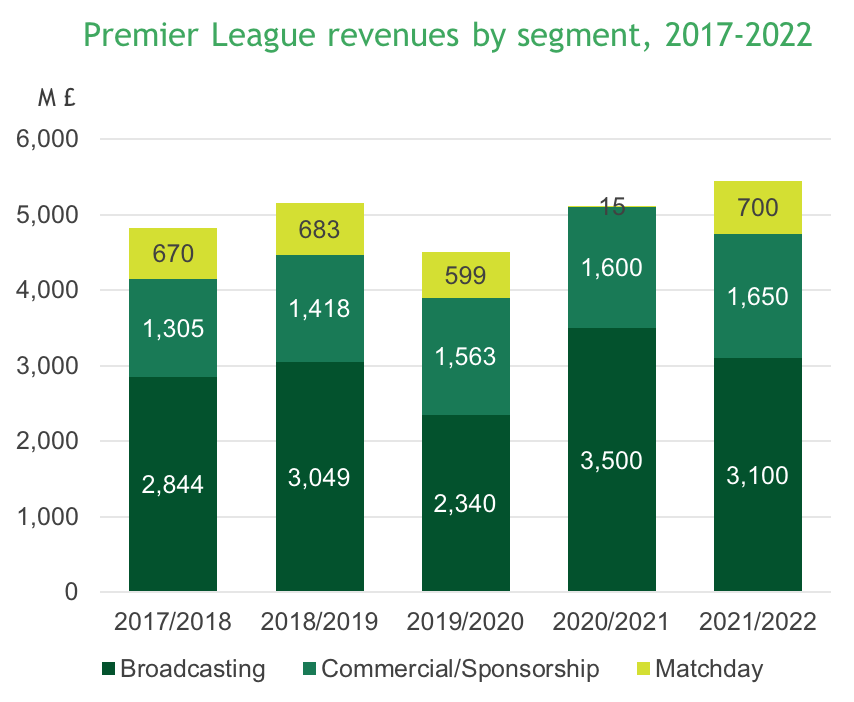
Question 1: Which segment grew fastest between 2017/18 and 2021/22, and by how much?
Divide each segment's 2021/22 revenue by its 2017/18 revenue, then subtract 100%:
- Broadcasting: 3,100 ÷ 2,844 = 1.090, so 9.0%
- Commercial and sponsorship: 1,650 ÷ 1,305 = 1.264, so 26.4%
- Matchday: 700 ÷ 670 = 1.045, so 4.5%
Commercial and sponsorship grew fastest, by about 26%.
Question 2: Which segment was hit hardest by COVID in 2019/20?
Compare 2019/20 with the year before, 2018/19:
- Broadcasting: 2,340 ÷ 3,049 = 0.767, so a 23% decline
- Commercial and sponsorship: 1,563 ÷ 1,418 = 1.102, so a 10% increase
- Matchday: 599 ÷ 683 = 0.877, so a 12% decline
Broadcasting fell the most, by about 23%. The trap here is matchday: it is the segment you would expect to suffer from empty stadiums, but its decline in this season was smaller.
Both questions use the same calculation. That is typical: once you know the three or four calculations the test repeats (growth rate, share of total, difference, simple sums), the section becomes a speed exercise.
The third question in this block asks for total revenue across all five seasons. Try it, and the other 57 numerical questions, in our Bain SOVA course →
Logical Reasoning: Pattern Types and Method
Each question shows a sequence of figures with one missing, usually the next one. You pick the figure that follows the rule. No words, no numbers: only shapes, lines and positions.
Most questions are built from a handful of rules, often two at once:
|
Rule |
What to look for |
|---|---|
|
Count |
One element (a line, a dot, a side) is added or removed at each step |
|
Movement |
An element moves one position at a time, clockwise or counterclockwise |
|
Cycle |
A feature (which part is shaded, which shape is in front) rotates through positions and starts again |
|
Opposite directions |
Two elements move at the same time, in different directions |
|
Symmetry |
Each figure is mirrored along the same axis |
Our method:
- Follow one element at a time. Track the circle through all the figures, then the cross, then the shading. Trying to see the whole figure at once is where time goes.
- Name the rule in words before you look at the options: "the circle moves one corner clockwise".
- Predict the answer, then eliminate. Rule out every option that breaks one of your rules. The one left is your answer; if two are left, you missed a rule.
Worked example from our course
This is the first logical reasoning question in Test 1 of our Bain SOVA course. Try it before you read the answer.

Which figure continues the sequence?
|
A |
B |
C |
D |
E |
F |
|---|---|---|---|---|---|
|
|
|
|
|
|
|


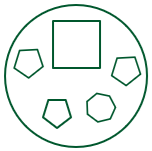



Answer: C. Two rules run at the same time:
- The big shape sets the count. The number of sides of the largest shape equals the number of small shapes around it. A square comes with four small shapes, a triangle with three, a pentagon with five.
- The total grows by two. Add up the sides of the small shapes: 14, 16, 18 and 20. The next figure needs 22.
Option C has a square with four small shapes (two hexagons and two pentagons: 6 + 6 + 5 + 5 = 22). It is the only option that satisfies both rules.
Notice that neither rule is visible at a glance. You only find them by following one element at a time: first the big shape, then the count, then the sides.
Personality Assessment
Expect about 40 screens, each with four statements about how you behave at work. You rate them on five columns from "Least Like Me" to "Most Like Me", and you can use each column only once per screen. In practice you are ranking the four statements and choosing which column to leave empty.
Bain says it is not looking for one type of person, but for a set of traits that help people do well at the firm. There are no right answers, but two habits make a difference:
- Be consistent. The same trait, such as teamwork, comes back many times in slightly different words. Answers that contradict each other make your profile look unreliable.
- Be yourself, at your best at work. Answer as you really behave, but keep the job in mind. Consulting rewards people who are comfortable persuading others, talk easily to people they do not know, recover quickly from setbacks, enjoy learning new things and can stay with detail. If a statement describes the opposite of these, it is usually one to place toward "Least Like Me", as long as that is true of you.
Do not try to reverse-engineer every screen. Answer at a steady pace: second-guessing each set is what makes answers inconsistent.
How to Prepare for the Bain SOVA Assessment
Start before you apply. Bain says that in some markets the link arrives within a week of your application, and you still have cases to practice. After the assessment, Bain's first round is usually two case interviews: see our Bain case interview guide.
- Learn the format first. Read this guide and SOVA's own Candidate Preparation Hub, which has a free practice test.
- Drill the numerical calculations. Growth rates, shares and differences from charts, with a calculator, until you do them without thinking. If your mental math is rusty, our free mental math practice helps with the estimates you use to sanity-check.
- Learn the logical patterns. Work through sequences until you recognize count, movement, cycle and symmetry rules on sight.
- Take full tests under real conditions. No clock, but time yourself afterward. Review every wrong answer and every slow one.
- Do the personality section last and calmly. It needs no practice beyond knowing the format.
On test day
- Use a computer. The test runs on a phone, but charts and shapes are easier to read on a larger screen.
- Have a calculator, pen and paper ready before you open the numerical section.
- Pick a quiet time and take each reasoning section in one sitting.
Practice with Prepmatter
Our Bain SOVA assessment course has four full practice tests, each with numerical and logical reasoning sets in the SOVA format, and a sample personality section. Every question comes with a written explanation. Verbal reasoning sets from the earlier version of the test are included as bonus practice.
If you also have case interviews coming, our Get the Offer course adds chart and numerical drills built on case interview exhibits.
Frequently Asked Questions
Is there verbal reasoning in the Bain SOVA test?
Not in the version candidates received in 2026. Older versions had a verbal section with true, false or cannot-say statements. Check the homepage of your own invitation, which lists the sections you will take.
How long is the Bain SOVA assessment?
About 40 minutes, according to the test's own instructions. There is no timer, so it can take longer, but your response time counts toward your result.
Can I use a calculator in the Bain SOVA test?
Yes, in the numerical reasoning section. Calculators are not allowed in the case interviews that follow, so practice your interview math by hand.
Can I take the Bain SOVA test in several sittings?
Yes. You can complete the sections in any order and across sittings, as long as you finish before the deadline in your invitation.
Can I go back and change an answer?
No. Once you answer a reasoning question and click Next, it is locked.
Is the Bain SOVA test the same as TestGorilla?
No. They are two different tests, and Bain's email tells you which one you have. See our Bain TestGorilla guide if yours says TestGorilla.
When will I hear back after the Bain SOVA test?
Bain says applicants can expect to hear back within 60 days, though timelines depend on the role and office.
Does the SOVA score alone decide whether I get an interview?
No. Bain says the assessment is one part of its review, alongside the rest of your application. A strong score will not rescue a weak resume, but a weak one can stop a strong application.
How do I pass the Bain SOVA test?
Be accurate first and steady second: there is no visible clock, but slow answers cost you. Drill the handful of calculations the numerical section repeats, learn the common shape patterns, and take full practice tests before your invitation arrives.
Sign up for our newsletter
Join a community of aspiring consultants and elevate your preparation journey with Prepmatter.