Bain TestGorilla Assessment 2026: Both Versions, All Six Sections, and Practice Questions
If you've applied to Bain in the Americas or Asia-Pacific, there's a good chance your next step is the TestGorilla assessment. It's a timed online test that sits between the resume screen and your first-round interviews, and Bain currently uses two different versions of it.
In this guide, I'll show you how to work out which version you're likely to get before you start, walk you through every section of both versions, and solve a practice question for each of the 24 question types you might see. None of the practice questions below are real Bain or TestGorilla questions.
What is the Bain TestGorilla assessment?
TestGorilla is the platform Bain uses to run its online screening test, which Bain itself calls the digital assessment. You'll also see people call it the Bain Gorilla test or simply the Bain online assessment. They all mean the same thing.
The test is multiple-choice, and every section has its own timer. Once you move past a question, you can't go back to it. Bain says the assessment takes roughly 30 to 40 minutes, which matches both versions below. If you see 45 or 50 minutes quoted on other prep sites, that usually refers to an older setup.
Where does the TestGorilla sit in Bain's hiring process?
After you submit your resume and cover letter, Bain will usually send you the assessment within about a week. If you pass, you move on to first-round interviews, which at most offices means two case interviews.
Bain works with two test providers, TestGorilla and SOVA. Broadly speaking, applicants to roles in the Americas or Asia-Pacific tend to receive TestGorilla, while applicants in the UK, Europe and the Middle East are more likely to get SOVA. Your invitation email will tell you which one you have. The two tests are quite different, so if yours turns out to be SOVA, have a look at our Bain SOVA practice tests instead.
Keep in mind that the test result isn't the only thing Bain looks at. It's read alongside your resume, cover letter and academic record, and we've seen candidates who had to guess the last few questions of a section still get invited to interviews.
What are the two versions of the Bain TestGorilla assessment?
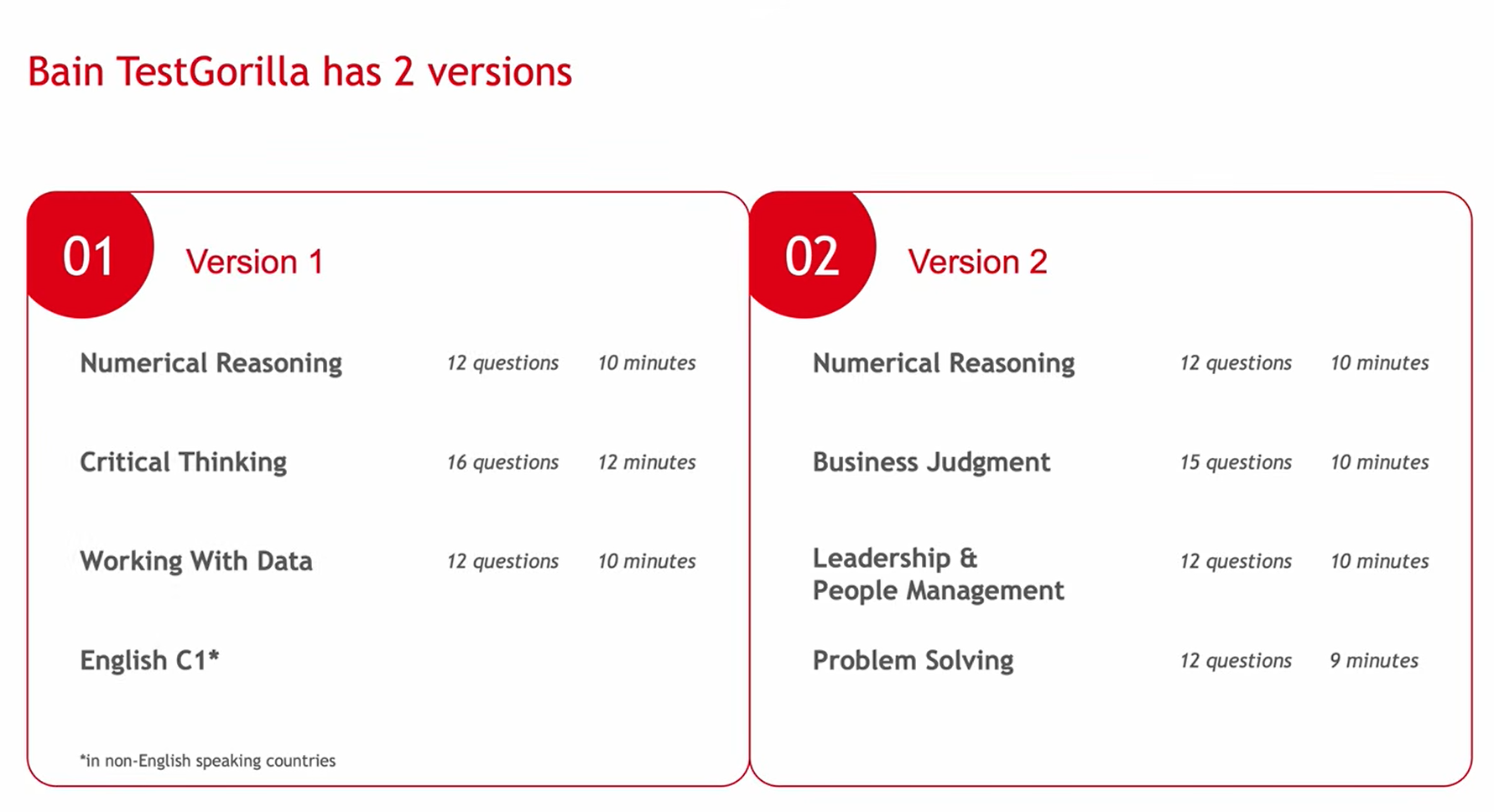
Based on what our students have reported since the start of 2026, Bain is using two versions of the test. Your invitation won't tell you which one you're getting, but there's a way to make a pretty good guess (more on that below).
| Section | Version 1 | Version 2 |
|---|---|---|
| Numerical Reasoning | 12 questions, 10 min | 12 questions, 10 min |
| Critical Thinking | 16 questions, 12 min | |
| Working With Data | 12 questions, 10 min | |
| Business Judgment | 15 questions, 10 min | |
| Leadership and People Management | 12 questions, 10 min | |
| Problem Solving | 12 questions, 9 min | |
| Total | 40 questions, 32 min | 51 questions, 39 min |
Numerical Reasoning is the only section that appears in both versions. So far, students applying to Amsterdam and Paris have reported Version 1, and students applying to US offices have reported Version 2. That's a pattern we've noticed rather than a rule, so don't rely on it.
How do you know which version you'll get?
This is the most useful tip in this guide. After Bain sends your invitation, you should also get a separate email from TestGorilla confirming how long the assessment will take. Look at that one, not Bain's email. We've seen several cases where the timing in Bain's email was out of date.
Based on the invitations our students have shared with us:
- 39 minutes usually means Version 2
- 44 minutes usually means Version 1 with the English C1 section
- 32 minutes usually means Version 1 without it
This isn't a 100% guarantee, and TestGorilla could change it at any time. You'll also see the list of sections on the opening screen, so double-check there before you start.
What does the English C1 Advanced section add?
In some non-English-speaking countries, Bain adds an English C1 Advanced section to Version 1. It has 16 questions in 12 minutes and tests reading comprehension and language use at the C1 level, which is the second-highest level on the European language framework. That's what takes Version 1 from 32 to 44 minutes. We haven't seen it at offices in English-speaking countries.
What does the Bain TestGorilla assessment test?
Across both versions, the test covers six areas: numerical reasoning, critical thinking, working with data, business judgment, leadership and people management, and problem solving. You don't need any consulting knowledge for any of them. What you do need is speed, because you'll have somewhere between 40 and 50 seconds per question depending on the section.
Below, I'll go through each section, explain the question types you can expect, and solve one example of each, so 24 worked examples in total. Bear in mind that TestGorilla is used by lots of employers and the format changes from company to company. Everything here is specific to Bain.
What is on the Numerical Reasoning section?
Numerical Reasoning is the first section in both versions. You'll have 10 minutes for 12 questions, which works out at 50 seconds per question. The good news is that you're allowed to use a calculator, which speeds things up a lot.
The questions broadly fall into three types: short numerical questions, numerical pattern questions and data interpretation.
Question type 1: short numerical question
A real estate agency pays its brokers a tiered commission:
- 3.5% on the first $200,000 of the sale price
- 2.5% on the part between $200,001 and $500,000
- 1.5% on anything above $500,000
A broker sells a property for $680,000. What is the total commission earned?
- A. $10,200
- B. $17,000
- C. $17,200
- D. $23,800
Answer: C, $17,200.
The trick is to work through it tier by tier rather than applying one rate to the whole price. The first $200,000 at 3.5% gives you $7,000. The next $300,000 at 2.5% gives you $7,500. That leaves $180,000 at 1.5%, which is $2,700. Add the three together and you get $17,200.
Question type 2: numerical pattern
A grid of numbers follows a consistent pattern across its rows and columns. The first three rows are:
| Row | Column 1 | Column 2 | Column 3 |
|---|---|---|---|
| 1 | 3 | 5 | 15 |
| 2 | 4 | 8 | 32 |
| 3 | 5 | 11 | 55 |
If the pattern continues, what are the three numbers in the 6th row?
- A. 7, 17, 119
- B. 8, 17, 136
- C. 8, 20, 160
- D. 9, 23, 207
Answer: C, 8, 20 and 160.
Start with the first column. It goes up by 1 each row, so three rows after 5 we get 8. The second column goes up by 3 each row, so three rows after 11 we add 9 and get 20. In the real test, these two numbers would often be enough to pick the right option, so you could move on here and save time.
The third column is a bit trickier, but if you look closely, it's the first column multiplied by the second: 3 × 5 = 15, 4 × 8 = 32, and 5 × 11 = 55. So in row 6, it's 8 × 20 = 160.
Notice how the wrong options are built. A is the 5th row, so it catches anyone who miscounts by one. D is the 7th row, for people who overshoot. And B gets the first column right but slips on the second. That's typical of this test, so it's worth counting the rows carefully.
Question type 3: data interpretation
The stacked bar chart below shows the 2025 budget of four departments at a technology company, in thousands of dollars, split into salaries, software and travel.
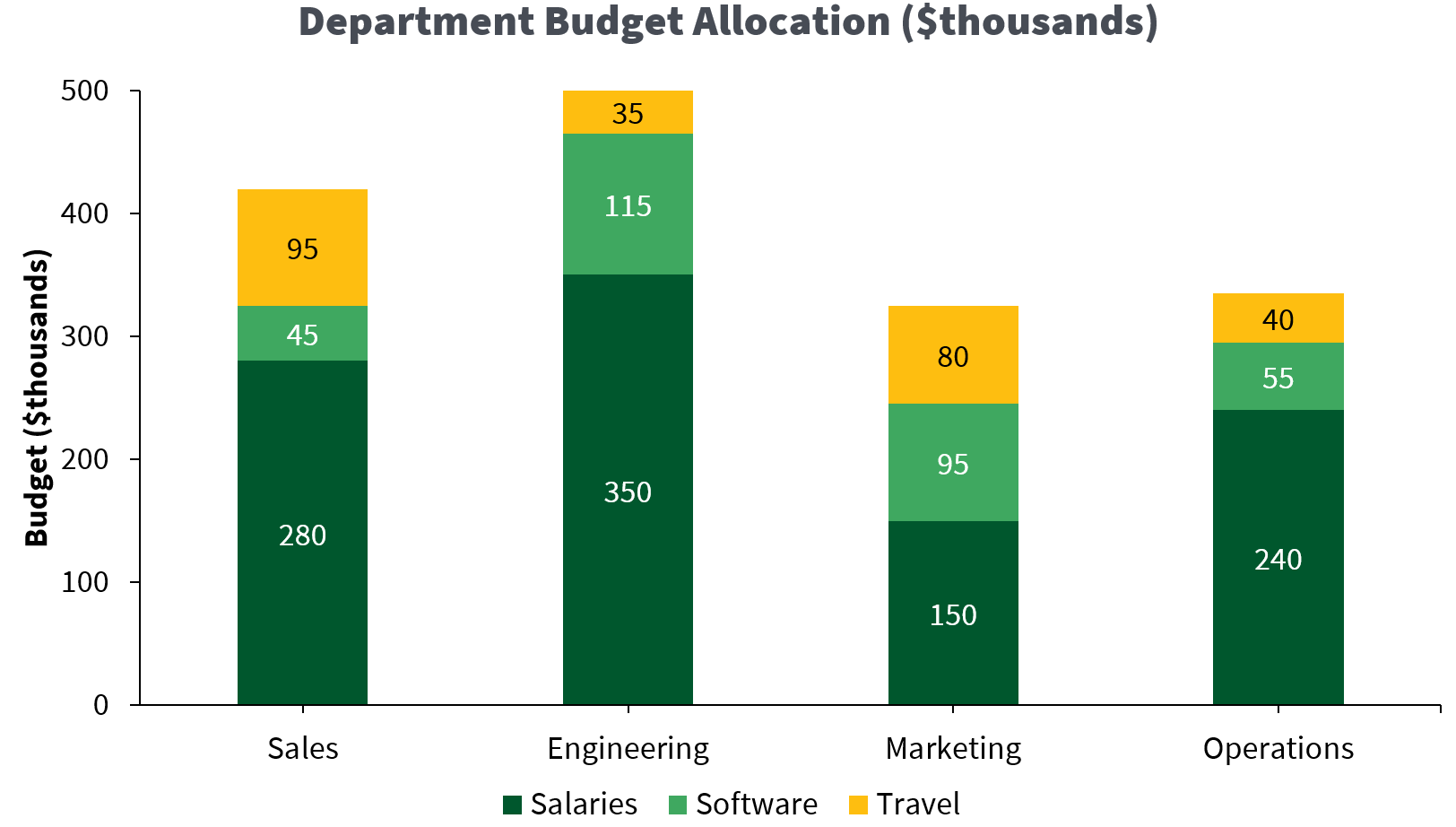
Which department spends the largest share of its total budget on software?
- A. Engineering
- B. Sales
- C. Marketing
- D. Operations
Answer: C, Marketing, at 29.2%.
We just need each department's total, then the software figure as a share of it:
- Sales: 45 out of 420, or 10.7%
- Engineering: 115 out of 500, or 23%
- Marketing: 95 out of 325, or 29.2%
- Operations: 55 out of 335, or 16.4%
Notice that Engineering spends the most on software in dollar terms, but Marketing spends the biggest share. That's exactly the kind of trap these questions set, so always check whether you're being asked about an amount or a proportion.
In our course, you can practice six full sets of Numerical Reasoning questions, so 72 questions in total, each with a detailed explanation.
What is on the Critical Thinking section?
Critical Thinking only appears in Version 1. You'll answer 16 questions in 12 minutes, so roughly 45 seconds per question. There are four question types.
- Deductive reasoning. You're given a set of premises to treat as true, and you pick the conclusion that logically follows.
- Relationship between statements. You judge how a second statement relates to the first: whether it conflicts with it, strengthens it, restates it or has no bearing on it.
- Assumptions. You read a short argument and find the assumption it depends on.
- Rule application. You're given a rule and a scenario, and you judge whether the rule was followed and whether the outcome was expected.
Across all four, the most important habit is to use only the information in front of you. Your real-world knowledge, however reasonable, will often lead you to the wrong answer here.
Question type 1: deductive reasoning
Treat the following two premises as facts.
- Premise 1: All employees who completed the compliance training received a certificate.
- Premise 2: All team supervisors completed the compliance training.
Which conclusion logically follows?
- A. No employees who received a certificate are team supervisors.
- B. All team supervisors received a certificate.
- C. All employees who received a certificate are team supervisors.
- D. No team supervisors completed the compliance training.
Answer: B.
Let's connect the two premises. All team supervisors completed the training, and everyone who completed the training received a certificate. So all team supervisors must have received a certificate.
Option C might look tempting, but it reverses the logic. Premise 1 tells us that people who completed the training got a certificate. It doesn't tell us that everyone with a certificate is a supervisor. Reversing a premise like this is one of the most common traps in this section. A and D simply contradict what we can infer.
Question type 2: relationship between statements
Read both statements. Which option best describes how the second statement relates to the first?
- Statement 1: Offering employees regular cybersecurity training reduces the risk of phishing-related security incidents.
- Statement 2: The company ran training programs to teach staff about AI and how AI agents can increase their productivity.
- A. It conflicts with the first statement.
- B. It strengthens the first statement.
- C. It restates the first statement in different words.
- D. It has no bearing on the first statement.
Answer: D, Statement 2 has no bearing on Statement 1.
Both statements are about employee training, and that's exactly what makes this question tricky. But Statement 1 is specifically about cybersecurity and phishing, while Statement 2 is about AI and productivity. Statement 2 tells us nothing about security, so it can't support or contradict Statement 1, and it's clearly not saying the same thing in different words.
Question type 3: assumptions
Read the passage and identify the assumption the argument depends on.
A restaurant chain found that locations allowing customers to join a digital waitlist in advance received fewer complaints about wait times. Therefore, introducing a digital waitlist system at all locations will likely improve customer satisfaction.
- A. Locations with digital waitlists often serve more guests during busy evening hours.
- B. Restaurants in the chain can support the added demands of waitlist software.
- C. Customers who complain less about wait times are usually more satisfied overall.
- D. Customers generally find digital waitlists easier to use than phone reservations.
Answer: C.
Look at the gap between the evidence and the conclusion. The evidence is about complaints about wait times, but the conclusion is about overall customer satisfaction. For the argument to work, fewer complaints have to mean happier customers, and that's exactly what C says. The other options might be relevant to digital waitlists in general, but the argument doesn't depend on any of them being true.
Question type 4: rule application
Rule: To be promoted to Senior Manager, an employee must have completed at least 3 full years in their current role and received an "Exceeds Expectations" rating in their most recent review. If both conditions are met, the promotion may be approved. If not, the promotion will be denied.
What happened: An employee with 2 years in the role and an "Exceeds Expectations" rating was promoted to Senior Manager.
Was the rule followed in this case, and is the outcome what the rule would lead you to expect?
- A. The rule was followed, and the outcome is what the rule predicts.
- B. The rule was not followed, but the outcome is what the rule predicts.
- C. The rule was followed, but the outcome is not what the rule predicts.
- D. The rule was not followed, and the outcome is not what the rule predicts.
Answer: D.
I'd break this into two separate questions. First, was the rule followed? No. The employee had the rating but only 2 of the 3 required years, so the rule was not followed. Second, is the outcome what the rule predicts? Also no. The rule says the promotion should have been denied, but it was approved. So the rule was not followed, and the outcome is not what the rule predicts.
What is on the Working With Data section?
Working With Data is the last section of Version 1. You'll have 10 minutes for 12 questions, so about 50 seconds each. The questions fall into four types.
- Data types and preparation. Cleaning or formatting a dataset, dealing with missing values, or getting data ready for analysis.
- Descriptive statistics. Averages, medians, ranges, percentages and rates.
- Data and chart interpretation. Working out what you can and can't conclude from a table, chart or graph.
- Data visualization. Choosing the right chart for a dataset, or the right variables to put in it.
Question type 1: data types and preparation
A logistics company's shipment table has four columns: Shipment ID (for example, 48213), destination ZIP code, weight in pounds, and priority (Standard, Express or Overnight). A colleague's summary reports an average Shipment ID and an average ZIP code alongside the average weight. What is the best correction?
- A. Keep all three averages, because all three columns contain numbers.
- B. Treat Shipment ID and ZIP code as text labels, and report an average for weight only.
- C. Recode priority as 1, 2 and 3 so that all four columns can be averaged.
- D. Delete the ZIP code column, because it cannot be used in the analysis.
Answer: B.
Shipment IDs and ZIP codes are labels that happen to be written with digits, so averaging them produces a number with no meaning. Storing them as text also protects ZIP codes that begin with zero, which lose that digit when stored as numbers. Option C is tempting because it looks tidy, but numbering a category does not turn it into a quantity. ZIP codes remain useful for grouping shipments by area, so deleting them (D) throws away information.
Question type 2: descriptive statistics
A logistics coordinator receives the following shipment weights, in kilograms, for identical components from the same supplier this week: 12, 15, 14, 13, 45, 16 and 14. She wants to use the median to report the typical shipment weight.
Why is the median more appropriate than the mean here?
- A. The median is easier to calculate than the mean.
- B. The median is less affected by the extreme value of 45 kilograms, making it a more representative measure of the typical shipment weight.
- C. The mean cannot be calculated when there is an outlier in the dataset.
- D. The median will always give a lower value than the mean.
Answer: B.
Most of the shipments weigh between 12 and 16 kilograms, so 45 clearly stands out. If you took the mean, that one value would pull the average up and make it less representative of a normal shipment. The median is just the middle value, so it barely moves. C is wrong because you can still calculate a mean with an outlier. It just isn't the best measure in this case.
Question type 3: data and chart interpretation
You're a finance analyst looking at the chart below, which shows quarterly profit margins for two business units over four quarters.
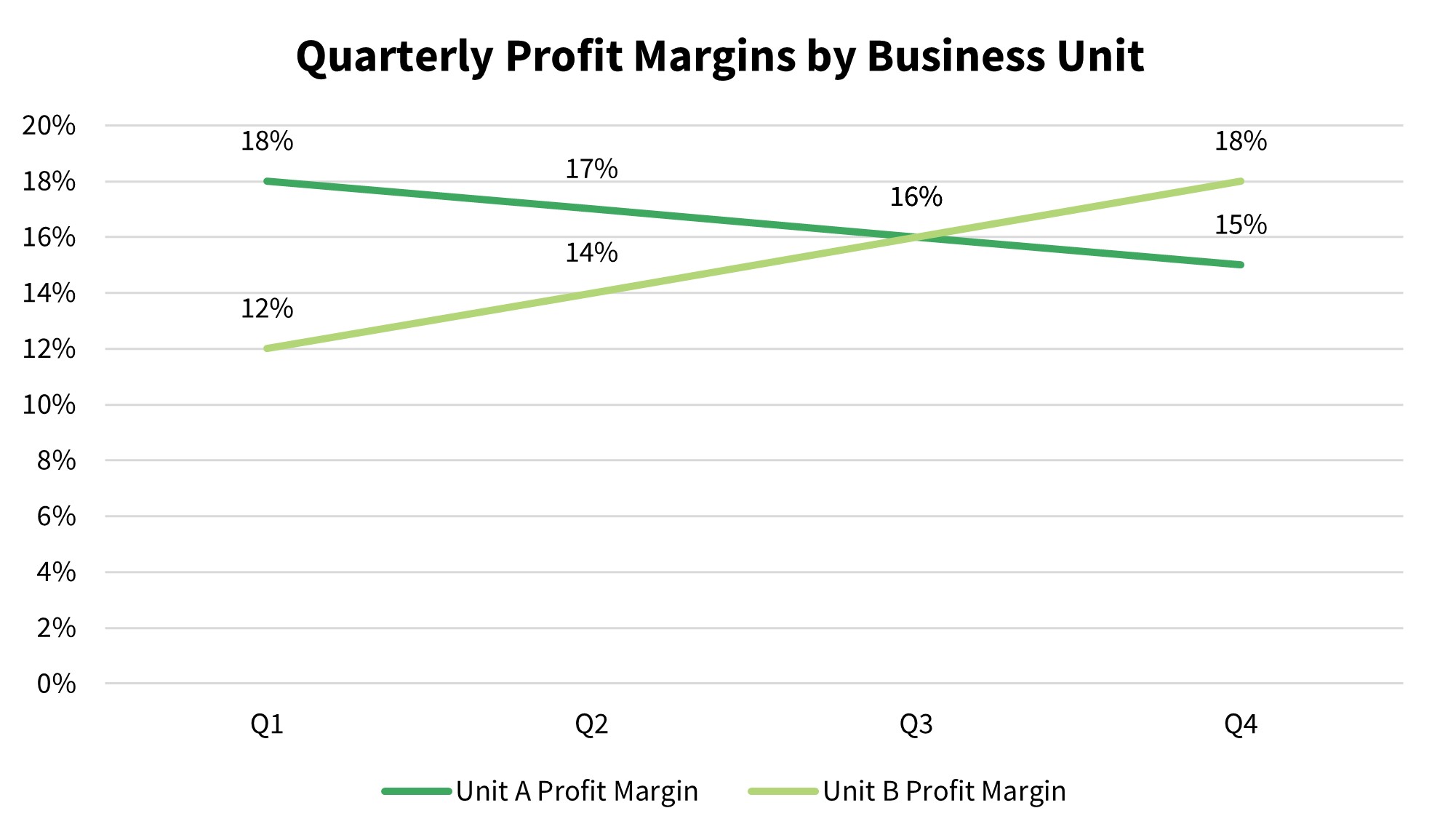
Which of the following statements can be concluded from the chart? Select all that apply.
- A. Unit A's profit margin declined every quarter.
- B. Unit B's profit margin grew every quarter.
- C. Unit B will have a higher margin than Unit A in the next quarter.
- D. Unit A had a higher margin than Unit B in Q1.
- E. By Q3, both units had equal profit margins.
Answer: A, B, D and E.
A, B, D and E can all be read straight off the chart. Unit A falls from 18% to 15%, Unit B rises from 12% to 18%, A leads 18% to 12% in Q1, and both sit at 16% in Q3. C is the one to avoid. Unit B is trending upward, but the chart doesn't show next quarter, and you can't assume a trend will continue. The rule for these questions is simple: only select what the data directly supports.
Question type 4: data visualization
A strategy analyst is preparing a presentation for senior leadership and wants to show clearly how revenue and profit compare across four regions, using the data below.
| Region | Revenue ($000) | Profit ($000) |
|---|---|---|
| North | 200 | 50 |
| South | 300 | 75 |
| West | 400 | 100 |
| East | 250 | 60 |
Which is the most suitable way to display the data?
- A. A pie chart showing each region's share of total revenue.
- B. A bar chart comparing profit across regions.
- C. A line chart showing revenue trends over time.
- D. A scatter plot comparing revenue and profit for each region.
Answer: D.
Start with what you're trying to show. We want to compare two numbers, revenue and profit, for each region. The pie chart only shows revenue, and the bar chart only shows profit, so each one leaves out half of the story. A line chart doesn't fit either, because we're comparing regions, not tracking change over time. A scatter plot puts revenue against profit for each region, which is exactly the comparison leadership wants to see.
What is on the Business Judgment section?
Now we're into Version 2. Numerical Reasoning comes first here too, and we've already covered it, so let's go straight to Business Judgment.
In my opinion, this is the hardest part of the whole assessment. You get 15 questions in 10 minutes, which is only 40 seconds per question, the tightest pace of any section. And even with around 12 years of work experience, I found some of these questions genuinely challenging.
Each question gives you a short business scenario and two answers. The problem is that both answers usually sound reasonable, so you have to pick the stronger one quickly. The scenarios fall into five types.
- Strategic decisions. Where a company should compete, how it should grow, or whether an acquisition makes sense.
- Commercial and customer decisions. Pricing, customer behavior, product positioning and routes to market.
- Operational and cost decisions. Improving efficiency, cutting costs or managing a supply chain. The key is often telling a structural fix apart from a short-term saving.
- Investment and prioritization decisions. Which project to fund, which to stop, or what you need to know before committing resources.
- Organizational and people decisions. Structure, incentives, management practices, accountability and culture.
Question type 1: strategic decisions
As the general manager of a premium coffee chain, you're evaluating entry into a new country. Demand for premium coffee is growing, but most customers regularly visit local cafés and rarely try unfamiliar brands. What should most influence the entry decision?
- A. Whether premium coffee demand will continue growing in the new market.
- B. Whether its brand can persuade customers to switch from local cafés.
Answer: B.
Both answers sound sensible, which is typical for this section. Growing demand does make the market attractive, but it doesn't mean customers will choose a new chain. The scenario tells us customers are loyal to their local cafés, so the real question is whether this brand is strong enough to win them over.
Question type 2: commercial and customer decisions
A software company charges a flat monthly fee per user. A competitor enters the market with usage-based pricing, so customers only pay for what they actually use. The CEO argues there's no need to respond because their product is better. Is the CEO right to be unconcerned?
- A. Yes, product superiority is the primary driver of enterprise software retention, and pricing model differences rarely cause churn among satisfied customers.
- B. No, even satisfied customers will switch if a competing pricing model structurally aligns better with how they actually consume the product.
Answer: B.
This one takes a bit of business judgment, so here's how I'd think about it. Large companies often buy user licenses for many employees who don't use the software regularly. Under per-user pricing, they end up paying for access they don't need, so a usage-based model can be much better value for them. Product quality and pricing fit are two separate things. A customer can love your product and still leave for a pricing structure that suits them better.
Question type 3: operational and cost decisions
You're the procurement director of a packaged food company that buys similar ingredients from 40 small regional suppliers. Some offer low prices, but inconsistent quality has caused production delays and waste. Which initiative is likely to create the most value?
- A. Consolidating volume with fewer suppliers to improve purchasing leverage and consistency.
- B. Running more frequent negotiations with all suppliers to capture price differences by region.
Answer: A.
Negotiating more often might squeeze out a bit more on price, but it does nothing about the quality problem that's causing the delays and waste. Moving your volume to fewer, more capable suppliers gives you better leverage, more consistent quality and a simpler supplier base to manage. It's a good example of the structural fix beating the short-term saving.
Question type 4: investment and prioritization decisions
You're managing innovation at a software company. Three projects have been approved: a major upgrade fixing reliability issues raised by several large customers, an AI analytics tool with promising early demos, and an expansion into a new vertical with a large addressable market but no customers yet. The budget only covers two. Which approach is most appropriate?
- A. Prioritize the AI analytics tool and the new vertical, because they offer the highest potential incremental revenue.
- B. Prioritize the reliability upgrade, then choose between the two growth projects based on evidence of customer demand and commercial viability.
Answer: B.
The reliability upgrade fixes a problem your biggest customers have already raised, so it protects revenue you already have. Skipping it to fund two speculative bets would put that revenue at risk. The second slot should then go to whichever growth project has stronger evidence of demand and a clearer path to making money.
Question type 5: organizational and people decisions
A regional grocery chain with 12 stores lets each store manager negotiate separately with produce suppliers. Stores pay prices that differ by up to 20% for identical items, although customer preferences are nearly the same across locations. Where should purchasing decisions sit?
- A. With a central purchasing team that negotiates for all 12 stores.
- B. With each store manager, as today.
Answer: A.
When units buy the same items for similar customers, combining their volume gives the company more bargaining power and consistent prices. Local control earns its cost only when local needs differ in ways headquarters cannot see, which is not the case here. The 20% price gap is the evidence that store-level negotiation is costing the chain money.
If this section worries you, our course has six full Business Judgment tests, so 90 questions in total. And if you want to build your business sense more broadly, the case studies and drills in Get the Offer, our case interview course, are designed for exactly that.
What is on the Leadership and People Management section?
This section puts you in a manager's shoes. Each question describes a workplace situation, usually involving an employee, a team or a wider organizational issue, and asks you to pick the best of four responses. You'll get 12 questions in 10 minutes, so about 50 seconds each. There are five question types.
- Performance management and feedback. Missed targets, mistakes, poor-quality work or problem behavior.
- Coaching, development and motivation. Helping someone improve, take on more responsibility or embrace a new opportunity.
- Delegation and team execution. Assigning work and setting expectations without micromanaging or leaving people unsupported.
- Conflict, conduct and accountability. Disagreements between colleagues, inappropriate behavior and policy breaches.
- Communication, influence and change leadership. Persuading people, introducing change and getting a team on board.
Across all five, the best answer usually does two things at once: it supports the people involved and still delivers the business outcome. The ideal manager here is neither passive nor punitive. They listen and work out what's really going on, but they also set clear ownership, expectations and next steps. If an answer sounds extreme in either direction, it's probably wrong.
Question type 1: performance management and feedback
A newly promoted team lead delivers strong results but postpones difficult feedback until formal performance reviews. Several employees have been surprised to hear about concerns that weren't raised when the problems first came up. Which behavior should the manager help the team lead develop?
- A. Collect more evidence before discussing performance concerns.
- B. Delegate difficult conversations to an experienced manager.
- C. Give employees more frequent written performance ratings.
- D. Give timely, specific feedback when concerns arise.
Answer: D.
Timely, specific feedback gives people a fair chance to fix things before their formal review. A would delay the feedback even further. B takes away the very skill the team lead needs to build. C replaces a conversation with a score, which doesn't solve the problem.
Question type 2: coaching, development and motivation
Your company has introduced a new tool to make work faster and more consistent. Several employees are still using the old process because they find the tool difficult, and the transition deadline is getting close. How should the manager support the employees who are struggling?
- A. Reinforce the deadline and remind them the new process is mandatory.
- B. Ask experienced users to complete difficult tasks for them temporarily.
- C. Discuss their difficulties individually and provide targeted coaching or practice.
- D. Allow them additional time to adopt the tool at their own pace.
Answer: C.
These employees need help building confidence with the tool, and talking to each of them is the only way to find out where they're stuck. A doesn't help, because they already know about the deadline. B means someone else does the hard part, so they never actually learn. And D isn't realistic, since the deadline is fixed.
Question type 3: delegation and team execution
You've delegated a proposal to a capable employee who has done similar work before. They keep asking for detailed guidance on every section because they want to make sure it meets your expectations. You want a strong result, but you'd also like them to take more ownership. Which level of direction is most appropriate?
- A. Provide detailed instructions for every section of the proposal.
- B. Clarify the objectives and boundaries, then ask for their proposed approach.
- C. Ask for a complete first draft before providing any guidance.
- D. Tell them to complete the proposal independently using their judgment.
Answer: B.
This employee has done similar work, so they don't need step-by-step instructions. But they still need to know what good looks like. B gets that balance right. A is too much hand-holding and would make them even more dependent on you. C gives them too little to work with upfront, and D goes too far the other way and leaves them completely on their own.
Question type 4: conflict, conduct and accountability
Two senior analysts on your team jointly own a monthly client report. It has gone out late three months in a row. In separate conversations, each says the other caused the delay, and you have no evidence favoring either account. What is the most effective next step?
- A. Warn both analysts that another late report will lower their performance ratings.
- B. Name one analyst as the owner of the deadline, and agree what the other must hand over and by when.
- C. Reassign one analyst to a different project so the two no longer work together.
- D. Decide which account is more believable and reprimand that analyst.
Answer: B.
The repeated delay points to a gap in accountability: when two people own a deadline, neither fully does. Naming one owner and fixing the handover closes that gap and makes any future delay easy to trace. A warning (A) raises the pressure without changing the setup that produces the delay. Separating the analysts (C) avoids the problem and costs the team a working pair. Reprimanding one person (D) assigns blame without evidence and damages trust with both.
Question type 5: communication, influence and change leadership
Your team has been asked to support a company initiative outside its usual responsibilities. Team members don't understand why it matters and worry it will distract them from their existing work. What's the most effective way to engage the team?
- A. Explain the initiative's purpose and clarify how existing priorities will change.
- B. Assign the most available employees while protecting the team's existing commitments.
- C. Share leadership's request and let the team decide how to contribute.
- D. Wait for a detailed implementation plan before reallocating the team's work.
Answer: A.
The team has two worries: they don't see why the initiative matters, and they're concerned about their workload. A is the only option that deals with both. B handles capacity but not the "why". C hands the team a decision that leadership should be making, and D just puts the problem off.
What is on the Problem Solving section?
Problem Solving is the last section of Version 2. You have 9 minutes for 12 questions, so about 45 seconds each, which makes time management really important here. The math itself isn't advanced. The challenge is picking out the relevant information and working through it quickly. There are three question types.
- Logical problem solving. You're given rules or constraints and work out what's possible or what must be true.
- Quantitative problem solving. Basic math applied to practical problems with quantities, rates, time or distance.
- Data-based problem solving. Reading a table or other structured information and using it to reach the right conclusion.
Question type 1: logical problem solving
A site reliability engineer needs to find the single corrupted database fragment (A, B, C, D or E) that's crashing a server. They run three diagnostic scripts:
- Script 1 scans fragments A, B and C. Result: crash.
- Script 2 scans fragments C, D and E. Result: stable.
- Script 3 scans fragments A and D. Result: stable.
Assuming exactly one fragment is corrupted, which one is it: A, B, C or E?
Answer: B.
Script 1 crashes, so the corrupted fragment must be A, B or C. Script 2 is stable, which clears C, D and E, so we're down to A or B. Script 3 is also stable, which clears A. That leaves only B.
Question type 2: quantitative problem solving
A bakery sends two delivery vans to a regional food festival along the same route. The regular van leaves at 8:00 a.m. and travels at a constant 45 km/h. The express van leaves at 9:00 a.m. and travels at a constant 60 km/h. At what time does the express van catch up?
- A. 11:00 a.m.
- B. 11:30 a.m.
- C. 12:00 p.m.
- D. 1:00 p.m.
Answer: C, 12:00 p.m.
The regular van has a one-hour head start, so by 9:00 a.m. it's already 45 km ahead. From then on, the express van closes the gap by 15 km every hour, since it's going 15 km/h faster. Closing a 45 km gap at 15 km/h takes 3 hours, so the express van catches up at 12:00 p.m.
Question type 3: data-based problem solving
A procurement team is choosing a software vendor with a weighted scoring matrix. Each vendor gets a raw score from 1 to 5 in three categories. The final score is each raw score multiplied by its weight, added together. There's also a knockout rule: any vendor with a raw score of 1 in any category is disqualified, whatever its total.
| Vendor | Usability (weight: 2) | Security (weight: 3) | Cost (weight: 1) |
|---|---|---|---|
| Alpha | 4 | 3 | 5 |
| Beta | 3 | 5 | 2 |
| Gamma | 2 | 4 | 5 |
| Delta | 5 | 5 | 1 |
Based strictly on the rules and the matrix, which vendor wins the contract: Alpha, Beta, Gamma or Delta?
Answer: B, Beta.
The first thing I'd check is the knockout rule, because it saves you a calculation. Delta has a 1 on cost, so it's out straight away. Then we weight the other three:
- Alpha: 4 × 2 + 3 × 3 + 5 × 1 = 22
- Beta: 3 × 2 + 5 × 3 + 2 × 1 = 23
- Gamma: 2 × 2 + 4 × 3 + 5 × 1 = 21
Beta has the highest score, so it wins the contract.
Each wrong option is designed to catch a specific mistake. If you add up the raw scores and ignore the weights, Alpha looks strongest. If you do the weighting perfectly but forget the knockout rule, Delta comes out on top with 26. That's exactly why I check the rules before doing any math.
How is the Bain TestGorilla assessment scored?
Bain doesn't publish a pass mark, a pass rate or how the sections are weighted. Individual results aren't shared with candidates either, so any cutoff you see quoted online is someone's estimate.
What we do know is that TestGorilla doesn't penalize wrong answers. So if you're running out of time, it's always better to guess than to leave a question blank.
How does the Bain TestGorilla compare to the Bain SOVA?
They're two different tests from two different providers, and your invitation will tell you which one you're taking. SOVA covers numerical reasoning, logical reasoning and a personality questionnaire. Our Bain SOVA guide walks through each section. TestGorilla covers the six sections above and has no personality component.
If you come across prep material for Bain that mentions verbal reasoning, a situational judgment test or a personality questionnaire, it's describing SOVA. Numerical reasoning is the only thing the two tests really have in common.
How should you prepare for the Bain TestGorilla assessment?
The content itself is undergraduate-level, so most people who struggle do so because of the clock, not the questions. That's why I'd focus your preparation on timed practice.
- Prepare for both versions until the TestGorilla email arrives. Once it tells you the duration, you can shift most of your time to the version it points to. Keep Numerical Reasoning in your plan either way.
- Practice each section against its real timer. That's about 50 seconds per question for Numerical Reasoning, Working With Data and Leadership, 45 for Critical Thinking and Problem Solving, and only 40 for Business Judgment.
- Read the question before the chart or passage. It tells you which numbers or sentences actually matter.
- Don't get stuck. Spending two minutes on one hard question costs you the next two, and you can't come back to it anyway.
- In the judgment sections, pick the balanced answer. The best option usually tackles the problem directly, uses only the information given and balances the people with the outcome.
Our Bain TestGorilla practice tests run every section against its real timer for exactly this reason.
What should you do on test day?
Bain allows a pen, paper and a calculator for the TestGorilla assessment, so have all three on your desk before you start. Just remember that the calculator is only allowed for the online test, not in your interviews later on.
Use a laptop or desktop with a stable connection. Bain recommends Google Chrome, and says other browsers work but aren't as reliable. Bain also asks you to complete the test in one sitting, although you can take a short pause between sections. Your invitation will list any camera requirements and your deadline. I'd take the test a few days before the deadline, so a technical problem doesn't cost you your attempt.
What are the most common mistakes on the Bain TestGorilla?
From what our students tell us, most people who don't pass lose out on pacing or overthink the judgment questions. It's rarely the math.
- Only practicing untimed questions, then running out of time on the day.
- Reading the whole chart or passage before looking at the question.
- Picking extreme answers in Leadership and People Management. Balanced, direct answers tend to score better.
- Bringing outside knowledge into Critical Thinking, when the premises are all you should use.
- Preparing for Version 2 only. We've had European candidates who prepared for Business Judgment and Leadership, then opened the test to find Critical Thinking and Working With Data.
- Trusting the duration in Bain's email instead of the one in the TestGorilla email.
What happens after you complete the Bain TestGorilla?
Bain reviews your result together with the rest of your application. Officially, Bain says you can expect to hear back within 60 days, though it depends on the role and office. In practice, our students usually hear back within one to two weeks, and some offices ask for transcripts a few days after the test before deciding.
If you pass, you'll move on to case interviews. Our case interview coaching with former BCG consultants is designed to prepare you for Bain's first round.
Practice both versions of the Bain TestGorilla assessment with Prepmatter
Our Bain TestGorilla course covers all six sections across both versions, with 36 timed practice tests and 474 questions. Each section has six full tests:
- Numerical Reasoning: 72 questions
- Critical Thinking: 96 questions
- Working With Data: 72 questions
- Business Judgment: 90 questions
- Leadership and People Management: 72 questions
- Problem Solving: 72 questions
Every test runs on the real section timer and ends with worked solutions, so you can see exactly where you went wrong. Access lasts 12 months for a one-time payment of $119, and we update the course whenever our students tell us the assessment has changed.
We also offer a 50% refund if you don't pass. Just forward the official email from Bain confirming your outcome to [email protected] within two months of your purchase. For context, fewer than 5% of trainees across our assessment courses have ever asked for a refund.
If you have any questions about your preparation, the assessment or the refund, email us at [email protected]. We usually reply within 8 hours.
Prepmatter's Bain TestGorilla practice tests are independently developed preparation materials. They are not official Bain or TestGorilla products and are not endorsed, sponsored by or affiliated with Bain & Company or TestGorilla. All practice questions are designed to reflect the skills, structure, timing and question formats candidates may encounter. Prepmatter is not responsible for the outcome of any Bain or TestGorilla assessment taken after using these materials.
Frequently asked questions
Is the Bain TestGorilla assessment recorded?
It can be, depending on the office. Bain's Seoul recruiting FAQ, for example, asks candidates to keep their video on with their full face visible, and says the whole assessment is recorded and monitored, including mouse movements. Your invitation will tell you what applies to you. Separately, Bain's digital assessment page says candidates themselves aren't allowed to record the test or take screenshots.
Can you use a calculator on the Bain TestGorilla assessment?
Yes. Bain allows a pen, paper and a calculator for the online assessment, though not in later interview rounds. You'll find it most useful in Numerical Reasoning, where the questions are built around it.
What is the pass rate for the Bain TestGorilla assessment?
Neither Bain nor TestGorilla publishes a pass rate or a pass mark, and Bain doesn't share individual results with candidates. Any figure you see online is an estimate.
Is there a Bain TestGorilla practice test or PDF?
There's no official question bank, and Bain says no specific preparation is needed. TestGorilla draws each test from a pool of questions, so documents that claim to be answer keys won't match the test you get. The best preparation is timed practice on the question types covered in this guide. Our Bain TestGorilla course has 36 full practice tests if you want to go further.
How long does it take to hear back after the Bain TestGorilla?
Bain says to expect a response within 60 days, depending on the role and office. Most of our students hear back much sooner, usually within one to two weeks.
Does the Bain TestGorilla assessment have video questions?
Neither version our students have reported includes a video question. Both are multiple-choice. If Bain uses a video interview for your role, it's a separate stage.
Can you retake the Bain TestGorilla assessment?
Not usually. Candidates report one attempt per application, and a new application cycle starts the process again. Bain's page also says that if you've already completed the assessment, you won't need to retake it unless you're told to. For your specific situation, Bain's recruiting team is the best place to ask.
How hard is the Bain TestGorilla assessment?
The content is undergraduate-level math and logic. What makes it hard is having 40 to 50 seconds per question with no way to go back. Even candidates with strong quantitative backgrounds tell us they ran out of time in Critical Thinking and Numerical Reasoning.
Which Bain roles get the TestGorilla assessment?
We've had reports from both Associate Consultant and Consultant applicants.
Should you prepare for TestGorilla if you might get SOVA?
Only for Numerical Reasoning, since that's the one section both tests share. Once your invitation tells you the provider, switch the rest of your practice to that test.
Is the Bain TestGorilla similar to the GMAT?
Partly. Candidates who've taken both say Numerical Reasoning and Critical Thinking feel similar to GMAT quant and verbal questions. Business Judgment and Leadership don't really have a GMAT equivalent.
What happens if your internet disconnects during the test?
Contact TestGorilla support from the test window and let your Bain recruiting contact know, including the time it happened. Try not to keep refreshing the page. A wired connection and closing other browser tabs will lower the risk.
How is the Bain TestGorilla different from McKinsey Solve and the BCG assessments?
TestGorilla is a timed multiple-choice aptitude test. McKinsey Solve is a game-based simulation, while BCG's Consulting Career Assessment and Online Case combine personality-style questions with a chatbot-led case.
Does everyone who applies to Bain take the TestGorilla?
Everyone who passes the resume screen takes an online assessment, but whether it's TestGorilla or SOVA depends on the office. Your invitation will name the provider.
Sign up for our newsletter
Join a community of aspiring consultants and elevate your preparation journey with Prepmatter.