How to Pass the BCG Consulting Career Assessment (CCA) in 2026
The BCG Consulting Career Assessment (CCA) is Boston Consulting Group's online screening test administered through SHL before case interviews. The assessment has 3 sections: Personality Test 1 (76 behavioral prompts), Numerical Reasoning (8 questions in 12 minutes), and Personality Test 2 (15 behavioral prompts). Candidates receive an email invitation and have 24 hours to complete the 30-minute assessment.
BCG introduced the CCA in August 2024 to evaluate behavioral traits and logical reasoning ability beyond resume screening. The numerical section tests scheduling logic, time reallocation, quantitative reasoning, and visual pattern recognition under time pressure. Personality sections assess leadership, communication, adaptability, empathy, teamwork, time management, and cognitive style.
We built the Prepmatter BCG CCA simulation after developing our BCG Online Case practice, training candidates through all stages of BCG's hiring process. This guide covers the full CCA format, question types, preparation strategies, and common mistakes to avoid.
Watch the full 24-minute walkthrough of the BCG CCA simulation below, including solved examples for each section:
What Is the BCG Consulting Career Assessment?
The BCG Consulting Career Assessment is Boston Consulting Group's standardized online screening test that evaluates candidates before case interviews. BCG introduced the CCA in August 2024 to filter applicants beyond resume review alone.
The assessment runs on the SHL platform and takes approximately 30 minutes to complete. After passing resume screening, candidates receive an email invitation with 24 hours to finish the test. The CCA has no video or camera requirement, and calculators are allowed during the numerical section.
Where BCG CCA Fits in the Hiring Process
|
Step |
Assessment |
|
1 |
Resume & Cover Letter Review |
|
2 |
BCG Pymetrics Test (some offices) |
|
3 |
BCG Consulting Career Assessment (CCA) |
|
4 |
BCG Online Case (Casey Chatbot) |
|
5 |
First Round: 2 live case interviews |
|
6 |
Final Round: 2-3 partner interviews |
|
7 |
Offer |
The CCA comes early in BCG's process. Strong performance here determines whether you advance to the BCG Online Case and live interviews.
Key Facts
-
Duration: 30 minutes total
-
Deadline: 24 hours from email
-
Sections: 3
-
Retakes: Not permitted
-
Camera: Not required
-
Calculator: Allowed
BCG CCA Format: 3 Sections Explained
The BCG CCA simulation includes three tasks. You can select all three for the full BCG-style experience, or practice any individual section for targeted preparation. Personality tests are not timed. The numerical reasoning section has 8 questions with a 12-minute timer.
Personality Test 1 (76 Behavioral Prompts)
The first section presents 76 behavioral prompts assessing your personality, values, and work style alignment with BCG. This section has no time limit.
How It Works:
You see three statements and pick the one that describes you best at work. Then you see the two remaining statements and pick which one is more like you. You can go back and change your last response, but you cannot go back further than that.
Example Statements:
-
"I make work-related decisions quickly and efficiently."
-
"I develop technology tools to improve my work."
-
"I willingly take on challenging projects for growth."
Another Example:
-
"I consistently meet deadlines."
-
"I express gratitude for others' contributions."
-
"I usually provide workable solutions to problems."
Traits Assessed:
-
Leadership
-
Communication
-
Adaptability
-
Empathy
-
Teamwork
-
Time Management
-
Cognitive Style
BCG claims there are no right or wrong answers since the goal is building a profile of your traits. However, your responses are compared against a benchmark of traits that BCG values in successful consultants. Strong candidates typically show balanced profiles across all traits.
Numerical Reasoning (8 Questions, 12 Minutes)
The second section is the timed and scored portion of the BCG CCA. You have 12 minutes to answer 8 questions, giving roughly 90 seconds per question.
Instructions from the Assessment:
"In this test, you will be using your problem-solving, numerical, and reasoning skills. You will be asked to analyze scenarios, interpret provided information, identify patterns and sequences, do numerical calculations, and draw logical conclusions."
Key Rules:
-
Number of questions: 8
-
Time limit: 12 minutes
-
All questions are mandatory
-
Once you move to the next question, you cannot go back and change your answer
Four Question Types:
|
Type |
Description |
|
Time Reallocation |
Fit tasks of different durations into a fixed daily schedule |
|
Scheduling Logic |
Apply repeating rules to determine when conditions are met |
|
Quantitative Reasoning |
Calculate changes or proportions from numerical data |
|
Visual Pattern Recognition |
Identify the rules behind changing shapes or sequences |
Time pressure is the biggest challenge. If you spend more than 90 seconds on a question, make your best guess and move on. Spending 3 minutes on one problem leaves you short on the remaining questions.
Personality Test 2 (15 Behavioral Prompts)
The third section contains 15 behavioral prompts with no time limit. Unlike the first personality test that asks how you see yourself, this section asks how colleagues, clients, or professors would perceive your professional behavior.
The questions assess the same traits: leadership, communication, adaptability, empathy, teamwork, time management, and cognitive style. Your answers should remain consistent with Personality Test 1 since both sections contribute to your overall trait profile.
BCG CCA Question Types with Examples
The numerical reasoning section tests four distinct question types. Understanding each type before the assessment saves valuable time.
Time Reallocation Questions
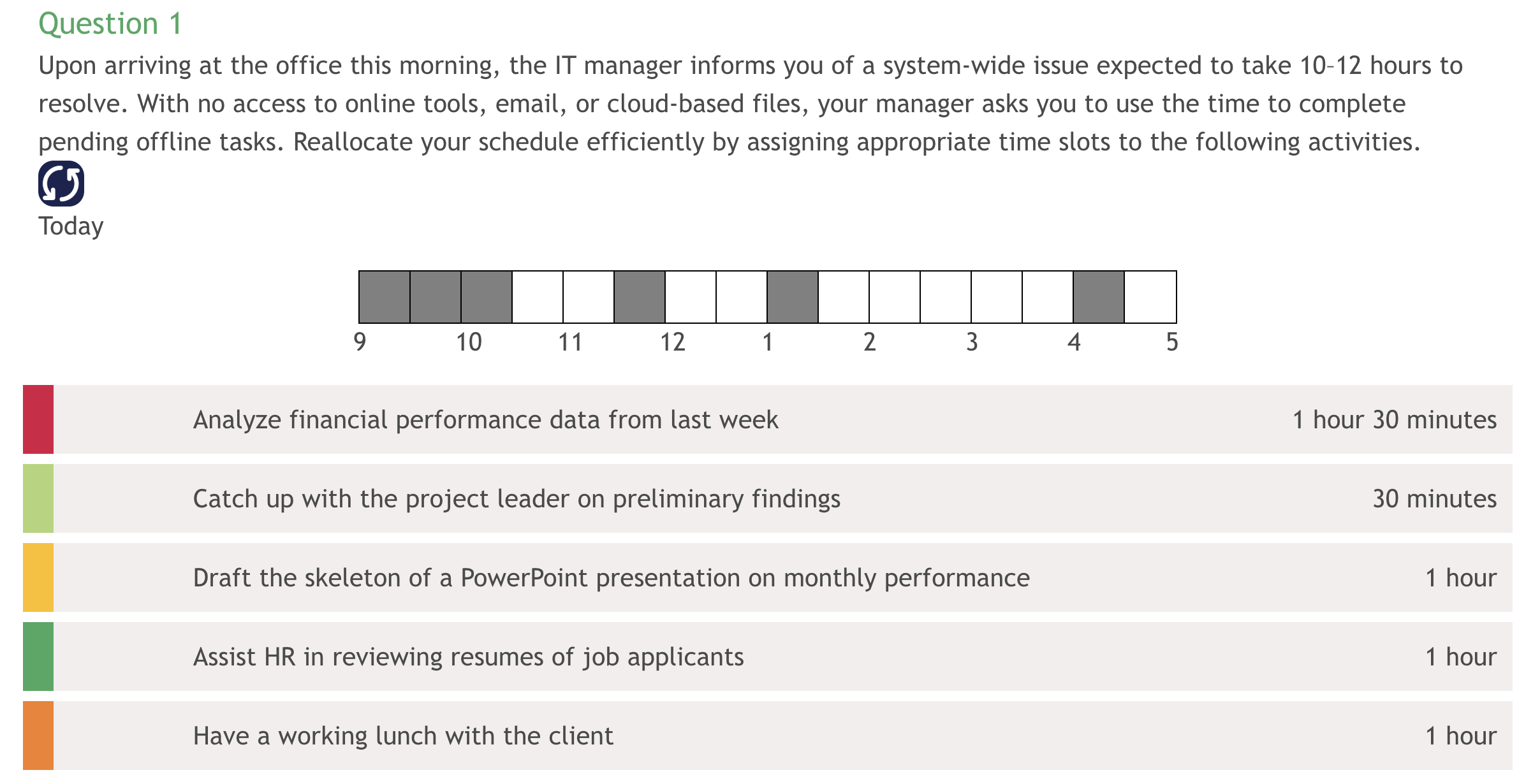
You receive a consultant's daily schedule with cancelled meetings or system issues. Your task is to fit tasks of specific durations into the available time windows.
Example from the Simulation:
Upon arriving at the office this morning, the IT manager informs you of a system-wide issue expected to take 10-12 hours to resolve. With no access to online tools, email, or cloud-based files, your manager asks you to use the time to complete pending offline tasks. Reallocate your schedule efficiently by assigning appropriate time slots to the following activities."
Tasks to Schedule:
-
Analyze financial performance data from last week (1 hour 30 minutes)
-
Catch up with the project leader on preliminary findings (30 minutes)
-
Draft the skeleton of a PowerPoint presentation on monthly performance (1 hour)
-
Assist HR in reviewing resumes of job applicants (1 hour)
-
Have a working lunch with the client (1 hour)
Approach: Identify empty time slots first, then sequence tasks logically. Client-facing activities typically take priority. Internal deliverables can fill remaining gaps.
Scheduling Logic Questions
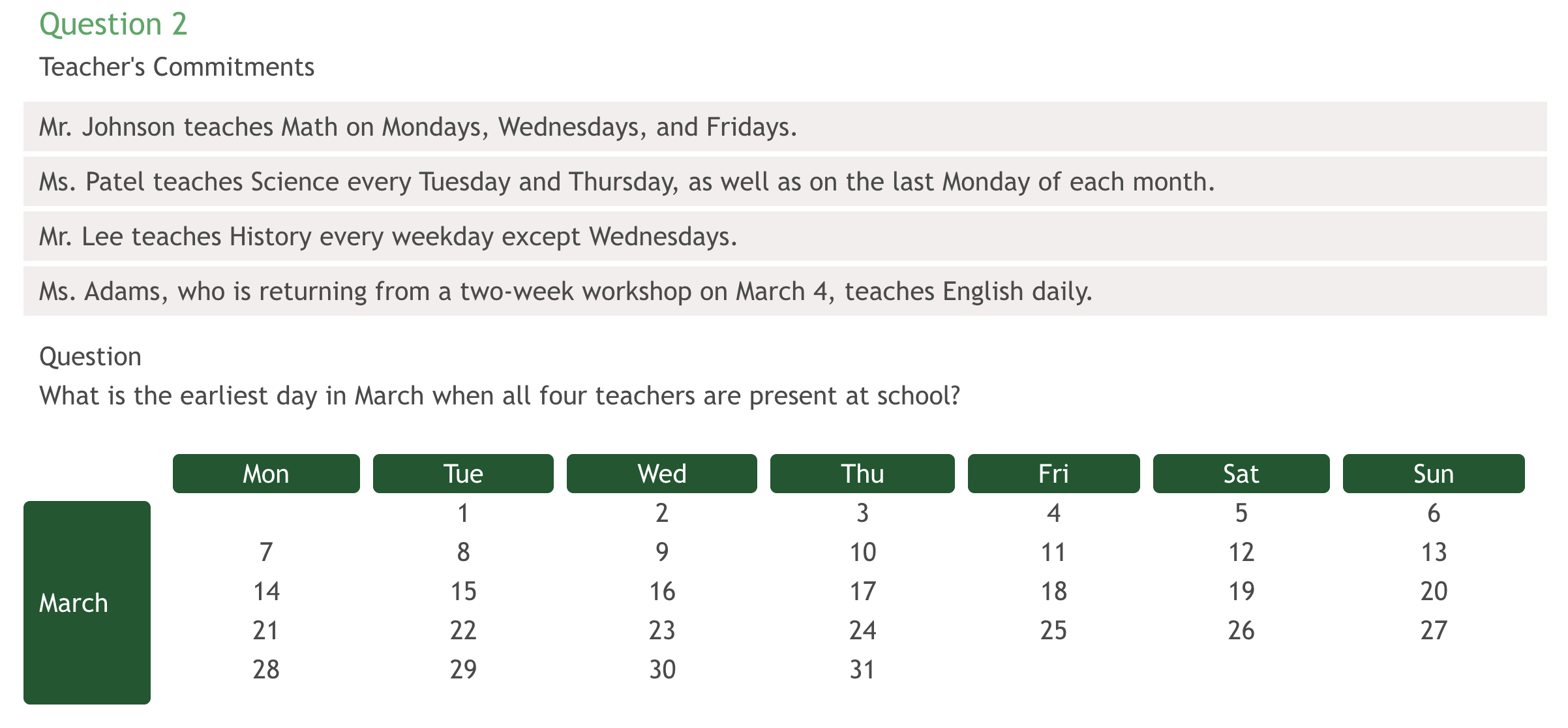
These questions provide rules about recurring schedules (who works specific days, alternating patterns, days off) and ask you to determine when a specific condition is met.
Example Scenario: Four doctors have different availability patterns. Dr. Mia works only weekdays except the first Saturday. Dr. Thomas is unavailable on odd-numbered Mondays and Saturdays. The question asks: "What is the earliest date a reserve doctor will be required?"
Approach: List each person's unavailable dates systematically, then find the first date where enough people are absent to trigger the condition. These questions consume the most time, so practice systematic rule tracking.
Quantitative Reasoning Questions
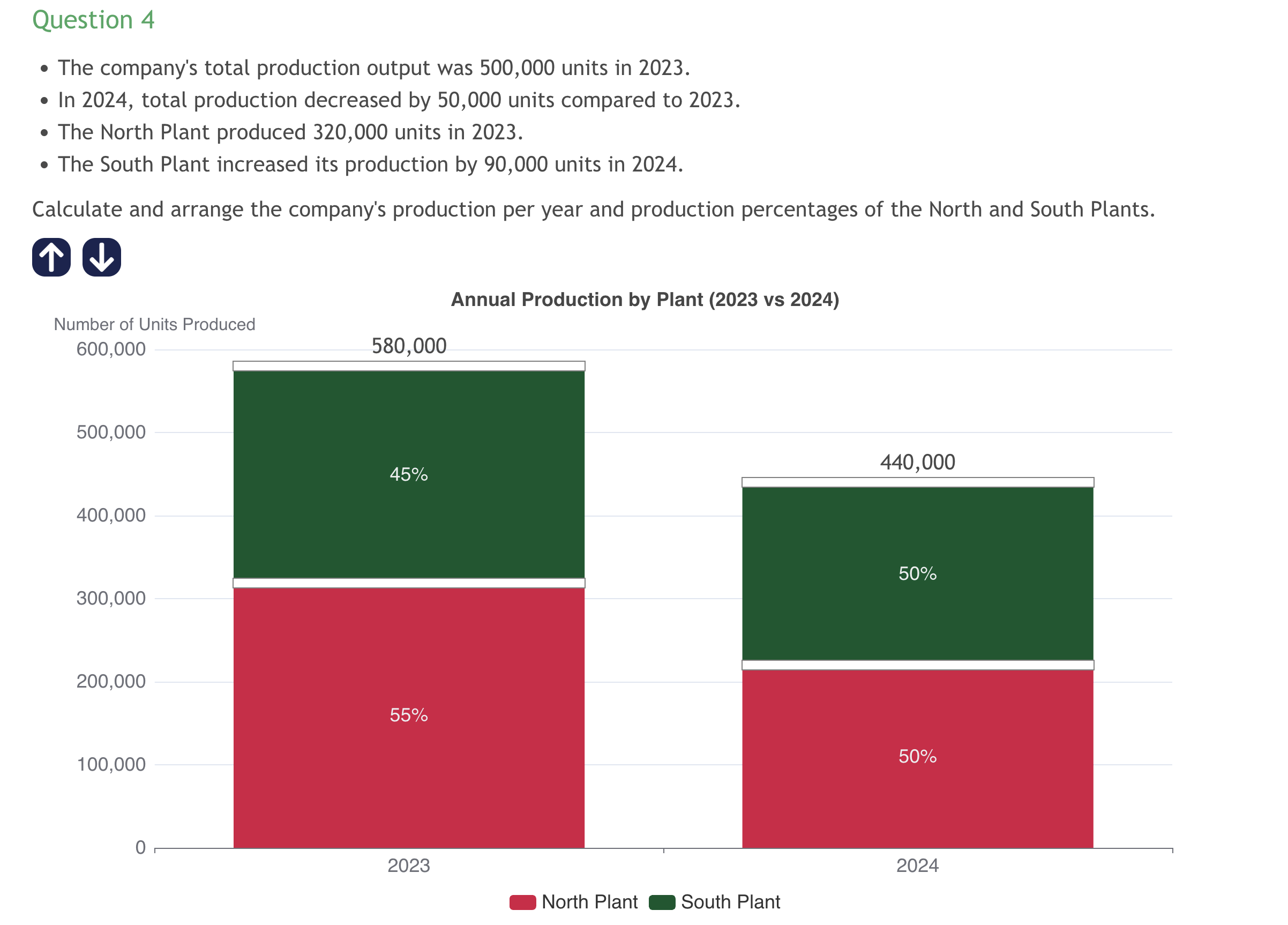
These questions provide numerical data and ask you to calculate changes, percentages, or proportions. Calculator use is helpful here.
Example Scenario: An agent recorded 350 memberships in January (140 monthly, 210 annual). In February, monthly memberships increased 20% while annual memberships decreased 10%. Calculate February totals.
Approach: Read carefully for percentage changes versus absolute numbers. Calculate step by step: 140 × 1.20 = 168 monthly, 210 × 0.90 = 189 annual, total = 357.
Visual Pattern Recognition Questions
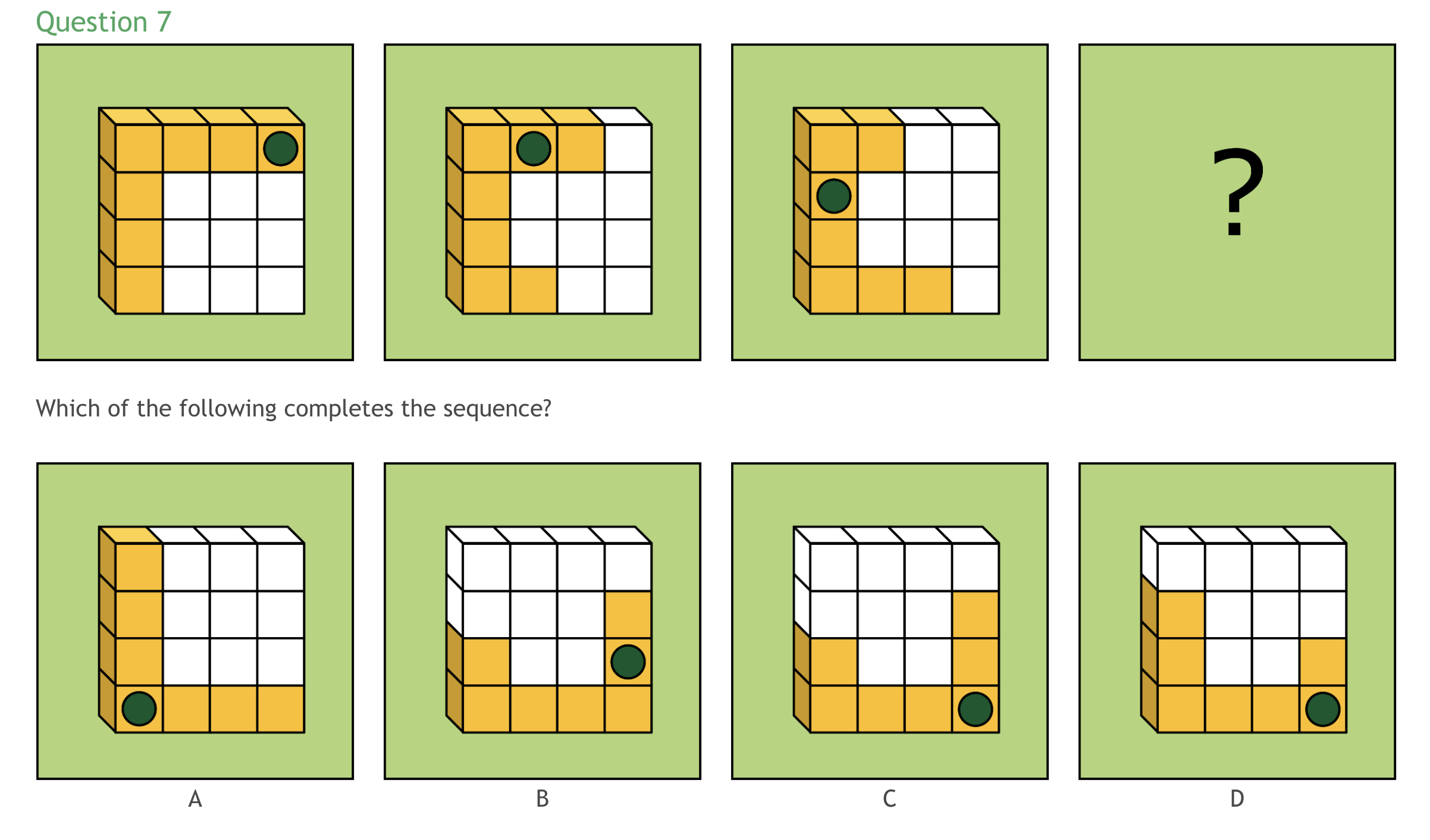
Shapes, symbols, or sequences change step by step. Identify the underlying rule and predict what comes next.
Example from the Simulation:
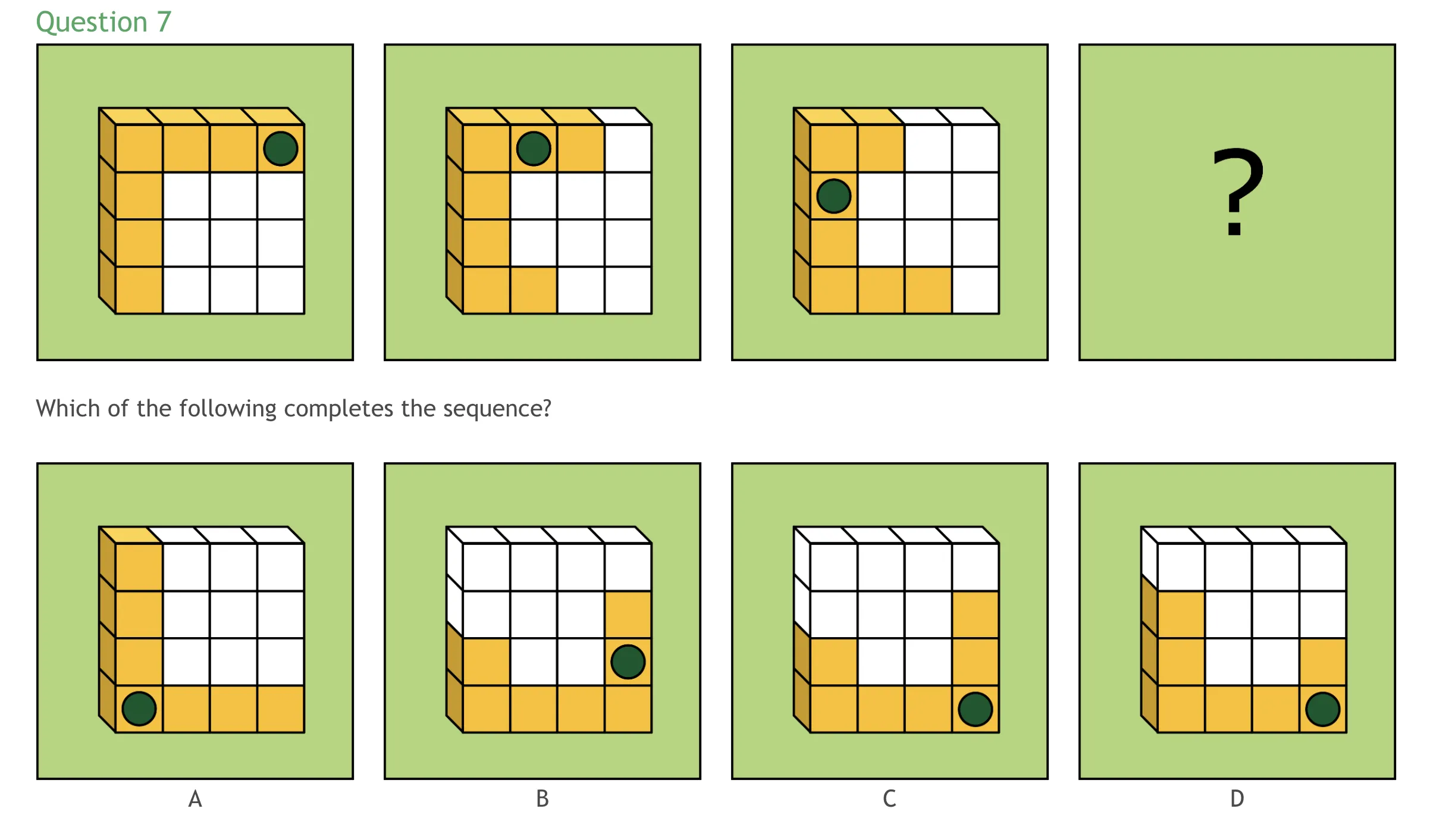
A 3D cube grid shows yellow colored sections and a green dot. Each step, the yellow pattern shifts and the green dot moves to a new position. The question asks: "Which of the following completes the sequence?"
Approach: Track each element separately. Look for rotation patterns, color shifts, position changes, or shape transformations. Test your hypothesis against all given steps before selecting from options A, B, C, or D.
Competency Assessment Profile: What You Get After the Simulation
After completing the personality tests in the Prepmatter BCG CCA simulation, you receive a detailed competency assessment profile showing your scores across all seven traits.
Sample Profile Results:
|
Trait |
Score |
Level |
Description |
|
Leadership |
36/90 |
Low |
Hesitant to take charge or mobilize others |
|
Communication |
33/70 |
Moderate |
Communicates adequately but lacks assertiveness or clarity |
|
Adaptability |
49/64 |
High |
Thrives in change and demonstrates emotional flexibility |
|
Empathy |
24/60 |
Low |
Misses cues or reacts impersonally |
|
Teamwork |
34/66 |
Moderate |
Participates actively but may need to balance self and group focus |
|
Time Management |
26/54 |
Moderate |
Understands priorities but needs support with follow-through |
|
Cognitive Style |
26/52 |
Moderate |
Shows some analytical clarity but needs consistency or creativity |
How Scoring Works:
The score is based on weighted points from your selected answers, with more weight given to first choices. The algorithm compares this to the maximum possible score and converts it into a 3-level band (Low to High).
Behavioral Traits Radar:
The simulation generates a radar chart visualizing your profile across all seven dimensions. This shows where you score strongly versus areas needing development.
Development Suggestions:
For traits scoring Low, you receive specific recommendations:
-
Leadership: Lead small initiatives, observe effective leaders, build reflection habits, and take responsibility without formal authority
-
Empathy: Practice active listening, ask deeper questions, read biographies, volunteer in emotionally engaged roles
This feedback helps you understand your profile before taking the real BCG CCA and identify traits where you may need adjustment.
How to Prepare for the BCG CCA
Personality Test Preparation Tips
Understand BCG's Core Values
BCG values intellectual curiosity, collaboration, integrity, and drive for impact. Before the assessment, reflect on experiences where you demonstrated these traits. When ranking statements, choose responses that align with balanced professional behavior rather than extreme positions.
Stay Consistent Across Both Tests
Both personality tests assess the same seven traits. If you rank yourself high on leadership in Test 1, your external perception answers in Test 2 should reflect similar patterns. Inconsistent responses can flag your profile.
Aim for Balanced Trait Profiles
Avoid ranking yourself at the extreme top or bottom in any single dimension. Strong candidates show competency across all traits rather than exceptional strength in one area with weaknesses elsewhere.
Numerical Reasoning Preparation Tips
Master Time Management
With 90 seconds per question, time pressure is the primary challenge. Set a personal rule: if stuck for more than 60 seconds, make your best guess and continue. Leaving one question unanswered is better than rushing through three.
Remember: You Cannot Go Back
Once you move to the next question, you cannot return to change your answer. Make your best choice before clicking Next.
Practice with Realistic Simulations
Generic logic puzzles help, but a realistic simulation provides the best preparation. The Prepmatter BCG CCA simulation covers all three sections with:
-
Full 76-question Personality Test 1 with randomized order
-
5 complete numerical reasoning sets (40 questions total)
-
Full 15-question Personality Test 2 with randomized order
-
Detailed answer explanations for every numerical question
-
Competency report showing your trait profile across 7 dimensions
-
Development suggestions for traits scoring Low
After completing the simulation, you see exactly where you stand across leadership, communication, adaptability, empathy, teamwork, time management, and cognitive style. This identifies traits where you may need adjustment before the real assessment. The numerical reasoning section includes five complete sets of eight questions each, giving you 40 practice questions total. Repeated practice builds familiarity with all four question types and improves your speed under the 12-minute time constraint, helping you aim for a perfect 8 out of 8.
BCG CCA vs. Other BCG Assessments
BCG uses several online assessments. Understanding the differences prevents confusion during your application.
BCG CCA vs. BCG Online Case (Casey Chatbot)
|
Attribute |
BCG CCA |
BCG Online Case |
|
Purpose |
Pre-interview screening |
Part of the interview process |
|
Format |
Behavioral prompts + numerical reasoning |
Interactive case study via chatbot |
|
Duration |
30 minutes |
35 minutes |
|
Focus |
Personality traits + logic |
Case solving + business acumen |
|
Video Component |
No |
Yes (final recommendation) |
|
When |
Before Online Case |
After CCA |
The CCA screens candidates before deeper investment. Passing the CCA advances you to the BCG Online Case, an interactive case study with the Casey chatbot that tests case-solving skills.
BCG CCA vs. BCG Pymetrics Test
Some BCG offices use the Pymetrics test (12-16 neuroscience mini-games) in addition to or instead of the CCA. The Pymetrics test evaluates cognitive and emotional traits through gamified exercises rather than direct questions.
Check your specific invitation email for which assessments you need to complete. The format varies by geography and application type.
BCG CCA vs. BCG Potential Test
The BCG Potential Test was BCG's older aptitude assessment, a 45-minute, 23-question format focusing on quantitative and verbal reasoning. The BCG Online Case (Casey Chatbot) replaced the Potential Test across all offices. German offices use a Cognitive Test and Real Life Assessment instead of the CCA.
Does Everyone Get the BCG CCA?
Not every BCG applicant receives the CCA. The assessment format varies by geography and application stage.
Who Gets the CCA:
-
Candidates who pass the resume and cover letter screening
-
Applicants to most global offices, including North America
-
Both undergraduate and MBA candidates
Who Does NOT Get the CCA:
-
Candidates rejected at the resume screening stage
-
Applicants to German offices (they take a Cognitive Test + Real Life Assessment instead)
-
Some offices may use Pymetrics alone
When you receive the invitation email, you have 24 hours to complete the assessment. The email specifies which assessments are required for your specific application.
If something prevents you from completing the CCA within the 24-hour window, contact your BCG recruiter immediately. They may extend the deadline depending on circumstances.
What Happens After the BCG CCA?
Passing the BCG CCA advances you to the next stage of BCG's hiring process.
1. BCG Online Case (Casey Chatbot)
Most candidates next face the BCG Online Case, a 35-minute interactive case study. You analyze data, interpret charts, and provide recommendations through a chatbot interface. The Online Case includes a video component where you record your final recommendation.
2. First Round Live Interviews
After passing online assessments, candidates complete two 45-minute live interviews combining case questions and behavioral (PEI) questions. These happen via video call or in-person, depending on the office.
3. Final Round Interviews
Successful first-round candidates advance to the final round: two to three 45-minute interviews with BCG partners.
Preparing for What Comes Next
After practicing for the CCA, start preparing for case interviews. The Get the Offer course covers case interview frameworks, structuring, and drills used in BCG interviews. The peer practice platform connects you with other candidates for live mock cases.
Common BCG CCA Mistakes to Avoid
1. Rushing Through Instructions
The CCA provides time to review instructions before each section begins. Read every instruction carefully. Candidates who rush sometimes misunderstand question formats, costing time and accuracy later.
2. Spending Too Long on Difficult Questions
With 90 seconds per numerical question, dwelling on one problem leaves you short on others. If stuck beyond 60 seconds, make your best choice and continue. One missed question rarely fails a candidacy; running out of time often does.
3. Forgetting You Cannot Go Back
Once you click Next on a numerical question, you cannot return to change your answer. Double-check your selection before moving forward.
4. Inconsistent Personality Test Answers
Both personality tests assess the same seven traits. Contradicting yourself between Test 1 and Test 2 raises flags. Answer honestly and maintain consistency in how you present your work style.
5. Overthinking Behavioral Questions
The personality sections have no correct answers. Trying to reverse-engineer what BCG wants often produces inconsistent responses. Pick statements that genuinely describe you and move on quickly.
6. Not Practicing Under Time Pressure
Generic logic puzzles help, but practicing without a timer misses the primary challenge. The numerical section is difficult because of time pressure, not question complexity. Simulate real conditions during preparation.
BCG CCA Reddit: What Candidates Say
Reddit discussions on r/consulting, r/MBA, and r/csMajors provide unfiltered candidate experiences with the BCG CCA.
On Difficulty:
Candidates describe the CCA as "not overly difficult" but "very time-pressured." The numerical section challenges even strong quantitative candidates because 90 seconds per question leaves little margin for error.
On Question Types:
Multiple threads confirm four question types: scheduling logic, time reallocation, quantitative reasoning, and visual pattern recognition. Scheduling logic questions consistently receive mentions as the most time-consuming.
On Personality Tests:
Reddit users recommend answering "honestly and quickly" rather than trying to game the system. The behavioral sections detect inconsistencies, so candidates suggest maintaining consistent self-presentation across both personality tests.
On Passing Without Finishing:
Several candidates report passing the CCA despite not completing every numerical question. BCG evaluates overall performance rather than requiring perfect completion. This aligns with advice to make your best guess and move on rather than dwelling on difficult problems.
On Preparation:
Common recommendations include practicing SHL-style tests, understanding BCG's values, and simulating time pressure during practice.
Start Your BCG CCA Preparation
The BCG Consulting Career Assessment screens candidates before BCG invests time in live interviews. Preparation matters since you get one attempt with no retakes.
The Prepmatter BCG CCA simulation covers all three sections with realistic practice:
|
Feature |
Details |
|
Personality Test 1 |
Full 76 behavioral prompts, randomized each attempt |
|
Numerical Reasoning |
5 complete sets (40 questions total) |
|
Personality Test 2 |
Full 15 behavioral prompts, randomized |
|
Answer Explanations |
Detailed explanations for every numerical question |
|
Competency Report |
Trait profile across 7 dimensions with development suggestions |
|
Access |
12 months, one-time $79 payment |
50% Refund Guarantee
If you complete the simulation and still do not pass the BCG CCA, forward the official BCG rejection email to team@prepmatter.com within 2 months of purchase for a 50% refund. We track success to improve our simulation.
After passing the CCA, prepare for the BCG Online Case and case interviews that follow.
Frequently Asked Questions
Does everyone get the BCG CCA?
No. Only candidates who pass the resume and cover letter screening receive the CCA invitation. Additionally, German offices use a different assessment (Cognitive Test + Real Life Assessment) instead of the CCA. Other geography variations may apply depending on the office.
Is the BCG CCA hard?
The CCA tests logic and behavioral traits rather than advanced knowledge. However, time pressure makes the numerical section challenging. With 8 questions in 12 minutes, you have roughly 90 seconds per question. Candidates who practice under time pressure report better experiences.
Can you use a calculator on the BCG CCA?
Yes. BCG allows calculator use during the Consulting Career Assessment. While only quantitative reasoning questions (typically 2 of 8) require calculations, having a calculator ready saves time when needed.
Is there a camera or video requirement?
No. The BCG CCA is entirely computer-based with no video or camera component. You do not need to turn on your webcam at any point during the assessment. The BCG Online Case (which comes after the CCA) does include a video recording component.
What happens if you run out of time on the BCG CCA?
Running out of time on the last question is common. BCG evaluates overall performance rather than requiring completion of every question. If your answers to completed questions were strong, one missed question is unlikely to end your candidacy.
Can you retake the BCG CCA?
No. BCG does not allow retakes of the Consulting Career Assessment. You get one attempt, so ensure you are prepared before starting. Do not click the assessment link until you have completed your preparation.
How long do you have to complete the BCG CCA?
You have 24 hours from receiving the invitation email to complete the assessment. The test itself takes approximately 30 minutes. Plan to complete it in one sitting in a distraction-free environment.
What is the BCG CCA pass rate?
BCG does not publish official pass rates for the CCA. However, the assessment serves as a screening tool, and candidate reports suggest many applicants do get screened out at this stage. The CCA does not have a traditional pass/fail score. Instead, your responses are compared against the traits BCG values in successful consultants.
What is the difference between BCG, CCA, and BCG Online Case?
The BCG CCA is a pre-interview screening test with behavioral prompts and numerical reasoning. The BCG Online Case is an interactive case study with the Casey chatbot that comes after the CCA. The Online Case tests case-solving skills and includes a video recommendation at the end.
Sign up for our newsletter
Join a community of aspiring consultants and elevate your preparation journey with Prepmatter.