McKinsey Solve Sea Wolf Game: Rules, Scoring, and Strategy (2026)
Sea Wolf is the second game in McKinsey Solve. You get 30 minutes to treat three contaminated ocean sites, and at each site your job is the same: pick the three microbes whose combined profile best matches what the site needs. You may also see it called Ocean Cleanup or Ocean Treatment. They are the same game.
McKinsey Solve now runs 95 minutes in total: Redrock Island for 35 minutes, Sea Wolf for 30, and Sustainable Futures Lab for 30. This guide covers how Sea Wolf works, how your treatment is scored, a task-by-task method, and a worked example from Prepmatter's simulation.
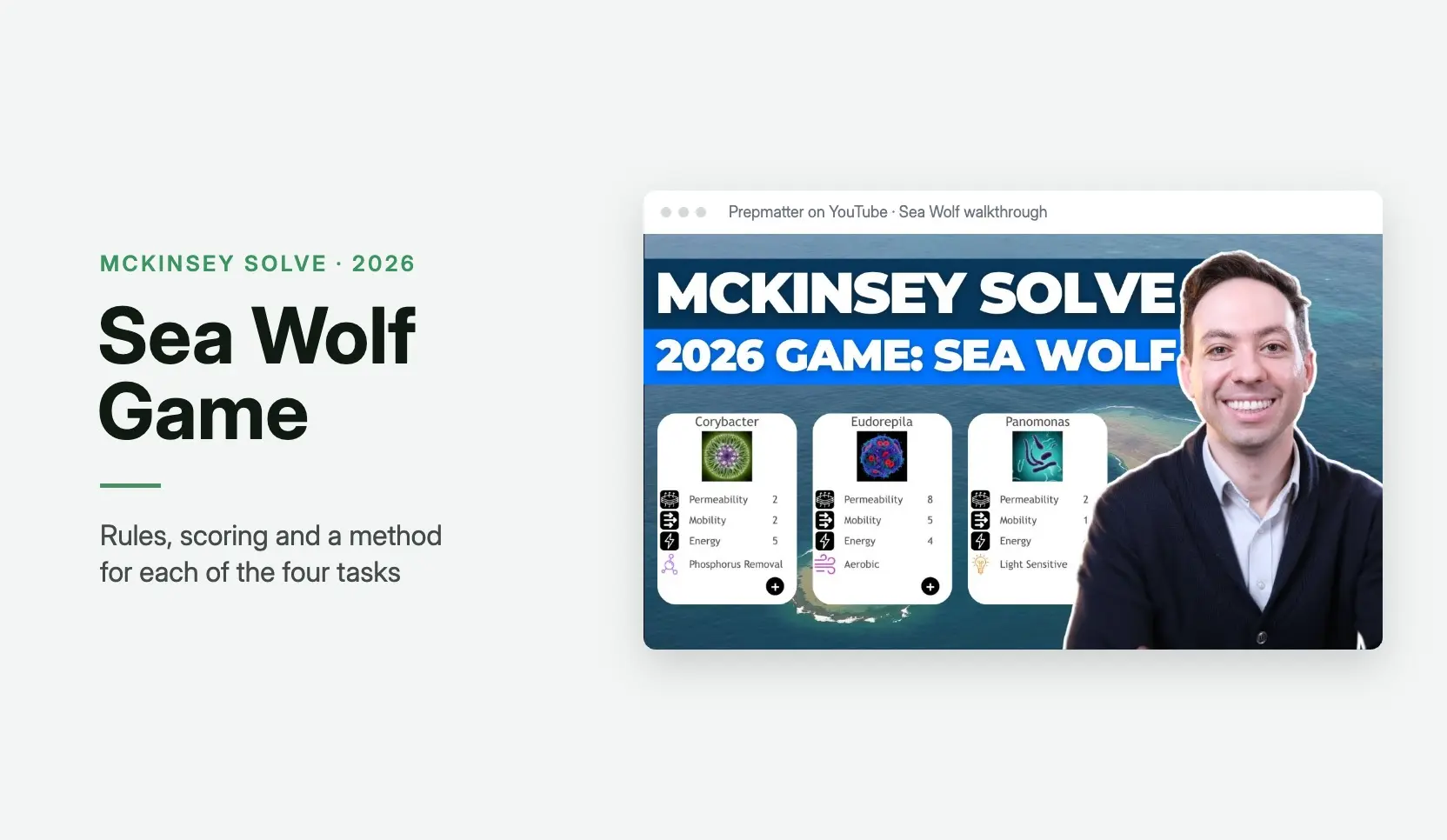
If you'd rather watch than read, here is Deniz, Prepmatter's founder, solving a Sea Wolf scenario in our simulation:
What Is Sea Wolf in McKinsey Solve?
Sea Wolf is an optimization game inside McKinsey Solve where you build microbe treatments for three contaminated ocean sites.
The name comes from the game's story. Sea Wolf is an oceanic laboratory that researches contamination sites and treats them with combinations of microbes. You work for the lab.
McKinsey piloted the game with a small group of candidates in mid-2024. In July 2025 it became the standard second game everywhere, replacing Ecosystem Creation. It runs after Redrock Island, on its own 30-minute timer, which covers all three sites. Earlier versions gave you 35 minutes, so older guides and videos quote the longer time.
The game has no business content and no calculator. It tests how well you hold several constraints in mind at once and how quickly you reach a good-enough decision.
How Does Sea Wolf Work?
Sea Wolf gives you three sites, and each site asks for a treatment made of three microbes that fit its profile.
Every site and every microbe is described with the same two kinds of characteristics:
|
Characteristic |
What it is |
Examples from Prepmatter's simulation |
|---|---|---|
|
Attributes |
Three numerical values on a scale of 1 to 10 |
Permeability, mobility, energy |
|
Traits |
Yes-or-no features |
Aerobic, heat resistant, light sensitive, phosphorus removal |
The real assessment can use different labels, such as adhesion or speed for attributes and bioluminescence or pressure resistant for traits. The logic stays the same.
Each site shows you:
- A target range for each of the three attributes, for example permeability 8 to 10
- One desired trait, which you want in your treatment
- One undesired trait, which you need to keep out of it
Each microbe has a value for each of the three attributes and exactly one trait.
Your treatment is judged on the average of the three microbes' attributes and on their traits taken together. This matters in practice. A microbe that sits outside a range can still belong in the best treatment, as long as the average lands inside.
The Four Tasks at Each Site
Each site runs through the same four tasks, after a tutorial that walks you through the interface.
- Set microbe characteristics. You choose two characteristics to program into the lab's database. They can be any mix of attributes and traits. The game says this choice influences the microbes in your starting prospect pool in Task 3. It does not change the microbes you categorize in Task 2.
- Categorize microbes. You review 10 microbes one by one and send each to the current site, the next site, or the return pile. For the next site you only see a partial preview, such as one attribute range or its desired trait.
- Build the prospect pool. Your pool starts with 6 microbes. In each of 4 rounds you see 3 new microbes and add 1 of them, which brings the pool to 10.
- Submit the treatment. You pick 3 of the 10 microbes in your pool. You can add and remove microbes as often as you like before you submit.
Sites 2 and 3 open with one extra step. Before Task 1, you sort the microbes you sent ahead from the previous site: keep them for the current site or return them.
How Is Sea Wolf Scored?
Each treatment gets an effectiveness score out of 100%, built from five checks worth 20% each.
|
Check |
Worth |
|---|---|
|
Averaged attribute 1 falls inside the site's range |
20% |
|
Averaged attribute 2 falls inside the site's range |
20% |
|
Averaged attribute 3 falls inside the site's range |
20% |
|
At least one of the three microbes has the desired trait |
20% |
|
None of the three microbes has the undesired trait |
20% |
One microbe with the undesired trait costs the full 20%, however good the other two are.
Here is the calculation for one treatment from our simulation. The site needs permeability 3 to 5, mobility 4 to 6 and energy 5 to 7. The three microbes average 4 on permeability, 5 on mobility and 6.33 on energy, so all three attributes score. One microbe carries the desired trait and none carries the undesired one. The treatment scores 100%.
Not every site can be solved to 100%. With some sets of microbes, 80% is the best available score. The game tells you this up front, and the performance report in our simulation shows the best achievable score for each site next to yours.
McKinsey does not publish how treatment effectiveness feeds into your overall Solve result. Solve as a whole looks at how you work as well as what you submit, so follow a consistent method instead of clicking through combinations at random.
Sea Wolf Strategy: A Method for Each Task
A good Sea Wolf run spends little time on the first three tasks and saves it for Task 4, where the score is decided.
|
Task |
Time per site |
Rule to follow |
|---|---|---|
|
Sort carried-over microbes (Sites 2 and 3 only) |
45 seconds |
Keep the ones that fit, return the rest |
|
1. Set characteristics |
1 minute |
One attribute with an extreme range, plus the desired trait |
|
2. Categorize 10 microbes |
3 minutes |
The 2-out-of-4 rule |
|
3. Build the prospect pool |
2 minutes |
Undesired trait out first, then count attributes in range |
|
4. Submit the treatment |
3.5 minutes |
Work with sums, not averages |
That adds up to the full 30 minutes: 9.5 minutes of tasks at each of the three sites, plus 45 seconds of sorting at Sites 2 and 3. One timer covers all three sites, so nothing stops you from overspending on Site 1. Check the clock as you finish each site: you want about 20 minutes left after Site 1 and about 10 after Site 2.
Task 1: Pick One Attribute and One Trait
Choose the attribute whose target range sits furthest from the middle of the scale. If the site needs permeability 8 to 10 and energy 4 to 6, pick permeability. Microbes with extreme values are harder to find, so that is where a better starting pool helps most.
For the trait, pick the site's desired trait. Do not pick the undesired one: you do not want to see more microbes that carry it.
In our experience, the starting pool still looks fairly random whatever you choose. Treat Task 1 as a one-minute decision and move on.
Task 2: Use the 2-out-of-4 Rule
For each microbe, count how many of four things match the current site: its three attributes and the desired trait.
- Two or more matches and no undesired trait: send it to the current site.
- Fewer than two matches, but it fits what you can see of the next site: send it to the next site.
- Neither: return it.
Do not aim for an even split. In some scenarios almost every microbe belongs to the current site, and only one or two go elsewhere.
Task 3: Build the Pool in Priority Order
In each of the four rounds, compare the three microbes in this order:
- Drop any microbe with the undesired trait. If you used it in your treatment, it would cost you 20%. Only take one when all three options carry it.
- Take the microbe with the most attributes in range. Three in range beats two, and two beats one.
- Use the desired trait as a tiebreaker. It matters most when your pool does not have one yet.
When two microbes are equally good, look at what your pool is missing. If its energy values run high, take the microbe with the lower energy.
Task 4: Work With Sums, Not Averages
Dividing by three over and over wastes time. Multiply each site range by three instead and compare it with the sum of your three microbes. A range of 8 to 10 becomes a target sum of 24 to 30.
Set up a small table on paper before you start: one column per attribute, three rows for your microbes, and a last row for the sum next to the target.
- Cross out every microbe with the undesired trait.
- Start with the microbes that have all three attributes in range.
- Add up your first two picks and work out what the third microbe needs in each attribute.
- Scan the pool for a microbe that fits those three gaps.
- Check that at least one of your three has the desired trait.
- If one attribute lands outside its range, swap a single microbe for one that is higher or lower on that attribute.
If you cannot find a 100% combination after a few swaps, submit your best 80%. Some sites do not have a perfect answer, and the minutes are worth more at the next site.
Sea Wolf Walkthrough: One Site, Start to Finish
The example below follows Deniz through Site 1 of a scenario in Prepmatter's McKinsey Solve simulation. The scenario and the microbes are Prepmatter's. McKinsey's real test uses its own, but the tasks and the scoring work the same way.
The site. Site 1 needs permeability 8 to 10, mobility 8 to 10 and energy 4 to 6. The desired trait is light sensitive. The undesired trait is phosphorus removal. The preview of Site 2 shows that its desired trait is aerobic.
Task 1. Deniz picks one of the two extreme attributes, permeability or mobility, and skips energy because its range sits in the middle of the scale. For the trait he picks light sensitive.
Task 2. Two of the ten microbes show how the rule works:
- Varabacter has permeability 9, mobility 6, energy 5, and is light sensitive. Permeability, energy and the trait match, so it scores 3 out of 4 and goes to the current site.
- Ranicaldus has permeability 7, a mobility inside the range, an energy above the range, and is aerobic. It scores 1 out of 4 for Site 1, but aerobic is what Site 2 wants, so it goes to the next site.
In this run, eight microbes go to the current site, two go to the next site, and none are returned.
Task 3. The first two rounds are easy: each offers a microbe with all three attributes in range and the desired trait. In round three, one option carries phosphorus removal and is dropped, and the other two each match only one attribute. Deniz takes the one with the lower energy, because the pool's energy values are already high. In round four, he again skips a microbe with the undesired trait and takes the one with two attributes in range.
Task 4. The target sums are three times the site ranges: 24 to 30 for permeability, 24 to 30 for mobility and 12 to 18 for energy. No microbe in the pool has phosphorus removal, so nothing needs crossing out. Two microbes have all three attributes in range, so they go in first.
|
Microbe |
Permeability |
Mobility |
Energy |
|---|---|---|---|
|
Shigella |
8 |
9 |
6 |
|
Saospira |
9 |
10 |
4 |
|
Sum of the first two |
17 |
19 |
10 |
|
What the third microbe needs |
7 to 13 |
5 to 11 |
2 to 8 |
|
Parapaeus |
7 |
9 |
8 |
|
Sum of all three |
24 |
28 |
18 |
|
Target sum |
24 to 30 |
24 to 30 |
12 to 18 |
All three sums land inside their targets. All three microbes are light sensitive, and none has phosphorus removal. The treatment scores 100%.
Notice that Parapaeus on its own misses two of the site's ranges: its permeability of 7 is below 8 to 10 and its energy of 8 is above 4 to 6. It still completes a perfect treatment, because only the average counts.
Five Sea Wolf Mistakes to Avoid
The math in Sea Wolf is simple. The avoidable mistakes come from the scoring rules.
- Judging microbes one by one in Task 4. The score depends on the average of three microbes. Rejecting every microbe with an out-of-range value throws away combinations that would have scored 100%.
- Letting an undesired trait into the treatment. One such microbe costs 20% on its own. Cross them out before you do anything else.
- Forgetting the desired trait. A treatment with three well-matched attributes and no desired trait stops at 80%. Make it the last check before you submit.
- Chasing 100% when the site tops out at 80%. The game says a perfect combination may not exist. After a few swaps, take the 80% and protect your time.
- Spending the clock on Task 2. Categorizing is the easy part. Minutes lost there are minutes missing from Task 4 at Site 3.
Should You Use a Sea Wolf Excel Solver?
No. Several websites sell Excel solvers and similar tools that promise to calculate the best Sea Wolf answer while you take the test. We advise against them, for three reasons:
- The rules prohibit them. The terms you accept before the test ban external software and name automated solvers specifically.
- McKinsey monitors the session. The platform tracks when you leave the assessment window or switch tabs, and the terms allow McKinsey to suspend your access if it suspects a violation.
- A solver costs you more than it gives. Typing microbe values into a spreadsheet takes time out of a 30-minute game.
Pen and paper do the same job. The sum table from Task 4 takes a minute to draw and replaces everything a solver would calculate. For the wider rules, see "Is McKinsey Solve Proctored?" in our full McKinsey Solve guide.
How Do You Practice Sea Wolf?
Practice Sea Wolf until you reach the best available score, 80% or 100%, at every site. Plan for at least three to four full runs.
Two things can be practiced away from the game. Add three small numbers in your head and compare the total with a range, again and again. And draw the sum table from memory until it takes you under a minute.
The rest needs the game itself. Prepmatter's McKinsey Solve simulation generates a new Sea Wolf scenario on every run, with different microbes and different site requirements, so you cannot memorize answers. After each run, a performance report shows your treatment for each site next to the recommended one, with the effectiveness score of both.
Updated in November 2026, the simulation covers all three Solve games: unlimited Sea Wolf, 30 Redrock Island scenarios and 30 Sustainable Futures Lab scenarios. You can play one game at a time or all three back to back in the real order and timing. More than 2,200 candidates have used it, and 97% of them passed Solve. If you don't place in the top 30% of the real assessment, Prepmatter refunds 50%: forward your official McKinsey result within two months of purchase.
To see how the simulation and its reports work before you buy, play one full Sustainable Futures Lab scenario in our free McKinsey Solve practice test. Sea Wolf itself is part of the full simulation.
The simulation is independently created by Prepmatter and is not affiliated with or endorsed by McKinsey.
How Does Sea Wolf Compare to Redrock Island and Sustainable Futures Lab?
Sea Wolf is the only Solve game built on optimization: many acceptable answers, one best one, and a clock.
|
Element |
Redrock Island |
Sea Wolf |
Sustainable Futures Lab |
|---|---|---|---|
|
Order |
First |
Second |
Third |
|
Timer |
35 minutes |
30 minutes |
30 minutes |
|
Focus |
Data analysis and case reasoning |
Optimization under constraints |
Team leadership and judgment |
|
Calculator |
Yes |
No |
No |
|
You produce |
Calculations plus written and visual reports |
A three-microbe treatment for each of three sites |
Delegation, support and team decisions |
Together, the three games run 95 minutes. For the other two games, see our Redrock Island guide and our Sustainable Futures Lab guide. For the assessment as a whole, see the full McKinsey Solve walkthrough.
Frequently Asked Questions About Sea Wolf
What is the Sea Wolf game in McKinsey Solve?
Sea Wolf is the second of the three McKinsey Solve games. You treat three contaminated ocean sites by choosing, for each one, the three microbes whose averaged attributes and traits best match the site's requirements.
Is Sea Wolf the same as Ocean Cleanup or Ocean Treatment?
Yes. Sea Wolf, Ocean Cleanup, Ocean Treatment and "the microbe game" are all names for the same game. Sea Wolf is the name of the laboratory in the game's story.
How long is the Sea Wolf game?
Sea Wolf runs 30 minutes, excluding the tutorial, on one timer for all three sites. Earlier versions ran 35 minutes. McKinsey Solve as a whole runs 95 minutes: Redrock Island 35, Sea Wolf 30 and Sustainable Futures Lab 30.
How is Sea Wolf scored?
Each treatment gets an effectiveness score out of 100%. You earn 20% for each of the three averaged attributes that falls inside the site's range, 20% for including at least one microbe with the desired trait, and 20% for including no microbe with the undesired trait.
Can you always reach 100% treatment effectiveness?
No. For some sites, no combination of the available microbes scores 100%, and 80% is the best possible result.
Did Sea Wolf replace the Ecosystem game?
Yes. McKinsey piloted Sea Wolf from mid-2024 and phased out Ecosystem Creation in July 2025. Sea Wolf has been the standard second game since then.
Should you use an Excel solver for Sea Wolf?
No. McKinsey's terms prohibit external software and name automated solvers, and the platform tracks when you leave the assessment window. A sum table on paper does the same job.
Can you use pen and paper in Sea Wolf?
The rules name software and help from other people, not pen and paper, so we recommend keeping paper next to you for the sum table.
Can you practice Sea Wolf?
Yes. Prepmatter's McKinsey Solve simulation generates a new Sea Wolf scenario on every run, with a performance report that compares your treatments with the recommended ones. It also includes 30 Redrock Island and 30 Sustainable Futures Lab scenarios.
Sign up for our newsletter
Join a community of aspiring consultants and elevate your preparation journey with Prepmatter.