McKinsey Solve Sustainable Futures Lab: New Format, Stages, and How to Prepare (2026)
Sustainable Futures Lab is the third game in McKinsey Solve, redesigned in 2026 as a three-day team leadership simulation that runs 30 minutes. The 13-question format this page previously described has been retired. McKinsey Solve now runs 95 minutes in total: Redrock Island for 35 minutes, Sea Wolf for 30, and Sustainable Futures Lab for 30.
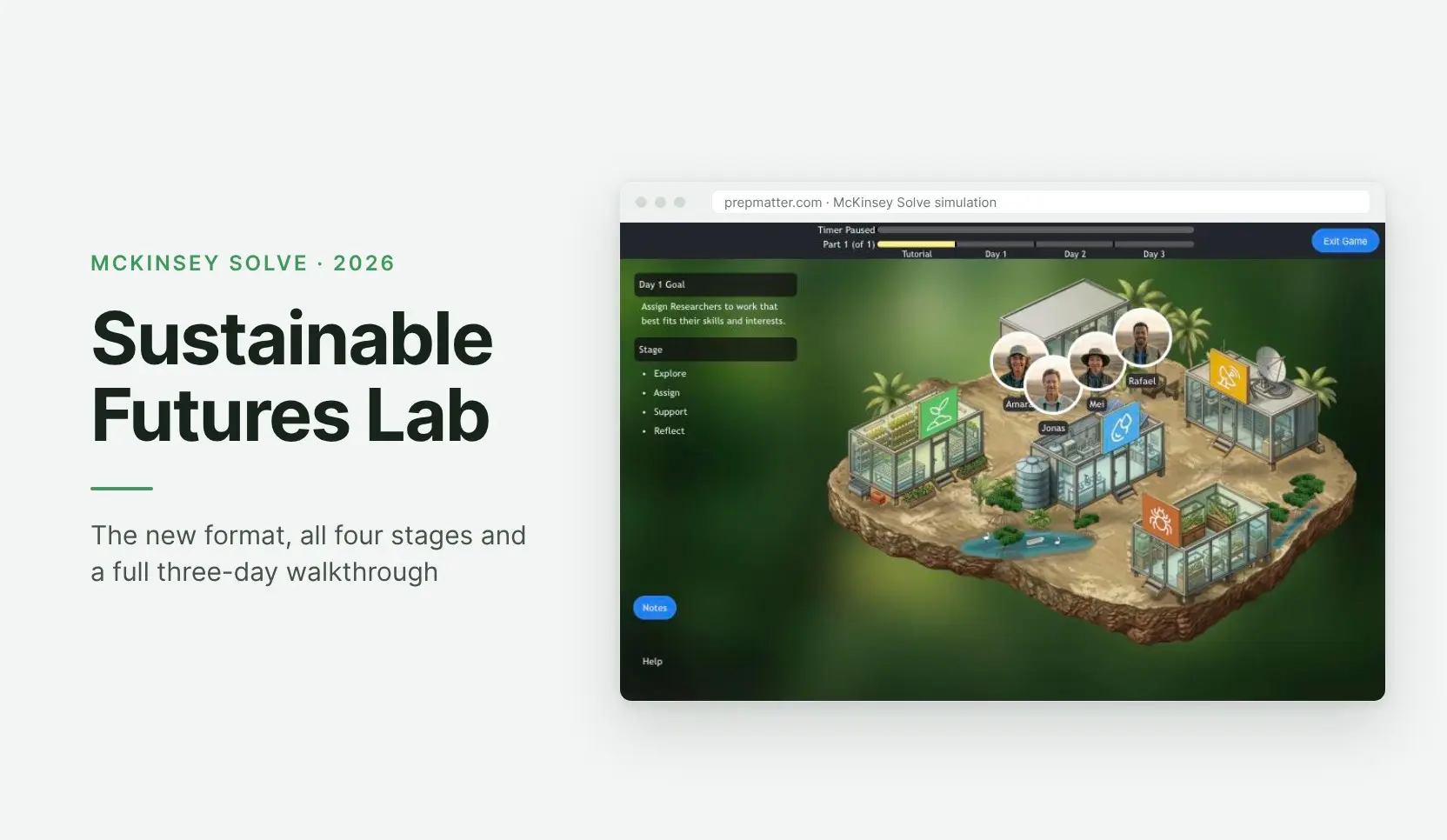
You play the leader of a four-person research team on an environmental project. Each project day cycles through four stages. You explore limited information, assign researchers to workstations, support them through judgment calls, and reflect on how each one is doing.
If you'd rather watch than read, here's Deniz Ahmet Derici, Prepmatter's founder, playing all three days of the new Sustainable Futures Lab in Prepmatter's simulation:
Play this scenario yourself, free. The Pelora Bay scenario from the video is open in our free McKinsey Solve practice test: all three days, with a performance report at the end.
Play the free Sustainable Futures Lab scenario →
What Is the Sustainable Futures Lab in McKinsey Solve?
Sustainable Futures Lab is a behavioral simulation inside McKinsey Solve where you lead a four-person research team through a three-day environmental project.
The game runs third in the Solve sequence, after Redrock Island and Sea Wolf, on its own 30-minute timer.
Your team holds four specialists: an ecologist, a biologist, a habitat planner, and an engineer. Their work spreads across four themed workstations covering water, plants, communications, and animals.
The module contains no calculations, no data exhibits, and no calculator. Every decision is a judgment call about people, priorities, and incomplete information.
What Changed in the 2026 Sustainable Futures Lab Redesign?
McKinsey rebuilt Sustainable Futures Lab in 2026, replacing the 13-question scenario format with a multi-day simulation while keeping the same name.
The game has now moved through three eras. Ecosystem Creation, an analytical food-chain puzzle, left the assessment in July 2025. A first version of Sustainable Futures Lab arrived in early 2026 as a single text scenario with 13 sequential questions in 20 minutes. The current version replaces that with an interactive team simulation spread across three project days.
An earlier version of this guide described the 13-question format. Prepmatter updated this page after completing the redesigned assessment in September 2026.
|
Element |
Previous version |
Current version |
|---|---|---|
|
Duration |
20 minutes |
30 minutes |
|
Structure |
13 sequential questions |
Tutorial, onboarding, and three project days |
|
Format |
One evolving text scenario |
Interactive simulation with a team and workstations |
|
Your role |
Answering situational questions |
Leading researchers and making delegation calls |
|
Interface |
Text screens with a question counter |
3D environment with a day tracker and minute timer |
The redesign changes what preparation means. Familiarity with the old question patterns transfers poorly, while the underlying judgment skills transfer completely.
How Does the Sustainable Futures Lab Work?
The Sustainable Futures Lab runs as a tutorial, an onboarding step, and three project days, with each day cycling through the same four stages.
A tutorial opens the game with the timer paused, so learning the interface costs nothing. Onboarding follows with a drag-and-drop task: you order the briefing questions you want answered, which shapes how the project context arrives. Rank them so you understand the task before the people. Deniz's order: the work needed across the Lab first, then how the team's view of the problem has evolved, then how the team works together, and individual researcher support last.
Each project day then opens with a daily goal. Day one centers on researcher needs, day two on workstation needs, and day three on balancing both.
How the Explore Stage Works
Explore gives you a small number of Explore Requests per day, and one request buys one question.
Workstations and researchers each offer a short menu of questions. A researcher answers only one question per day, and availability rotates, so some team members stay out of reach on certain days.
The Notes panel saves each researcher's profile, your Explore conversations and workstation information. It does not save Support conversations, so jot down who you supported, their concern and your advice. You'll need that in Reflect.
Scarcity is the point. Requests drop as the project moves on: expect three on each of the first two days and two on Day 3. The stage rewards asking the questions your daily goal actually needs.
How the Assign Stage Works
Assign places your researchers onto workstations, and every move needs a reason.
On Day 1, every researcher starts at the base, so your first Assign stage places the whole team. You drag people to assign them, and each workstation holds up to two researchers or stays empty.
Moving anyone triggers a prompt asking why, with a fixed set of reasons to choose from. The game records the justification behind each move, not only the move itself, which makes this the most consulting-like mechanic in Solve.
There are four reasons: researcher preference, researcher assistance, latest workstation needs, and workstation coverage. Pick the reason your evidence supports. If you never explored a researcher's preference, use workstation coverage, not researcher preference.
How the Support and Reflect Stages Work
Support presents workplace dilemmas from your researchers, and Reflect closes each day with a read on the team.
In Support, a researcher raises a real leadership problem: pressure to act on incomplete evidence, or how to deliver unwelcome findings to another group. You choose between paragraph-length responses, and when several requests arrive together, picking which one to handle first is part of the test.
Reflect asks how each researcher is likely to feel at the end of the day, and the scale changes daily. Day 1 uses Confident, Doubtful, Neutral or I don't know. Day 2 uses Balanced, Unbalanced, Neutral or I don't know. Day 3 uses Certain, Uncertain, Neutral or I don't know. Choose Neutral when you have evidence but it's mixed. Choose I don't know when you have no evidence about that researcher for the day. Claiming knowledge you never gathered is its own signal.
What Does the Sustainable Futures Lab Test?
The Sustainable Futures Lab tests leadership judgment: how you gather information under scarcity, delegate with reasons, handle team friction, and read people.
The mechanics reward five behaviors:
- Prioritizing questions when requests are scarce and the daily goal is specific
- Delegating with a defensible reason rather than by instinct
- Handling interpersonal pressure without swinging between extremes
- Tracking how each team member is doing across the days
- Staying consistent as the situation develops
McKinsey has not published how the module is scored or how it weighs into overall Solve results. Treat any claimed scoring framework for this version with caution, including older ones.
Prepmatter's simulation reports performance in four areas, one per stage: Information Prioritization (onboarding and Explore), Resource Allocation (Assign), Adaptive Problem Solving (Support) and People Judgment (Reflect). These are Prepmatter's feedback categories, not McKinsey's.
The skills mirror what McKinsey interviewers assess in the PEI and case rounds, now tested digitally before a human ever meets you.
Sustainable Futures Lab Walkthrough: A Full Three-Day Practice Scenario
The walkthrough below follows Deniz Ahmet Derici through all three days of a practice scenario from Prepmatter's McKinsey Solve simulation. The scenario and the researchers are Prepmatter's. McKinsey's real test uses its own scenario and team, but the stages, reasons and scales work the same way.
Want to try it before you see the answers? Play this scenario free →
The scenario: mangroves in Pelora Bay started declining after a severe storm season. The possible causes are rising salinity, polluted runoff and disease. Your team has four researchers: Amara, a coastal ecologist; Jonas, a hydrologist; Mei, a plant pathologist; and Rafael, an environmental systems analyst.
Day 1: Learn What Your Researchers Want
Explore. Deniz uses his three requests on Amara, Jonas and Mei. Amara is interested in fish and coastal animals. Jonas wants to study tidal movement. Mei wants to examine the trees directly. He skips Rafael because his role is broader.
Assign. Amara goes to Animals, Jonas to Water and Mei to Plants, each with the reason "researcher preference". Rafael goes to Communication with "workstation coverage", because his preference was never explored.
Support: Mei suspects disease but lacks evidence. Best answer: introduce limited precautions in the affected areas while comparing damaged and healthy trees, and adjust as the evidence becomes clearer. Why the others fail: examining more without acting is too passive. Waiting for the Water team leaves the risk open. Treating the most damaged trees assumes disease before it's confirmed.
Support: Rafael says the team discussion is losing focus. Best answer: ask each researcher what supports or challenges their explanation, then agree on the most important evidence still needed. Why the others fail: separate discussions deepen each person's attachment to their own position. Equal time plus a written summary produces no decision. Letting the most senior expert choose puts seniority above evidence.
Reflect. All four researchers are Confident. Amara, Jonas and Mei are each placed where their interest lies, Mei received a balanced answer to her concern, and Rafael's concern was handled in Support.
Day 2: Focus on What the Workstations Need
Explore. Deniz checks the Water workstation (a model of how the storms changed tidal flow, pushing salt water farther inland), the Animals workstation (falling fish numbers, from habitat loss or water conditions) and how Mei is feeling. Her symptoms aren't spreading like an aggressive disease, so she is updating her view.
Assign. Amara and Jonas move with "latest workstation needs". Mei and Rafael stay with "workstation coverage", because their workstations weren't explored that day.
Support: Jonas sees a strong salinity pattern but has gaps in the data. Best answer: build a provisional model now, identify which gaps could change the conclusion, and collect only those samples. Why the others fail: the team doesn't need to fill every gap before making progress. Treating salinity as the leading cause commits too early while important gaps remain. Splitting effort equally doesn't say which missing samples matter.
Support: Amara says the plants and animals teams record locations differently. Best answer: select common locations and use one shared map before expanding. Why the others fail: letting both teams continue with their own methods leaves the inconsistency unresolved. Handing the data to Rafael delays the comparison and takes ownership away from the specialist teams. A shared map gives a common basis to test whether the patterns line up, on a manageable scale.
Reflect. Amara, Jonas and Mei are Balanced. Rafael is "I don't know", because Deniz had no Explore or Support contact with him that day.
Day 3: Balance People and Workstation Needs
Explore. With only two requests, Deniz checks the Water workstation (whether a small tidal-channel intervention is safe to try in another area) and asks Rafael "how would you like to work with others" instead of "how are you feeling". Rafael will organize the plan while the specialists own their decisions, with owners and checkpoints.
Assign. Amara and Mei stay with "workstation coverage". Jonas moves with "latest workstation needs". Rafael stays where he is.
Support: a temporary barrier cut salinity in one channel, but conditions vary across the bay. Best answer: test one additional channel, define stop conditions, and monitor water, plants and animals. Why the others fail: making no further changes is too cautious. Barriers in two channels at once take on too much risk. Monitoring only the first site may not show whether the intervention works under different conditions elsewhere in the bay.
Support: Rafael says the recovery actions depend on each other and nobody knows where to start. Best answer: start reversible actions in parallel, assign an owner to each, and agree on a checkpoint. Why the others fail: starting with water makes every other action wait on one result, even though some are reversible and useful now. Another planning discussion may never resolve every uncertainty in advance. Letting everyone start their own priority loses coordination.
Reflect. Amara and Mei are "I don't know", because there was no fresh evidence about them. Jonas and Rafael are Certain.
The pattern across the three days: explore for the daily goal, give the reason your evidence supports, act on evidence without overreacting to explanations nobody has confirmed, and say "I don't know" when you have no current evidence. Some decisions allow more than one strong response, so consistency across days matters more than any single answer.
How Do You Prepare for the Sustainable Futures Lab?
Preparation for the Sustainable Futures Lab means building consistent leadership judgment, not memorizing question patterns.
Decide your operating principles before the test. Know how you weigh incomplete information, when you act versus wait, and how you respond to a colleague pushing to move early.
Read everything closely. The module is dense text, every response option is a full paragraph, and rushed reading misses the differences between reasonable-sounding choices.
Practice attaching reasons to decisions. The game asks why you moved someone, so the habit of justifying delegation transfers directly.
Updated in November 2026, Prepmatter's McKinsey Solve simulation has 30 Sustainable Futures Lab scenarios, 30 Redrock Island scenarios and unlimited Sea Wolf. Each Sustainable Futures Lab scenario has its own team, workstations and dilemmas. You can replay each scenario, and every attempt ends with a performance report. To try one first, play Pelora Bay in our free McKinsey Solve practice test. If you don't place in the top 30% of the real assessment, Prepmatter refunds 50%: forward your official McKinsey result within two months of purchase. Since the refund offer launched in February 2025, only 3% of users have requested one. The simulation is independently created by Prepmatter and is not affiliated with or endorsed by McKinsey.
How Does Sustainable Futures Lab Compare to Redrock Island and Sea Wolf?
Sustainable Futures Lab is the only Solve game built on people decisions rather than analysis or optimization.
|
Element |
Redrock Island |
Sea Wolf |
Sustainable Futures Lab |
|---|---|---|---|
|
Timer |
35 minutes |
30 minutes |
30 minutes |
|
Focus |
Data analysis and case reasoning |
Optimization under constraints |
Team leadership and judgment |
|
Calculator |
Yes |
No |
No |
|
You produce |
Calculations plus written and visual reports |
Submitted treatments per site |
Delegation, support, and team decisions |
Together, the three games run 95 minutes, each on its own timer as shown on screen. A short survey follows the third game and completes the sitting. See our Redrock Island guide, our Sea Wolf guide and the full McKinsey Solve walkthrough for the other two games in detail.
What Is the Solve Survey at the End of the Assessment?
Solve now closes with a required feedback survey after the third game.
The survey asks how engaging and challenging each task felt, how the time allowance worked, and if any technical issues came up. A dedicated section asks candidates to rate the clarity of each Sustainable Futures Lab stage. Companies ask that kind of question about freshly launched modules.
One question stands out. McKinsey asks candidates how many hours they spent preparing for Solve, which settles any doubt about candidates preparing for the assessment. The firm expects preparation and measures it.
The survey is feedback, not assessment. Answer it honestly and move on.
Where to Start Preparing for the Sustainable Futures Lab
The game changed. The skills did not.
McKinsey moved its leadership assessment from questions about judgment to a simulation of it, and simulated judgment improves with deliberate practice. Start with the full Solve sequence. When the case and PEI rounds arrive, one-on-one preparation with a former BCG consultant covers the human half of the process.
Frequently Asked Questions About the Sustainable Futures Lab
How long is the Sustainable Futures Lab?
The game runs on its own 30-minute timer covering the tutorial, onboarding, and all three project days. Redrock Island and Sea Wolf carry separate timers of 35 and 30 minutes.
How long is McKinsey Solve in 2026?
McKinsey Solve runs 95 minutes in total. Redrock Island takes 35 minutes, Sea Wolf 30 minutes and the redesigned Sustainable Futures Lab 30 minutes, each on its own timer. Some older guides mention 85-minute invitations, which carried the previous 20-minute version of Sustainable Futures Lab. Current invitations are 95 minutes.
What happened to the 13-question Sustainable Futures Lab format?
McKinsey retired it in the 2026 redesign. The single-scenario, 13-question version described across most prep guides, including the earlier version of this page, no longer appears in the assessment.
Which order do the McKinsey Solve games follow now?
Redrock Island runs first, Sea Wolf second, and Sustainable Futures Lab third. A short feedback survey follows the third game and completes the assessment.
What are the assignment reasons in the Sustainable Futures Lab?
The game offers four reasons: researcher preference, researcher assistance, latest workstation needs and workstation coverage. Choose the one your evidence supports, and use workstation coverage when you have no fresh information about a researcher.
Does the Notes panel save everything in the Sustainable Futures Lab?
No. The Notes panel saves researcher profiles, Explore conversations and workstation information, but not Support conversations. Keep short notes on who you supported and what you advised, because Reflect asks how each researcher feels.
Can you practice the new Sustainable Futures Lab?
Yes. Prepmatter's McKinsey Solve simulation includes the rebuilt Sustainable Futures Lab, with 30 different scenarios, a performance report after each attempt and a 50% refund if you don't place in the top 30%.
Is there a free Sustainable Futures Lab practice test?
Yes. Prepmatter's free McKinsey Solve practice test opens one full Sustainable Futures Lab scenario, Pelora Bay, with all three project days. When you finish, you enter your email to see your performance report.
What happened to the old Ecosystem Creation game?
Ecosystem Creation was an analytical food-chain puzzle that left Solve in July 2025, replaced by Sea Wolf. Sustainable Futures Lab shares the ecological theme and nothing else.
How should you treat older Sustainable Futures Lab guides and videos?
Treat anything describing 13 questions, a 20-minute timer, or a single text scenario as historical. Those materials cover the retired format, and practicing against them builds familiarity with a game that no longer exists.
Sign up for our newsletter
Join a community of aspiring consultants and elevate your preparation journey with Prepmatter.