What McKinsey and BCG Interviewers Actually Look For: The Real Scoring Framework (2026)
McKinsey and BCG interviewers score candidates against two structured frameworks: the case interview scorecard and the fit interview scorecard (called the Personal Experience Interview or PEI at McKinsey).
Each framework uses named dimensions and a specific scoring scale. The final hiring decision aggregates scores across multiple interviewers and rounds.
This article draws on insider testimony from a former McKinsey engagement manager interviewed by Prepmatter, plus Prepmatter's BCG-rooted scoring methodology developed by Deniz from his 4 years at BCG. Bain and other top consulting firms follow similar evaluation patterns.
McKinsey updated its PEI dimensions in mid-2025 to Connection, Drive, Leadership, and Growth (renamed from Courageous Change). McKinsey interviewers score candidates on a 4-level scale: Poor, Average, Strong, Distinctive. BCG interviewers use a 1 to 5 scale mapped to a 6-level hire/reject recommendation.
How do McKinsey and BCG interviewers score candidates?
McKinsey and BCG interviewers fill out a structured scorecard during every interview. Each candidate receives ratings across multiple dimensions.
McKinsey uses a 4-level scale: Poor, Average, Strong, Distinctive.
BCG uses a 1 to 5 numerical scale where 1 means Definite Hire and 5 means Definite Reject. The middle rating (3, meaning "I am unsure") is actively discouraged.
BCG interviewers are coached to commit: be bold, hire or reject. The final interview recommendation maps to a 6-level call: H+, H, H-, R-, R, R+.
How McKinsey ratings translate
A Poor rating on any dimension flags an automatic issue. A single Poor rating ends an offer trajectory.
An Average rating creates a question mark. Multiple Average ratings across dimensions add up to a reject.
Strong is the default rating for offer-track candidates. Strong across all dimensions clears the threshold.
Distinctive signals upside. Distinctive ratings carry weight in close decisions.
How BCG ratings translate
A 1 or 2 signals the candidate met BCG needs sufficiently or excellently. A 1 means the interviewer would actively champion the candidate. A 4 or 5 signals the candidate did not meet BCG needs and would be vetoed. The instruction to avoid 3 forces interviewers off the fence and produces clear hire or reject signals on the dimensions tested.
What are the 4 PEI dimensions McKinsey scores in 2026?
McKinsey scores PEI candidates across 4 dimensions updated in mid-2025.
Connection (Previously Personal Impact)
Consulting work depends on candor between colleagues and clients. Interviewers assess how a candidate challenges others productively while maintaining the trust that makes hard conversations possible. Sub-criteria include Empathy, Listening, and Influence.
The typical PEI question in this dimension asks candidates to describe a moment when they navigated genuine disagreement with someone whose view they did not share.
Drive (Previously Entrepreneurial Drive)
Consultants take on problems where the answer is not obvious and the path is not clear. Interviewers assess persistence under difficulty, the ability to find non-obvious solutions, and sound judgment when facing incomplete information.
The typical PEI question asks candidates to walk through a specific achievement earned through sustained hard work against difficult conditions.
Leadership (Previously Inclusive Leadership)
Consulting teams pull from different disciplines, seniority levels, and backgrounds. Interviewers assess how a candidate translates that variety into aligned action, understands what motivates each person, and sets conditions for their best work.
The typical PEI question asks candidates to describe leading or contributing to a team whose members brought meaningfully different perspectives.
Growth (Renamed From Courageous Change in 2025)
Consulting demands rapid adaptation to new industries, new clients, and new problems every few months. Interviewers assess how a candidate absorbs feedback, incorporates new information, and adjusts their approach when the situation shifts.
The typical PEI question asks candidates to describe a time they had to master something unfamiliar under time pressure. The scoring logic did not change with the rename.
How is each PEI dimension evaluated?
Each PEI dimension receives roughly 15 minutes of interview time in total, including follow-up questions on a single story. The candidate delivers the main story in 5 to 7 minutes, and the interviewer fills the remaining time with probing questions.
Interviewers probe for exact thoughts, motivations, and decisions.
Engagement managers versus partners
The general pattern: engagement managers and junior associate partners wait for the candidate to finish before asking follow-ups, while partners interrupt and challenge mid-answer. Senior partners sometimes ask off-script questions to test recovery under pressure.
Individual interviewer style varies. Some engagement managers interrupt frequently. Some partners hold questions until the end. The pattern is directional, not a rule.
The "I" versus "We" rule
Interviewers explicitly score the candidate's individual contribution. Stories told in "we" language receive lower scores regardless of outcome quality.
Recency and recovery
Stories from the last 2 to 3 years carry more weight. A candidate who makes a mistake mid-story and corrects it scores higher than one who delivers a polished but scripted answer.
What does McKinsey score in the case interview?
McKinsey does not publish an official case interview scoring rubric. The public careers page groups case performance under Problem Solving, one of four evaluation areas alongside Connection, Drive, and Leadership.
Interviewer debriefs and prep community synthesis point to three consistent assessment areas within a case: structuring, quantitative reasoning, and business judgment. Communication and presence run through all three rather than sitting as separate scoring dimensions.
McKinsey also looks for a "spike": exceptional performance in at least one area, not uniform ratings across the board.
Structuring
The ability to break a complex problem into MECE components specific to the case. Generic frameworks receive lower scores than custom-built ones.
Quantitative Reasoning
Speed and accuracy under pressure. A self-corrected error scores higher than a confidently wrong answer. Interviewers check if numbers translate into business meaning.
Business Judgment
Translating analysis into recommendations a CEO could act on. A spike on business judgment often separates offer-track candidates from candidates who otherwise score consistently strong across other areas.
The "spike" concept
McKinsey values a candidate who is exceptional in at least one area over one who is merely acceptable in all. A candidate scoring Strong across the board may still be rejected.
The candidate who scored Distinctive in a single dimension often wins the offer, even while landing Strong or Average in others. This is why generic prep advice emphasizing uniform coverage often underperforms in practice.
McKinsey cases are interviewer-led: the interviewer drives the case flow and decides which area to probe next. Unlike BCG and Bain interviewers, McKinsey interviewers often do not ask for a final recommendation, so the case can end with the last question.
Are the PEI and case interview weighted equally at McKinsey?
McKinsey officially positions both as equal weight. Interviewers report a different reality.
In close decisions, PEI plays an outsized role because it creates the bond that shapes subjective evaluations.
A former McKinsey senior consultant interviewed by Prepmatter described it directly: when two candidates have similar case performance, the one with stronger PEI wins the offer.
An Average rating on PEI raises concerns even with a Strong case.
The reason is human. Interviewers advocate for candidates they connect with during the post-interview debrief.
How does first-round scoring differ from the decision round?
First-round interviewers apply leniency. The bar for advancing is lower than the bar for offering.
Diversity considerations factor into how first-round flags are weighed in some offices.
Weakness flags from the first round pass forward to the second round. Second-round interviewers receive the flag and probe the same area harder. The candidate does not know which weakness was flagged.
In decision rounds, partners interrupt more, challenge more, and ask off-script questions deliberately. Off-script questions about resume items are stress tests for over-prepared candidates, not real evaluation questions.
What does BCG score in the interview?
BCG groups its scoring dimensions into 3 evaluation pillars. Every BCG candidate is scored across all 3 pillars during the interview process, with sub-dimensions inside each.
Communication and Presence
The pillar that captures how the candidate shows up in the room. Sub-dimensions include presence (self-assurance and credibility), precision (concise and effective communication), active listening (engaging with what the interviewer actually said), and relationship management (building trust during the conversation).
Problem Solving and Insight
The case-focused pillar. Sub-dimensions include structure (breaking the problem into MECE components), judgment (showing business prioritization), rigor (quantitative accuracy under pressure), creativity (going beyond the obvious framework), and synthesis (developing a defensible conclusion).
Effectiveness and Impact
The pillar that captures candidate substance and drive. Sub-dimensions include independence (self-motivation and tenacity), team contribution (leadership and collaboration evidence), substance (backing up claims with depth), learning (curiosity and self-development), and achievement (delivery orientation).
The Prepmatter Scorecard inside the Get the Offer course applies this 3-pillar framework with a structured rating system that candidates use on their own mock cases.
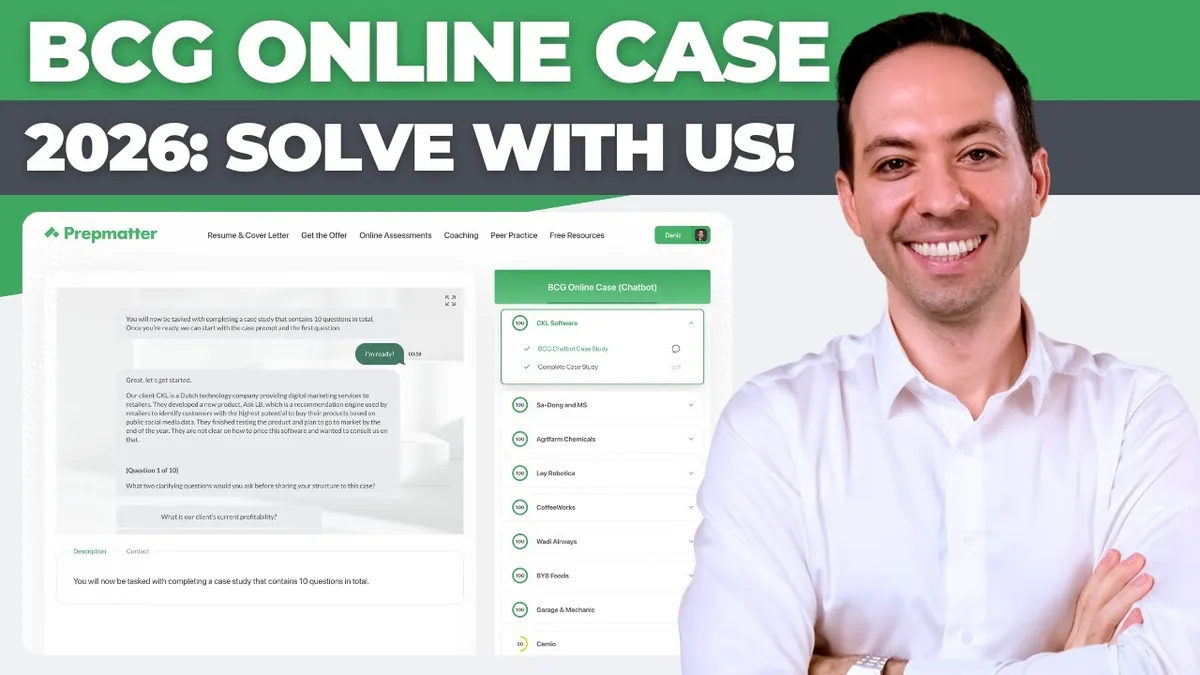
BCG cases are candidate-led: the candidate drives the case structure, prioritizes the problem, and signals next steps. BCG also uses the Online Case Assessment and the Consulting Career Assessment as pre-interview screens.
How does BCG scoring differ from McKinsey?
The two firms score against similar underlying criteria but use different scales, pillar structures, and case formats.
|
Aspect |
McKinsey |
BCG |
|
Scoring scale |
4-level (Poor, Average, Strong, Distinctive) |
1 to 5 numerical, 6-level recommendation (H+, H, H-, R-, R, R+) |
|
Fit interview structure |
Highly structured: 4 named PEI dimensions, roughly 15 minutes per dimension including follow-ups |
Less rigid structure than McKinsey's PEI |
|
Case format |
Interviewer-led |
Candidate-led |
|
Sub-rubric |
Sub-criteria within each PEI dimension (e.g. Empathy, Listening, Influence inside Connection) |
Sub-dimensions grouped under 3 pillars: Communication and Presence (C&P), Problem Solving and Insight (PS&I), and Effectiveness and Impact (E&I)" |
|
Pre-interview screen |
Solve digital assessment |
Online Case + Consulting Career Assessment |
What about Bain and other top consulting firms?
Bain and other top consulting firms follow evaluation patterns similar to BCG. Holistic scoring, candidate-led cases, strong emphasis on cultural fit. Sub-rubric varies by office.
Across McKinsey, BCG, Bain, and the tier-2 firms, the universal scoring currencies are the same: structure, quantitative rigor, business judgment, communication, presence, and demonstrated substance. The scales and weighting differ, but the dimensions tested overlap heavily.
The Prepmatter coaching service covers firm-specific evaluation differences across the major consulting firms.
What do partners score beyond the framework?
Partners look for general interest and curiosity in the actual work of consulting.
This signal does not appear on the scorecard but shapes the final decision.
Curiosity shows up in how candidates ask follow-up questions during the case, how they engage with the business context, and how they raise interesting angles spontaneously.
Reading business news and developing views on business problems before the interview registers in the conversation.
What behaviors could cost you the offer?
Six behaviors trigger automatic disqualification:
-
Reading from a script. Scripted delivery is detectable within seconds. Bullet point notes are acceptable. Word-for-word memorization is not.
-
Speaking too fast without pausing. Senior interviewers challenge mid-answer. Racing through signals weak executive composure.
-
Math errors without recovery. A self-corrected error is fine. An uncorrected error that produces a confidently wrong recommendation is fatal.
-
Failing to answer the actual question. Polished responses that miss the question signal weak listening.
-
Inability to recover from a mistake. Interviewers watch the recovery, not the mistake. Defensive reactions signal poor executive maturity.
-
No genuine curiosity about the problem. Partners detect preparation that lacks business interest within minutes.
How do you score yourself against the McKinsey and BCG frameworks?
Score yourself separately against each firm's framework. The dimensions overlap, but the scales differ.
Scoring against McKinsey's framework:
-
Poor: Cannot reliably demonstrate this dimension under pressure
-
Average: Demonstrates inconsistently or with significant errors
-
Strong: Reliable with minor errors
-
Distinctive: Consistently better than practice peers
Apply this scoring across the 5 McKinsey case dimensions (Structure, Math, Business Judgment, Communication, Presence) and the 4 PEI dimensions (Connection, Drive, Leadership, Growth).
Scoring against BCG's framework:
-
1 to 2: Definite or probable hire on this pillar
-
3: Mixed picture (BCG interviewers are coached to avoid this rating, but candidates can use 3 honestly for self-assessment to identify uneven dimensions)
-
4 to 5: Probable or definite reject on this pillar
Apply this scoring across the 3 BCG pillars: Communication and Presence, Problem Solving and Insight, Effectiveness and Impact.
What your scores tell you:
-
A Poor or a 4-5 rating identifies your highest-priority prep area
-
Multiple Average or 3 ratings indicate coaching delivers value
-
Strong or 1-2 across the board places you at the offer threshold and requires practice diversification
-
Distinctive or consistent 1 ratings signal interview readiness
The Prepmatter Get the Offer course includes the full scorecard inside the evaluation criteria module.
Frequently Asked Questions
What does McKinsey look for in a candidate?
McKinsey scores candidates against 4 PEI dimensions (Connection, Drive, Leadership, Growth) and 5 case dimensions (Structure, Math, Business Judgment, Communication, Presence) using a Poor / Average / Strong / Distinctive scale.
What does BCG look for in a candidate?
BCG scores candidates across 3 evaluation pillars: Communication and Presence, Problem Solving and Insight, and Effectiveness and Impact. Each pillar contains multiple sub-dimensions. BCG uses a 1 to 5 numerical scale mapped to a 6-level hire/reject recommendation (H+, H, H-, R-, R, R+). Interviewers are coached to avoid the middle rating and commit to a clear hire or reject signal.
How many PEI stories should I prepare?
Prepare 4 to 6 detailed stories that flex across multiple dimensions. McKinsey expects 2 distinct stories per dimension at minimum.
Can a small math error cost you the offer?
A self-corrected math error is fine. An uncorrected error that produces a confidently wrong recommendation can cost you the offer, particularly when interviewers debrief at the decision round.
How does BCG case interview scoring differ from McKinsey?
BCG uses a 1 to 5 numerical scale across 3 evaluation pillars, while McKinsey uses a 4-level Poor / Average / Strong / Distinctive scale across 4 PEI dimensions and 5 case dimensions. BCG cases are candidate-led; McKinsey cases are interviewer-led.
How early should I start practicing for MBB interviews?
4 to 8 weeks before the interview is the typical window. Less than 2 weeks limits skill building, though intensive coaching can still help in that window.
What is the McKinsey 80/20 rule?
The 80/20 rule applies the Pareto principle: identify the 20% of inputs driving 80% of outcomes. Interviewers reward candidates who prioritize the highest-impact issues first.
How to Prepare for What McKinsey and BCG Interviewers Score
Most candidates prepare against generic case interview tips rather than the actual scoring frameworks. The candidates who outperform practice with the rubric in mind.
Prepmatter applies the same scoring frameworks outlined above across its coaching, course, and peer practice resources. One-on-one coaching with a former BCG consultant delivers structured feedback against each dimension.
For deeper preparation on the firm-specific assessments referenced above, see the guides on the McKinsey Solve walkthrough, the McKinsey Sustainable Future Lab, the BCG Online Case Assessment, and the BCG Consulting Career Assessment. The Is Case Interview Coaching Worth It analysis covers when coaching delivers ROI based on your self-assessment score.
Score yourself against the framework. Identify your weakest dimension. Practice until that dimension moves from Average to Strong, or from a 3 to a 2.
Sign up for our newsletter
Join a community of aspiring consultants and elevate your preparation journey with Prepmatter.